
Kennisbank
Veelgestelde vragen
Alles over infraroodverwarming, Opranic-technologie en hoe u de juiste heater kiest.
Alles wat u moet weten over hoe infraroodverwarming werkt, wat Opranic onderscheidt en hoe u de juiste verwarming voor uw ruimte kiest.
Wat is het verschil tussen infraroodverwarming en traditionele verwarming?
Het verschil zit in wat er wordt verwarmd. Traditionele verwarming verwarmt de lucht. Infraroodverwarming verwarmt mensen en voorwerpen rechtstreeks.
Buiten is dat verschil doorslaggevend. Wind voert warmte via de lucht snel af, zeker bij terrassen met open zijkanten. De infraroodstraling verwarmt u rechtstreeks en blijft ook bij wisselende omstandigheden om u heen effectief.
Binnen verwarmen infraroodpanelen muren, vloeren en meubels, die vervolgens een constante warmte uitstralen. Zo voorkomt u temperatuurverschillen tussen vloer en plafond die bij convectiesystemen ontstaan doordat warme lucht zich onder het plafond ophoopt.
In de meeste toepassingen geeft infrarood sneller warmte af, op de plek waar mensen zich bevinden. Daarbij ontstaat geen luchtstroming die stof doet opwaaien.
Zijn de verwarmers van Opranic geschikt voor zakelijk gebruik?
Ja. De buitenverwarmers zijn gebouwd voor restaurants, cafés, hotels en evenementenlocaties.
- Pro V70 heeft een vast vermogen van 1.800 W en een aan-uitschakelaar aan de achterzijde. Het model is bedoeld voor restaurants die hun verwarmers centraal schakelen; dankzij het vaste vermogen kunnen meerdere verwarmers op dezelfde stroomvoorziening werken.
- Pro V70R heeft vijf warmtestanden, een afstandsbediening, een timer en Auto-restart mode. Zodra de centrale stroomvoorziening weer wordt ingeschakeld, gaat de verwarmer automatisch verder met verwarmen.
- S70R is het vrijstaande model dat u kunt verplaatsen.
Alle drie hebben beschermingsklasse IP65 en zijn ontworpen in Zweden. Bij montage aan een wand of plafond op 3–10 m hoogte levert Pro I90 tot 9.000 W voor hallen, werkplaatsen en magazijnen. De P5-panelen verwarmen kantoren en andere binnenruimten geruisloos, zonder bewegende delen.
Is de straling van infraroodverwarmers schadelijk?
Nee. Infraroodverwarmers geven elektromagnetische straling af in het infrarode deel van het spectrum, net onder zichtbaar licht. Het is dezelfde soort warmte die u voelt van zonlicht, een open haard of een ander warm voorwerp.
De straling bevat geen ultraviolet licht (UV), het deel van zonlicht dat huidschade veroorzaakt. Ze bevat ook geen ioniserende straling. Bij de intensiteiten die voor verwarming worden gebruikt, beschadigt infraroodstraling geen cellen of DNA.
Infraroodstraling wordt ook veel gebruikt in de geneeskunde, voor het warmhouden van voedsel en voor industriële droogprocessen.
Hoe werkt infraroodverwarming?
Infraroodverwarming zendt elektromagnetische golven uit die zich zonder energieverlies door de lucht verplaatsen. Zodra ze voorwerpen, oppervlakken of mensen bereiken, geven ze warmte af. Het principe is vergelijkbaar met de warmte van zonlicht op uw huid, maar dan zonder de ultraviolette component.
Dat verschilt wezenlijk van convectieverwarming. Een traditionele radiator verwarmt de lucht. Die stijgt op, mengt zich met koelere lucht en verhoogt zo geleidelijk de kamertemperatuur. Een infraroodverwarmer slaat die stap over en verwarmt direct wat zich ervoor bevindt.
Het resultaat is directe, gerichte warmte, waarbij nauwelijks energie wordt verspild aan het verwarmen van lege ruimte.
Wat is het verschil tussen de verwarmers van Opranic voor binnen en buiten?
Ze zijn ontworpen voor verschillende toepassingen.
Buitenstralers (V70-Line, V50-Line, S70-Line, S50-Line) gebruiken het IR-X Carbon Black™-element. De straling heeft een piek rond 2,2 µm in het middengolfgebied. Met een vermogen van 1.800–2.300 W en beschermingsklasse IP65 verwarmen ze mensen buiten, ook bij bewegende lucht. Ze zijn uitsluitend bedoeld voor buitengebruik.
P5-panelen voor binnengebruik hebben een stalen voorzijde die 95–115 °C bereikt en geven langgolvige infraroodstraling af boven 3 µm. Met een vermogen van 300–900 W en beschermingsklasse IP44 verwarmen ze muren, vloeren en mensen gelijkmatig in een gesloten ruimte, zonder de lucht te verplaatsen.
Pro I90 is een middengolfstraler voor hallen en werkplaatsen met hoge plafonds.
Waar kan ik Opranic-producten kopen?
Buiten Zweden zijn Opranic-producten rechtstreeks verkrijgbaar via opranic.com en Amazon. In Zweden zijn ze ook verkrijgbaar via elektrotechnische groothandels en winkels. Opranic bouwt aan een netwerk van wederverkopers in heel Europa. Neem voor projecten, grotere bestellingen of vragen over wederverkoop contact op via info@opranic.com.
Wat zijn de voordelen van de infraroodverwarmers van Opranic?
Elke infraroodverwarmer uit de V- en S-Line heeft een IR-X Carbon Black™-element. Bij vol vermogen ligt de piekgolflengte rond 2,2 µm, een golflengte die het lichaam goed opneemt. Zo voelt u de warmte die wordt opgewekt met de energie waarvoor u betaalt.
- Ontworpen in Zweden voor het klimaat in Noord-Europa, met IP65-bescherming. De wandverwarmers kunnen het hele jaar door gemonteerd blijven.
- Tot 96% van de elektrische energie wordt omgezet in stralingswarmte; de verwarmer geeft binnen 3–5 seconden zijn volledige warmte af.
- Stil, zonder ventilator of bewegende delen.
- De V50R, Pro V70R, S50R en S70R hebben vijf warmtestanden en een afstandsbediening. De Pro V70 heeft een vast vermogen van 1.800 W en kan centraal worden bediend.
- Geen verbranding en geen directe CO₂-uitstoot tijdens gebruik.
Waarvan hangt het energieverbruik van een infraroodpaneel af?
Een P5-paneel zet ongeveer 99% van de verbruikte elektriciteit om in warmte. De gebruikskosten hangen daarom af van hoeveel warmte de ruimte nodig heeft en hoelang het paneel aanstaat:
- Afmetingen en isolatie van de ruimte: reken in een geïsoleerde ruimte met een plafondhoogte van 2,4 m op ongeveer 100 W per vierkante meter. Oudere woningen, glazen wanden en hoge plafonds vragen meer vermogen.
- Regeling: een stekkerthermostaat of slimme stekker schakelt het paneel uit zodra de ruimte warm is.
- Plaatsing: als het paneel vrij zicht heeft op de ruimte, kan de straling mensen en oppervlakken bereiken.
- Elektriciteitsprijs: ook eventuele lagere tarieven tijdens daluren beïnvloeden de gebruikskosten.
Wat zijn de voordelen van infraroodverwarming in huis?
Infraroodverwarming verwarmt mensen en oppervlakken rechtstreeks, in plaats van de lucht te verwarmen en te laten circuleren. Dat merkt u in de ruimte:
- Geen ventilator of convectiestromen, waardoor er minder stof door de ruimte circuleert.
- Geen stroom warme lucht die door de kamer blaast.
- Gelijkmatige warmte van muren, vloer en meubels, zonder warme luchtlaag onder het plafond en koude voeten.
- Stil en zonder bewegende onderdelen, geschikt voor slaapkamers, werkkamers en andere rustige ruimtes.
- Geen verbranding, dus geen rookgassen of koolmonoxide binnenshuis.
Waar plaats ik een infraroodpaneel binnenshuis?
Richt het P5-paneel op de plek waar mensen zitten, staan of werken. De warmte is voelbaar waar de straling terechtkomt.
- Bevestig het paneel met de meegeleverde veiligheidsbeugel horizontaal of verticaal aan de wand of het plafond.
- Houd de ruimte vóór het paneel vrij van meubels en gordijnen.
- In grotere of onregelmatig gevormde ruimtes geven meerdere kleinere panelen, verspreid over de ruimte, een gelijkmatigere warmte dan één groot paneel.
- Reken in een geïsoleerde ruimte met een plafondhoogte van 2,4 m op ongeveer 100 W per vierkante meter. Oudere huizen, glazen wanden en hoge plafonds vragen om meer vermogen.
Zijn Opranic-panelen voor binnen veilig?
Ja. De P5-panelen zijn gecertificeerd door TÜV Süd, voldoen aan de eisen van EMC, REACH en RoHS en zijn voorzien van CE-markering.
- Oververhittingsbeveiliging: een thermische schakelaar houdt de oppervlaktetemperatuur binnen het toegestane bereik.
- Overspanningsbeveiliging voor de elektronica.
- IP44: beschermd tegen spatwater.
- Geen blootliggend verwarmingselement, geen verbranding en geen uitstoot.
De stalen voorzijde wordt 95–115 °C heet. Houd meubels en textiel op afstand en volg de aanwijzingen in de handleiding voor gebruik in de buurt van kinderen.
Wat is het verschil tussen de verwarmers van Opranic voor binnen en buiten?
Ze zijn ontworpen voor verschillende toepassingen.
Buitenstralers (V70-Line, V50-Line, S70-Line, S50-Line) gebruiken het IR-X Carbon Black™-element. De straling heeft een piek rond 2,2 µm in het middengolfgebied. Met een vermogen van 1.800–2.300 W en beschermingsklasse IP65 verwarmen ze mensen buiten, ook bij bewegende lucht. Ze zijn uitsluitend bedoeld voor buitengebruik.
P5-panelen voor binnengebruik hebben een stalen voorzijde die 95–115 °C bereikt en geven langgolvige infraroodstraling af boven 3 µm. Met een vermogen van 300–900 W en beschermingsklasse IP44 verwarmen ze muren, vloeren en mensen gelijkmatig in een gesloten ruimte, zonder de lucht te verplaatsen.
Pro I90 is een middengolfstraler voor hallen en werkplaatsen met hoge plafonds.
Zijn de infraroodpanelen van Opranic geschikt voor de badkamer?
Ja. De P5-panelen hebben beschermingsklasse IP44 en zijn beschermd tegen spatwater. Infraroodstraling verwarmt u direct wanneer u uit de douche stapt. Ook muren en spiegels worden verwarmd, wat het drogen bevordert.
De elektrische voorschriften in uw land bepalen in welke zone van de badkamer een verwarming mag worden geïnstalleerd en hoe die moet worden aangesloten. De P5 is een paneel met stekker. Omdat voor stopcontacten in de buurt van baden en douches beperkingen gelden, laat u de installatie controleren door een elektricien.
Hoe kan ik de energiekosten van mijn infraroodpaneel verlagen?
- Kies het juiste vermogen: reken op ongeveer 100 W per vierkante meter in een geïsoleerde ruimte. Een paneel met te weinig vermogen blijft voortdurend aan zonder de ruimte comfortabel te verwarmen.
- Regel de temperatuur: P5 heeft geen ingebouwde thermostaat. Gebruik een stekkerthermostaat of slimme stekker om de gewenste temperatuur aan te houden.
- Verwarm de ruimtes die u gebruikt, op de momenten dat u er bent. Infraroodwarmte voelt u snel, dus lege ruimtes hoeven niet warm te blijven.
- Voorkom tocht: afdichtingen bij deuren en ramen maken merkbaar verschil.
- Richt het paneel op de plek waar u zit of werkt en zorg dat er niets voor staat.
- Biedt uw energieleverancier goedkopere daluren aan, gebruik die dan voor de basisverwarming.
Hoe werkt infraroodverwarming als aanvulling op de centrale verwarming?
Infraroodverwarming is een aanvulling op de centrale verwarming als u afzonderlijke ruimtes wilt verwarmen, snel warmte nodig hebt of gericht wilt verwarmen.
Verwarming per ruimte. In de meeste huizen worden sommige kamers maar een paar uur per dag gebruikt, zoals een werkkamer, logeerkamer of werkplaats in de kelder. Om zo’n kamer via de centrale verwarming aangenaam warm te krijgen, verwarmt u ook de rest van het huis. Een infraroodpaneel verwarmt alleen die ruimte, terwijl de centrale verwarming op een lagere basistemperatuur blijft werken.
Snelle warmte. Centrale verwarming moet in een koude kamer eerst de lucht opwarmen. U voelt de warmte van infrarood eerder, omdat het mensen en oppervlakken direct verwarmt. Dat is handig in het voor- en najaar, wanneer u de centrale verwarming niet wilt inschakelen.
Gerichte warmte. In badkamers, serres en kamers met grote ramen of onbeschutte hoeken blijven vaak koude plekken bestaan die de centrale verwarming niet kan verhelpen. Een infraroodpaneel op zo’n plek is efficiënter dan de thermostaat voor het hele huis hoger zetten.
Als u infraroodverwarming zo gebruikt, zet u de thermostaat van de centrale verwarming doorgaans 1–2 °C lager en gebruikt u infraroodwarmte waar u bent. Zo voegt u alleen warmte toe op de plek en het moment dat u die nodig hebt.
Hoe energiezuinig zijn de infraroodpanelen van Opranic voor binnen?
Ongeveer 99% van de elektriciteit die een P5-paneel verbruikt, wordt omgezet in warmte. Het paneel heeft geen ventilator en er vindt geen verbranding plaats. De gebruikskosten hangen daarom af van de warmtebehoefte van de ruimte: de isolatie, een paneel met het juiste vermogen (ongeveer 100 W per m²) en een thermostaat die het paneel uitschakelt zodra de ruimte warm is.
Een P5 900 is bijvoorbeeld geschikt voor een geïsoleerde ruimte van 9–12 m². Op vol vermogen verbruikt het paneel in 6 uur 5,4 kWh. Bij € 0,30 per kWh kost dat ongeveer € 1,62 per dag, en minder wanneer een thermostaat de temperatuur op peil houdt.
Hoe snel warmt een ruimte op met een infraroodverwarmer van Opranic?
De warmte van een Opranic-verwarmer voelt u al voordat de ruimte op temperatuur is. Infrarood verwarmt mensen en oppervlakken direct, zonder eerst de lucht op te warmen. U merkt de warmte zodra de verwarmer zijn bedrijfstemperatuur bereikt: binnen enkele seconden bij IR-X Carbon Black-verwarmers buiten en binnen enkele minuten bij een P5-paneel, wanneer het oppervlak 95 tot 115 °C bereikt.
De ruimte zelf warmt geleidelijker op. Muren, vloer en meubels nemen de straling op en geven de warmte weer af. Zo houdt de ruimte de warmte gelijkmatig vast, zonder tocht door warme luchtstromen. Hoe lang dat duurt, hangt af van de grootte en isolatie van de ruimte en van het vermogen van het paneel. Reken in een geïsoleerde ruimte op ongeveer 100 W per vierkante meter.
Is er een vloerstandaard voor de wandmodellen van Opranic?
Nee. De Pro V70, Pro V70R en V50R zijn ontworpen, getest en gecertificeerd voor vaste montage aan de wand of het plafond. Opranic raadt het gebruik van een geïmproviseerde standaard af. Daardoor veranderen zowel de richting van de warmtestraling als de stabiliteit van de verwarmer. Deze installatiewijze is niet beschreven in de handleiding en valt niet onder de garantie.
Wilt u de verwarmer kunnen verplaatsen, kies dan een vrijstaand model:
- S70R: 2.300 W, vijf warmtestanden, afstandsbediening en omvalbeveiliging, 8,2 kg.
- S50R: 1.800 W of 2.300 W, dezelfde bediening, weegt 4,5–4,7 kg en is lichter dan de S70R.
Beide modellen gebruiken hetzelfde IR-X Carbon Black-element als de wandmodellen.
Wat is de aanbevolen montagehoogte?
Monteer verwarmers uit de V70- en V50-serie (Pro V70, Pro V70R, V50R) op 1,8–2,5 m hoogte en richt ze onder een hoek van 30–45° op de zitplek. De afstand van de vloer tot de laagste buitenrand van de verwarmer moet minimaal 180 cm zijn. Meet dit nadat u de hoek hebt ingesteld.
- Bij montage dicht bij een plafond richt u de verwarmer 45° omlaag. Houd minimaal 10 cm afstand tot het plafond.
- Houd vóór de verwarmer 100 cm vrij. Houd aan de zijkanten en onder de verwarmer 70 cm afstand tot brandbaar materiaal, 30 cm tot zijwanden en 10 cm tot de wand erachter.
Monteer de Pro I90 horizontaal op 3–10 m hoogte, doorgaans op 4–6 m. De afstand tot de vloer moet minimaal 300 cm zijn.
De vrijstaande S70R en S50R hoeven niet te worden gemonteerd. Plaats ze rechtop op een stevige, vlakke ondergrond. Houd vóór de verwarmer 100 cm vrij, aan de zijkanten 70 cm en erboven en erachter 50 cm.
Welke golflengte stralen de terrasverwarmers van Opranic uit?
Op vol vermogen ligt de stralingspiek van het IR-X Carbon Black™-element rond 2,2 µm, binnen de middengolfband IR-B. Deze golflengte zorgt voor comfortabel verwarmen in de buitenlucht:
- De straling verwarmt mensen en oppervlakken rechtstreeks, zonder eerst de lucht op te warmen.
- Huid en kleding absorberen de straling goed, waardoor die als warmte voelbaar is.
- De straling verblindt nauwelijks en geeft alleen een zachte oranje gloed.
Kortgolvige stralers worden heter en geven een groter deel van hun vermogen af als zichtbaar licht. Stralers met een temperatuur onder ongeveer 700 °C geven geen zichtbare gloed, maar staan een groter deel van hun energie af via convectie. De wind voert die warmte af.
Wat is IR-X Carbon Black™?
IR-X Carbon Black is het volledige stralingssysteem in de verwarmers uit de V- en S-Line van Opranic. Het bestaat uit een hoogwaardig koolstofvezelelement in een afgesloten buis van kwartsglas, de bedrijfstemperatuur van het element en de geometrie van de reflector.
- Een spectrale piek van ongeveer 2,2 µm bij vol vermogen
- Tot 96% van de elektrische energie wordt omgezet in stralingswarmte
- Volledige stralingswarmte binnen 3 tot 5 seconden na inschakeling
- Nauwelijks verblindend licht
Het kwartsglas laat de straling door. De reflector bepaalt hoe de straling zich verspreidt en richt deze op de mensen die u wilt verwarmen.
Zijn de buitenverwarmers van Opranic waterdicht?
Ze zijn weerbestendig, maar mogen niet worden ondergedompeld. Alle verwarmers uit de V70-, V50-, S70- en S50-serie hebben beschermingsklasse IP65: ze zijn stofdicht en beschermd tegen waterstralen onder lage druk uit elke richting, waaronder regen en opspattend water.
- Wand- en plafondverwarmers (Pro V70, Pro V70R, V50R) zijn ontworpen om het hele jaar buiten gemonteerd te blijven.
- Vrijstaande verwarmers (S70R, S50R) zijn tijdens gebruik bestand tegen regen. Wanneer u ze niet gebruikt, haalt u de stekker uit het stopcontact, laat u ze afkoelen en bergt u ze op een droge plaats op.
De IP65-classificatie geldt niet voor de afstandsbediening, de stekker of het stopcontact. Een gewoon stopcontact biedt niet dezelfde bescherming als de verwarmer; houd de aansluitingen daarom droog. Gebruik de verwarmers niet in een badkamer of naast een zwembad. Pro I90 voor hallen en werkplaatsen heeft beschermingsklasse IP34 en is bedoeld voor overdekte ruimten.
Wat is het verschil tussen de verwarmers van Opranic voor binnen en buiten?
Ze zijn ontworpen voor verschillende toepassingen.
Buitenstralers (V70-Line, V50-Line, S70-Line, S50-Line) gebruiken het IR-X Carbon Black™-element. De straling heeft een piek rond 2,2 µm in het middengolfgebied. Met een vermogen van 1.800–2.300 W en beschermingsklasse IP65 verwarmen ze mensen buiten, ook bij bewegende lucht. Ze zijn uitsluitend bedoeld voor buitengebruik.
P5-panelen voor binnengebruik hebben een stalen voorzijde die 95–115 °C bereikt en geven langgolvige infraroodstraling af boven 3 µm. Met een vermogen van 300–900 W en beschermingsklasse IP44 verwarmen ze muren, vloeren en mensen gelijkmatig in een gesloten ruimte, zonder de lucht te verplaatsen.
Pro I90 is een middengolfstraler voor hallen en werkplaatsen met hoge plafonds.
Zijn de terrasverwarmers van Opranic bestand tegen roest en corrosie?
Ja. De terrasverwarmers hebben beschermingsklasse IP65. De wandmodellen uit de V70-Line en V50-Line zijn ontworpen om het hele jaar buiten te hangen.
- Behuizing: geanodiseerd aluminium, zeer corrosiebestendig.
- Rooster aan de voorzijde: verchroomd staal. In kustgebieden of in een industriële omgeving kan zich na verloop van tijd wat patina vormen.
- Zijkappen: glasvezelversterkte kunststof, bestand tegen uv-straling, vorst en weersinvloeden.
Lichte gebruikssporen en een afwerking die na verloop van tijd doffer wordt, zijn normale slijtage bij een terrasverwarmer die buiten staat. Roest als gevolg van een defect valt onder de garantie. Haal de stekker uit het stopcontact en laat de verwarmer afkoelen. Neem hem daarna af met een zachte, licht vochtige doek om hem er verzorgd uit te laten zien. Doe dit vooral in kustgebieden en gebruik de beschermhoes wanneer de verwarmer niet in gebruik is. Berg de vrijstaande S70R en S50R binnen op wanneer u ze niet gebruikt. Vervangingsroosters en zijkappen zijn op aanvraag verkrijgbaar via info@opranic.com.
Kan ik mijn Opranic terrasverwarmer ook in de winter en bij regen gebruiken?
Ja. Alle verwarmers uit de V70-Line, V50-Line, S70-Line en S50-Line hebben beschermingsklasse IP65. De wandmodellen zijn ontworpen om het hele jaar buiten gemonteerd te blijven, ook bij regen, sneeuw en vorst. Binnen 3–5 seconden na inschakeling geven ze hun volledige warmte af. U hoeft geen gasfles te vervangen. Bovendien kan de wind geen vlam doven.
De vrijstaande S70R en S50R kunt u in de regen gebruiken. Haal de stekker uit het stopcontact, laat de verwarmers afkoelen en berg ze op een droge plaats op wanneer u ze niet gebruikt. Houd de stekker, het stopcontact en de afstandsbediening onder alle weersomstandigheden droog.
Kan ik meerdere Opranic-verwarmers met dezelfde afstandsbediening bedienen?
Ja. De V50R, Pro V70R, S50R en S70R gebruiken dezelfde afstandsbediening. Een signaal bereikt alle verwarmers die zich in de zichtlijn van de afstandsbediening bevinden. Richt de afstandsbediening op de verwarmer die u wilt bedienen en ga dichterbij staan als andere verwarmers ook reageren. Fel licht of zonlicht kan het bereik verkleinen.
Een reserveafstandsbediening kunt u bestellen via opranic.com. Daar zijn ook afstandsbedieningen voor oudere Opranic-modellen verkrijgbaar.
Hoe werken Opranic terrasverwarmers bij wind?
Wind verzwakt infraroodstraling niet. De warmte gaat rechtstreeks van de verwarmer naar mensen en oppervlakken en wordt, anders dan bij een gas- of convectieverwarmer, niet met de lucht meegevoerd. Wind koelt uw huid wel af. Op een open terras voelt u daardoor minder warmte.
IR-X Carbon Black™ is ontworpen met oog voor die balans. Op vol vermogen ligt de stralingspiek van het element rond 2,2 µm, in het middengolfgebied. Het lichaam absorbeert deze golflengte goed, terwijl de zichtbare gloed zeer beperkt blijft. Kortgolvige stralers werken op een hogere temperatuur en geven een groter deel van hun energie af als zichtbaar licht. Stralers met een lage temperatuur gloeien niet, maar geven een groter deel van hun energie af via convectie. Die warmte voert de wind af.
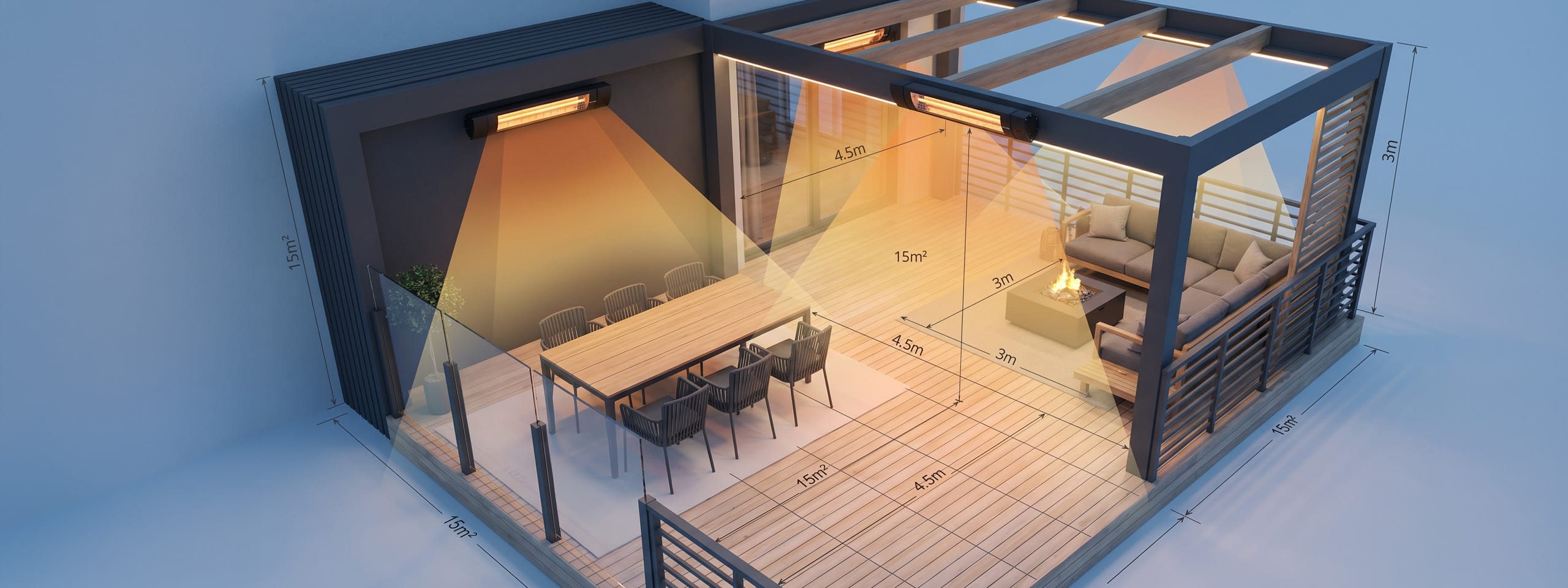
Houd op een onbeschutte plek rekening met meer verwarmingsvermogen. Beschutting door een muur, scherm of dak maakt het grootste verschil. Twee verwarmers die aan weerszijden van een tafel naar elkaar toe gericht zijn, zorgen voor de gelijkmatigste warmteverdeling. Reken buiten als vuistregel op maximaal 200 W per vierkante meter; één verwarmer van 2.300 W verwarmt ongeveer 11 m² beschut terras. De warmtecalculator op opranic.com past de berekening aan op beschutting en wind.
Hoe lang is het snoer van Opranic terrasverwarmers?
Elke verwarmer uit de V70-Line, V50-Line, S70-Line en S50-Line heeft een kabel van 1,9 m met stekker: een geaarde EU-stekker (Schuko) of een Britse stekker bij uitvoeringen voor het Verenigd Koninkrijk (artikelnummers die eindigen op -GB). Sluit de verwarmer aan op een geaard stopcontact op een stroomgroep die is afgezekerd op minimaal 10 A, zonder andere apparaten op dezelfde groep. Bij montage op 2,2 m reikt de kabel tot een wandcontactdoos. Houd de stekker en de wandcontactdoos buiten het verwarmingsgebied en plaats ze nooit direct onder de verwarmer. Pro I90 heeft een vaste aansluiting die door een elektricien wordt aangelegd.
Hoe werken Opranic terrasverwarmers bij wind?
Wind verzwakt infraroodstraling niet. De warmte gaat rechtstreeks van de verwarmer naar mensen en oppervlakken en wordt, anders dan bij een gas- of convectieverwarmer, niet met de lucht meegevoerd. Wind koelt uw huid wel af. Op een open terras voelt u daardoor minder warmte.
IR-X Carbon Black™ is ontworpen met oog voor die balans. Op vol vermogen ligt de stralingspiek van het element rond 2,2 µm, in het middengolfgebied. Het lichaam absorbeert deze golflengte goed, terwijl de zichtbare gloed zeer beperkt blijft. Kortgolvige stralers werken op een hogere temperatuur en geven een groter deel van hun energie af als zichtbaar licht. Stralers met een lage temperatuur gloeien niet, maar geven een groter deel van hun energie af via convectie. Die warmte voert de wind af.
Houd op een onbeschutte plek rekening met meer verwarmingsvermogen. Beschutting door een muur, scherm of dak maakt het grootste verschil. Twee verwarmers die aan weerszijden van een tafel naar elkaar toe gericht zijn, zorgen voor de gelijkmatigste warmteverdeling. Reken buiten als vuistregel op maximaal 200 W per vierkante meter; één verwarmer van 2.300 W verwarmt ongeveer 11 m² beschut terras. De warmtecalculator op opranic.com past de berekening aan op beschutting en wind.
Hoe lang is het snoer van Opranic terrasverwarmers?
Elke verwarmer uit de V70-Line, V50-Line, S70-Line en S50-Line heeft een kabel van 1,9 m met stekker: een geaarde EU-stekker (Schuko) of een Britse stekker bij uitvoeringen voor het Verenigd Koninkrijk (artikelnummers die eindigen op -GB). Sluit de verwarmer aan op een geaard stopcontact op een stroomgroep die is afgezekerd op minimaal 10 A, zonder andere apparaten op dezelfde groep. Bij montage op 2,2 m reikt de kabel tot een wandcontactdoos. Houd de stekker en de wandcontactdoos buiten het verwarmingsgebied en plaats ze nooit direct onder de verwarmer. Pro I90 heeft een vaste aansluiting die door een elektricien wordt aangelegd.
Wat is de aanbevolen montagehoogte?
Monteer verwarmers uit de V70- en V50-serie (Pro V70, Pro V70R, V50R) op 1,8–2,5 m hoogte en richt ze onder een hoek van 30–45° op de zitplek. De afstand van de vloer tot de laagste buitenrand van de verwarmer moet minimaal 180 cm zijn. Meet dit nadat u de hoek hebt ingesteld.
- Bij montage dicht bij een plafond richt u de verwarmer 45° omlaag. Houd minimaal 10 cm afstand tot het plafond.
- Houd vóór de verwarmer 100 cm vrij. Houd aan de zijkanten en onder de verwarmer 70 cm afstand tot brandbaar materiaal, 30 cm tot zijwanden en 10 cm tot de wand erachter.
Monteer de Pro I90 horizontaal op 3–10 m hoogte, doorgaans op 4–6 m. De afstand tot de vloer moet minimaal 300 cm zijn.
De vrijstaande S70R en S50R hoeven niet te worden gemonteerd. Plaats ze rechtop op een stevige, vlakke ondergrond. Houd vóór de verwarmer 100 cm vrij, aan de zijkanten 70 cm en erboven en erachter 50 cm.
Welke golflengte stralen de terrasverwarmers van Opranic uit?
Op vol vermogen ligt de stralingspiek van het IR-X Carbon Black™-element rond 2,2 µm, binnen de middengolfband IR-B. Deze golflengte zorgt voor comfortabel verwarmen in de buitenlucht:
- De straling verwarmt mensen en oppervlakken rechtstreeks, zonder eerst de lucht op te warmen.
- Huid en kleding absorberen de straling goed, waardoor die als warmte voelbaar is.
- De straling verblindt nauwelijks en geeft alleen een zachte oranje gloed.
Kortgolvige stralers worden heter en geven een groter deel van hun vermogen af als zichtbaar licht. Stralers met een temperatuur onder ongeveer 700 °C geven geen zichtbare gloed, maar staan een groter deel van hun energie af via convectie. De wind voert die warmte af.
Kan ik een Opranic-verwarmer aan een houten wand monteren?
Ja, mits u de handleiding volgt. Kies een stevige, dragende ondergrond en gebruik bevestigingsmateriaal dat geschikt is voor die ondergrond en de belasting. Monteer de verwarmer niet op kunststof, nylon, vinyl of karton. Houd bij elke wand de volgende afstanden aan:
- 10 cm tussen de verwarmer en de wand erachter
- 30 cm tot zijwanden buiten het stralingsgebied
- 70 cm tot brandbaar materiaal naast en onder de verwarmer
- 100 cm tot brandbaar materiaal in de richting waarin de verwarmer straalt
De handleiding voor elk model vindt u op opranic.com/doc.
Kan ik mijn Opranic-verwarmer op een verlengsnoer aansluiten?
Gebruik liever geen verlengsnoer. Bij een vermogen van 1.800 tot 2.300 W kan het snoer oververhit raken en brand veroorzaken. Is een verlengsnoer onvermijdelijk, gebruik dan een snoer dat:
- een aderdoorsnede van minimaal 1,5 mm² heeft
- geschikt is voor minimaal 10 A
- geschikt is voor buitengebruik
- volledig is afgerold en zo kort mogelijk is
Sluit nooit een ander apparaat aan op hetzelfde verlengsnoer of dezelfde stroomkring. Laat voor een permanente installatie een elektricien een buitenstopcontact dicht bij de verwarmer plaatsen.
Wat is IR-X Carbon Black™?
IR-X Carbon Black is het volledige stralingssysteem in de verwarmers uit de V- en S-Line van Opranic. Het bestaat uit een hoogwaardig koolstofvezelelement in een afgesloten buis van kwartsglas, de bedrijfstemperatuur van het element en de geometrie van de reflector.
- Een spectrale piek van ongeveer 2,2 µm bij vol vermogen
- Tot 96% van de elektrische energie wordt omgezet in stralingswarmte
- Volledige stralingswarmte binnen 3 tot 5 seconden na inschakeling
- Nauwelijks verblindend licht
Het kwartsglas laat de straling door. De reflector bepaalt hoe de straling zich verspreidt en richt deze op de mensen die u wilt verwarmen.
Zijn Opranic-panelen voor binnen veilig?
Ja. De P5-panelen zijn gecertificeerd door TÜV Süd, voldoen aan de eisen van EMC, REACH en RoHS en zijn voorzien van CE-markering.
- Oververhittingsbeveiliging: een thermische schakelaar houdt de oppervlaktetemperatuur binnen het toegestane bereik.
- Overspanningsbeveiliging voor de elektronica.
- IP44: beschermd tegen spatwater.
- Geen blootliggend verwarmingselement, geen verbranding en geen uitstoot.
De stalen voorzijde wordt 95–115 °C heet. Houd meubels en textiel op afstand en volg de aanwijzingen in de handleiding voor gebruik in de buurt van kinderen.
Zijn de buitenverwarmers van Opranic waterdicht?
Ze zijn weerbestendig, maar mogen niet worden ondergedompeld. Alle verwarmers uit de V70-, V50-, S70- en S50-serie hebben beschermingsklasse IP65: ze zijn stofdicht en beschermd tegen waterstralen onder lage druk uit elke richting, waaronder regen en opspattend water.
- Wand- en plafondverwarmers (Pro V70, Pro V70R, V50R) zijn ontworpen om het hele jaar buiten gemonteerd te blijven.
- Vrijstaande verwarmers (S70R, S50R) zijn tijdens gebruik bestand tegen regen. Wanneer u ze niet gebruikt, haalt u de stekker uit het stopcontact, laat u ze afkoelen en bergt u ze op een droge plaats op.
De IP65-classificatie geldt niet voor de afstandsbediening, de stekker of het stopcontact. Een gewoon stopcontact biedt niet dezelfde bescherming als de verwarmer; houd de aansluitingen daarom droog. Gebruik de verwarmers niet in een badkamer of naast een zwembad. Pro I90 voor hallen en werkplaatsen heeft beschermingsklasse IP34 en is bedoeld voor overdekte ruimten.
Is de straling van infraroodverwarmers schadelijk?
Nee. Infraroodverwarmers geven elektromagnetische straling af in het infrarode deel van het spectrum, net onder zichtbaar licht. Het is dezelfde soort warmte die u voelt van zonlicht, een open haard of een ander warm voorwerp.
De straling bevat geen ultraviolet licht (UV), het deel van zonlicht dat huidschade veroorzaakt. Ze bevat ook geen ioniserende straling. Bij de intensiteiten die voor verwarming worden gebruikt, beschadigt infraroodstraling geen cellen of DNA.
Infraroodstraling wordt ook veel gebruikt in de geneeskunde, voor het warmhouden van voedsel en voor industriële droogprocessen.
Zijn de infraroodpanelen van Opranic geschikt voor de badkamer?
Ja. De P5-panelen hebben beschermingsklasse IP44 en zijn beschermd tegen spatwater. Infraroodstraling verwarmt u direct wanneer u uit de douche stapt. Ook muren en spiegels worden verwarmd, wat het drogen bevordert.
De elektrische voorschriften in uw land bepalen in welke zone van de badkamer een verwarming mag worden geïnstalleerd en hoe die moet worden aangesloten. De P5 is een paneel met stekker. Omdat voor stopcontacten in de buurt van baden en douches beperkingen gelden, laat u de installatie controleren door een elektricien.
Hoe energiezuinig zijn de infraroodpanelen van Opranic voor binnen?
Ongeveer 99% van de elektriciteit die een P5-paneel verbruikt, wordt omgezet in warmte. Het paneel heeft geen ventilator en er vindt geen verbranding plaats. De gebruikskosten hangen daarom af van de warmtebehoefte van de ruimte: de isolatie, een paneel met het juiste vermogen (ongeveer 100 W per m²) en een thermostaat die het paneel uitschakelt zodra de ruimte warm is.
Een P5 900 is bijvoorbeeld geschikt voor een geïsoleerde ruimte van 9–12 m². Op vol vermogen verbruikt het paneel in 6 uur 5,4 kWh. Bij € 0,30 per kWh kost dat ongeveer € 1,62 per dag, en minder wanneer een thermostaat de temperatuur op peil houdt.
Waarvan hangt het energieverbruik van een infraroodpaneel af?
Een P5-paneel zet ongeveer 99% van de verbruikte elektriciteit om in warmte. De gebruikskosten hangen daarom af van hoeveel warmte de ruimte nodig heeft en hoelang het paneel aanstaat:
- Afmetingen en isolatie van de ruimte: reken in een geïsoleerde ruimte met een plafondhoogte van 2,4 m op ongeveer 100 W per vierkante meter. Oudere woningen, glazen wanden en hoge plafonds vragen meer vermogen.
- Regeling: een stekkerthermostaat of slimme stekker schakelt het paneel uit zodra de ruimte warm is.
- Plaatsing: als het paneel vrij zicht heeft op de ruimte, kan de straling mensen en oppervlakken bereiken.
- Elektriciteitsprijs: ook eventuele lagere tarieven tijdens daluren beïnvloeden de gebruikskosten.
Waar plaats ik een infraroodpaneel binnenshuis?
Richt het P5-paneel op de plek waar mensen zitten, staan of werken. De warmte is voelbaar waar de straling terechtkomt.
- Bevestig het paneel met de meegeleverde veiligheidsbeugel horizontaal of verticaal aan de wand of het plafond.
- Houd de ruimte vóór het paneel vrij van meubels en gordijnen.
- In grotere of onregelmatig gevormde ruimtes geven meerdere kleinere panelen, verspreid over de ruimte, een gelijkmatigere warmte dan één groot paneel.
- Reken in een geïsoleerde ruimte met een plafondhoogte van 2,4 m op ongeveer 100 W per vierkante meter. Oudere huizen, glazen wanden en hoge plafonds vragen om meer vermogen.
Zijn de terrasverwarmers van Opranic bestand tegen roest en corrosie?
Ja. De terrasverwarmers hebben beschermingsklasse IP65. De wandmodellen uit de V70-Line en V50-Line zijn ontworpen om het hele jaar buiten te hangen.
- Behuizing: geanodiseerd aluminium, zeer corrosiebestendig.
- Rooster aan de voorzijde: verchroomd staal. In kustgebieden of in een industriële omgeving kan zich na verloop van tijd wat patina vormen.
- Zijkappen: glasvezelversterkte kunststof, bestand tegen uv-straling, vorst en weersinvloeden.
Lichte gebruikssporen en een afwerking die na verloop van tijd doffer wordt, zijn normale slijtage bij een terrasverwarmer die buiten staat. Roest als gevolg van een defect valt onder de garantie. Haal de stekker uit het stopcontact en laat de verwarmer afkoelen. Neem hem daarna af met een zachte, licht vochtige doek om hem er verzorgd uit te laten zien. Doe dit vooral in kustgebieden en gebruik de beschermhoes wanneer de verwarmer niet in gebruik is. Berg de vrijstaande S70R en S50R binnen op wanneer u ze niet gebruikt. Vervangingsroosters en zijkappen zijn op aanvraag verkrijgbaar via info@opranic.com.
Wat zit er in de doos?
- V70-Line en V50-Line (wand- en plafondmontage): de verwarmer, montagebeugels, bevestigingsmateriaal en de gebruiksaanwijzing. Bij de V50R en Pro V70R zit ook een afstandsbediening.
- S70-Line en S50-Line (vrijstaand): de verwarmer, een losse voet met bevestigingsschroeven, de afstandsbediening en de gebruiksaanwijzing.
Als er iets ontbreekt, neem dan contact op met uw verkoper of mail naar info@opranic.com.
Welke garantie biedt Opranic?
De garantietermijn verschilt per model:
- Pro V70, Pro V70R en S70R: 5 jaar op het verwarmingstoestel en de elektronica, 2 jaar op de verwarmingsbuis.
- V50R en S50R: 2 jaar.
- P5-panelen voor binnen: 5 jaar.
- A70R-ventilator: 5 jaar, inclusief de voedingsadapter.
- Pro I90: 3 jaar.
De garantie gaat in op de leverdatum en dekt ontwerp-, materiaal- en fabricagefouten. Normale slijtage en schade door verkeerd gebruik, onjuiste installatie of onjuist onderhoud vallen er niet onder. Bij een buiten gemonteerd verwarmingstoestel gelden lichte sporen op het oppervlak en een afwerking die na verloop van tijd doffer wordt als normale slijtage.
Wilt u aanspraak maken op de garantie, neem dan contact op met uw verkoper of mail naar info@opranic.com. Vermeld het model- of artikelnummer, voeg uw aankoopbewijs toe en beschrijf het defect. De volledige voorwaarden vindt u op opranic.com/doc. De garantie doet geen afbreuk aan uw wettelijke rechten.