
Tool
Infrared heater power calculator
Work out how many units your patio needs.
POWER CALCULATOR
Work out how many Opranic infrared heaters you need
Choosing the right number of infrared heaters should not come down to guesswork. Our infrared heater power calculator combines real-world temperature measurements with physics-based heat distribution to give you a concrete recommendation in 30 seconds.
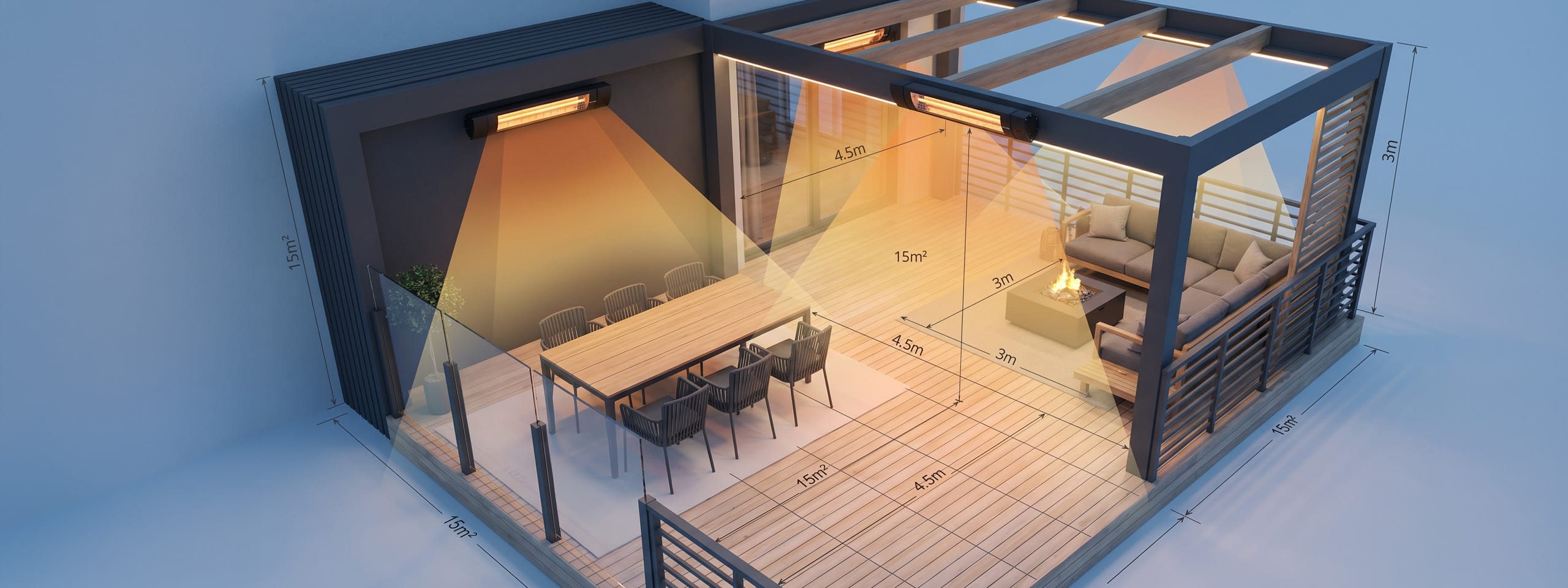
Enter the dimensions of your patio, balcony or conservatory and the calculator works out the estimated comfort output and recommends the number of Opranic PRO V70R units. You can adjust placement, mounting (wall or ceiling) and environmental factors such as wind protection and outdoor temperature, all parameters that affect how far the warmth reaches.
The result appears in a top-down visualisation where each heater’s coverage is drawn from actual measured values. You see immediately whether your area is adequately covered and what it costs to run the heaters per hour.
Calculate the power requirement for your outdoor infrared heater
Enter the dimensions of your terrace, balcony or conservatory and we calculate the estimated comfort power and recommend the number of PRO V70R units for wall or ceiling mounting.
Your area
Drag the sliders to match the size of your terrace or balcony.
The height where the heater is mounted above ground. The default 2.2 m works for most terraces.
Your environment
Select how the area is sheltered and at what temperature you want to heat.
The outdoor temperature at which you want to sit outside. 10 °C is a typical spring and autumn value.
Adjust the calculation (optional)
Our recommendation on the right is already calculated. To compare alternatives, adjust the settings below.
Wall = mounted on the house wall or fence. Ceiling = mounted in a pergola or roof structure.
Triac-controlled power per heater. P5 = full power (2,300 W) is the default showing maximum capacity. P3 (1,610 W) is usually sufficient in spring and autumn and costs about 30% less to run.
Auto selects the optimal number for your area. You can also choose manually.
Click to place = you position the heaters manually on the drawing to the right.
The drawing updates as you adjust the settings on the left. Select Click to place in step 3 if you want to position the heaters manually.
| Distance | Surface temp | Δ vs air |
|---|---|---|
| 1.0 m | 95 °C | +76 °C |
| 1.5 m | 57 °C | +38 °C |
| 2.0 m | 45 °C | +26 °C |
| 2.5 m | 38 °C | +19 °C |
| 3.0 m | 32.5 °C | +13.5 °C |
| 4.0 m | 28.5 °C | +9.5 °C |
| 4.5 m | 27 °C | +8 °C |
| 5.0 m | 25 °C | +6 °C |
This measurement is a benchmark showing how the heater performs in a controlled environment against a perfectly absorbing surface. In practice, human skin, clothing and common surfaces absorb less than matt black plywood, so the perceived heat at the same distance will be slightly lower. Outdoors, convection losses (wind cooling the skin) also apply, which the model compensates for via the settings above.
METHOD
How the Opranic power calculator works
Rather than relying on generic rules of thumb such as “150 W per square metre”, the Opranic infrared heater power calculator is built on three factors that genuinely determine how radiant warmth travels:
1. Real-world temperature measurements
Opranic has measured the surface temperature produced by the PRO V70R at distances from 1 to 5 metres, against a matte black timber background, in 19 °C still air. The results, from 95 °C at one metre down to 25 °C at five metres, form the basis of the heat coverage shown by the Opranic calculator. The full measurement series is plotted in the graph further down the page.
2. Physics-based modifiers
Range is shaped by the environment. An exposed terrace loses more warmth to the wind than a glazed conservatory. A high mounting position spreads the radiation more thinly. Lower outdoor temperatures call for more power. The Opranic calculator adjusts the range in real time as you change each parameter.
3. Triac-controlled power regulation
The Opranic PRO V70R offers five power settings, P1 to P5, corresponding to 40, 55, 70, 85 and 100 percent of the 2,300 W maximum output. This is not a linear dimmer. The Opranic power calculator computes the running cost at each P setting based on the actual wattage drawn and the electricity price you enter.
The difference from theoretical range
The Opranic visualisation shows two zones. The coloured zone is the perceived comfort zone, where you genuinely feel the warmth, adjusted for your environmental settings. The dashed rings beyond it mark the theoretical maximum radiation range, where heat is still present but so faint that it is barely noticeable.
FREQUENTLY ASKED QUESTIONS
Infrared heater power calculator: your questions answered
How many Opranic infrared heaters do I need for 20 m²?
It depends on mounting height, wind exposure and whether you have a roof. For a typical 20 m² patio with a pergola and partial wind shelter, the Opranic infrared heater power calculator usually recommends 2-3 Opranic PRO V70R units at P3-P5. Use the calculator above for an exact recommendation based on your specific space.
What is the difference between wall and ceiling mounting?
Wall mounting directs warmth from the side and suits patios with one or two walls. Ceiling mounting spreads warmth more evenly across the whole area and suits pergolas or covered roofs. The Opranic PRO V70R is approved for both. In the Opranic calculator you can switch between the two and see how the heat distribution changes.
What does it cost to run an Opranic infrared heater per hour?
At €0.38/kWh, the Opranic PRO V70R costs around €0.35/h on P1 (lowest) and €0.87/h on P5 (full power). Two Opranic heaters on P3 (mid setting) come to around €1.22/h. The calculator shows the exact running cost for your configuration and updates instantly when you change the electricity price or P setting.
Does wind affect how far the warmth reaches?
Yes, significantly. Infrared radiation travels the same distance regardless of wind, but the warm air layer that forms around your skin is carried away on an exposed patio. The Opranic calculator models this through the wind shelter setting; exposed locations show up to 18% shorter effective reach compared with fully sheltered positions.
Can I use the Opranic calculator for the S70R?
Technically yes. The Opranic S70R uses the same IR-X Carbon Black radiation and the same maximum power as the Opranic PRO V70R. The difference is that the S70R is freestanding and sits on the floor, so furniture, plants and objects in front of the heater can block the radiation, making the practical reach slightly shorter. Use the Opranic calculator as a guideline and allow for 10-20% shorter effective reach.
How accurate are Opranic’s measured values?
The measurements are taken against matt black plywood, a surface that absorbs almost all incoming infrared radiation. In practice, human skin, clothing and ordinary surfaces absorb less, so the perceived warmth at the same distance is slightly lower than the raw measurement series suggests. The comfort zone in the Opranic calculator (the coloured zone) already accounts for this.
IN DEPTH
Learn more about infrared heating
Want to understand the engineering behind the calculator? Explore our guides to Opranic infrared heaters:
- What is infrared heating? A complete guide to how infrared radiation works and why it differs from convection heating.
- How infrared heating works. The physics behind the Opranic IR-X Carbon Black emitter and why 2.2 µm is the optimal wavelength for outdoor heating.
- Outdoor infrared heaters, a buyer’s guide. A side-by-side comparison of the Opranic S70R, V50R and PRO V70R across different applications.
- Gas patio heaters vs infrared heaters. Running cost, environmental impact and the practical differences between the two technologies.