Patio gas heater or infrared heater – what is actually best for your patio or outdoor seating area? This article gives you real costs, real technology and a clear calculation. Not marketing, but an honest comparison you can apply to your situation.
Every spring, the same question arises: should you choose a patio gas heater or an electric infrared heater? The market is full of opinions, but rarely of honest figures. This article gives you both.
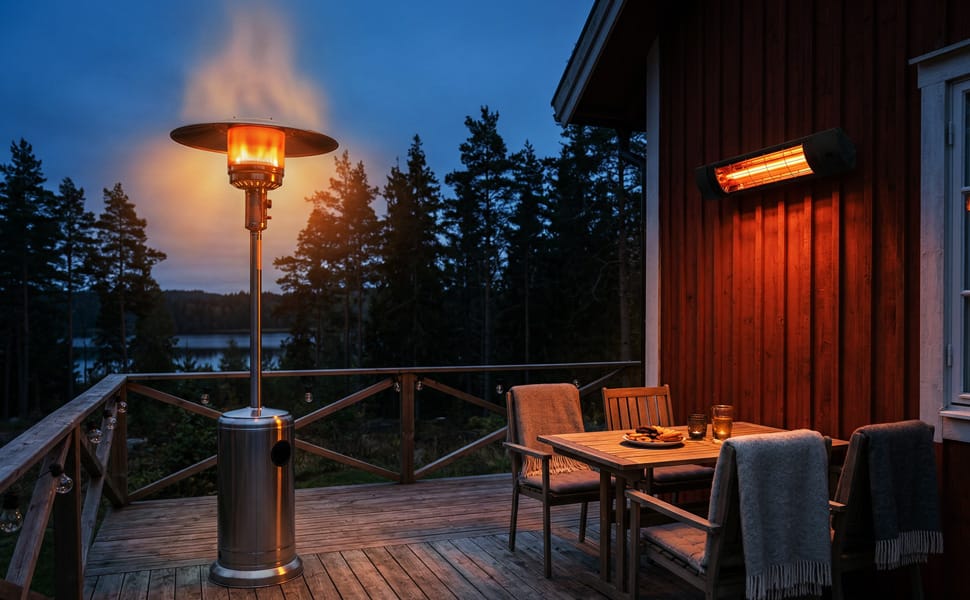
We compare the Opranic PRO V70, a 2,300 W electric infrared heater for wall or ceiling mounting, with a typical 11 to 13 kW patio gas heater (mushroom-style), the kind you will find at most DIY retailers.
We clarify what it actually costs to purchase, run and own each option. And we are strict with ourselves: patio gas heaters get the advantage where there is reason for it.
For private individuals: costs for home use
Most comparison guides are written for restaurants. However, most people searching right now are at home, considering what to buy for the terrace, patio/deck or balcony. Let us start there.
What does LPG cost in Sweden?
LPG is sold via LPG vending machines and DIY retailers. The system is simple: you buy a cylinder once, then exchange or refill it when it is empty. The most common cylinder size for a mushroom-style patio heater is PC10 or P11, which holds 10 and 11 kilograms of LPG respectively.
Prices in 2025: a new PC10 cylinder with LPG costs approx. SEK 1,500. Exchanging an empty cylinder for a full one costs approx. SEK 270 to 399 depending on the location, typically about SEK 320 per refill. That gives a price per kilogram of about SEK 30 to 35/kg.
A 13 kW patio gas heater consumes approx. 0.94 kg of LPG per hour, which results in an operating cost of about SEK 30 per hour at the average price and maximum output. Please note that the regulator is sold separately by most retailers, typically SEK 200 to 400, and is rarely included in the price of the heater.
What does it cost to buy a complete gas setup?
The price range for an 11 to 13 kW mushroom-style patio gas heater is wide. A budget model costs approx. SEK 1,200 to 1,600. Mid-range is SEK 2,000 to 3,500, and premium SEK 4,000 to 6,000.
In addition, you will need a new PC10 cylinder with LPG at approx. SEK 1,500 and a regulator at approx. SEK 300.
Total initial investment: from around SEK 3,000 for budget options, typically SEK 4,000 to 5,000 for a capable mid-range setup ready to use.
How much time do you spend outdoors? Three Swedish profiles
In Sweden, being outdoors in comfort usually requires a heat source for most of the season. Evening temperatures drop quickly, even in summer, and the need for supplemental heat is real from May to September.
| Profile | Description | Hours/season |
|---|---|---|
| The sun seeker | Only brings out the heater on exceptionally nice evenings and for BBQ parties. | 40–60 hours |
| The typical family | Sits outside most evenings when it is not raining. The infrared heater is used from May to September. | 100–120 hours |
| The patio enthusiast | Moves the living room outdoors in May. The infrared heater runs almost every evening when it is not raining sideways. | 200+ hours |
In the comparison below, we base the calculation on the typical family at 110 hours per season, a reasonable midpoint for active patio use in Sweden.
Private cost comparison: PRO V70 vs mushroom-style gas heater
Our comparison product is the Opranic PRO V70 at 2,300 W, with an electricity price of approx. SEK 2.00/kWh, including grid fees and tax. This results in an operating cost of about SEK 4.60 per hour.
| PRO V70 (electric) | Patio gas heater (mushroom-style) | |
|---|---|---|
| Purchase price (heater) | SEK 3,990 | from SEK 3,000, typically SEK 4,000–5,000 |
| Additional costs | Electrical outlet (existing) | LPG cylinder ~SEK 1,500 + regulator ~SEK 300 |
| Operating cost per hour | ~SEK 4.60 | ~SEK 30 |
| One season (110 hours) | ~SEK 505 | ~SEK 3,300 |
| Total, year 1 | ~SEK 4,495 | ~SEK 7,600–8,800 |
| From year 2, per season | ~SEK 505 | ~SEK 3,300 |
| Service life | Up to 12,000 h, 3-year warranty | 4–6 years (industry average) |
The gas costs more per season than it costs to buy a PRO V70. From year 2, you save about SEK 2,800 per season. Within three seasons, the electric heater has paid for itself several times over.
Source: gasolmacken.se, gasolfyllarna.se, jula.se (prices in 2025). Electricity price: SE ~SEK 2.00/kWh incl. grid fees and tax.
What happens if you spend more time outdoors?
If you are a patio enthusiast with 200+ hours per season, it looks like this: gas costs approx. SEK 6,000 to run versus approx. SEK 920 for the PRO V70. The difference is nearly SEK 5,000 per season. On top of that: no LPG cylinders to exchange, no trips to the shop, and no adjusting controls at the table.
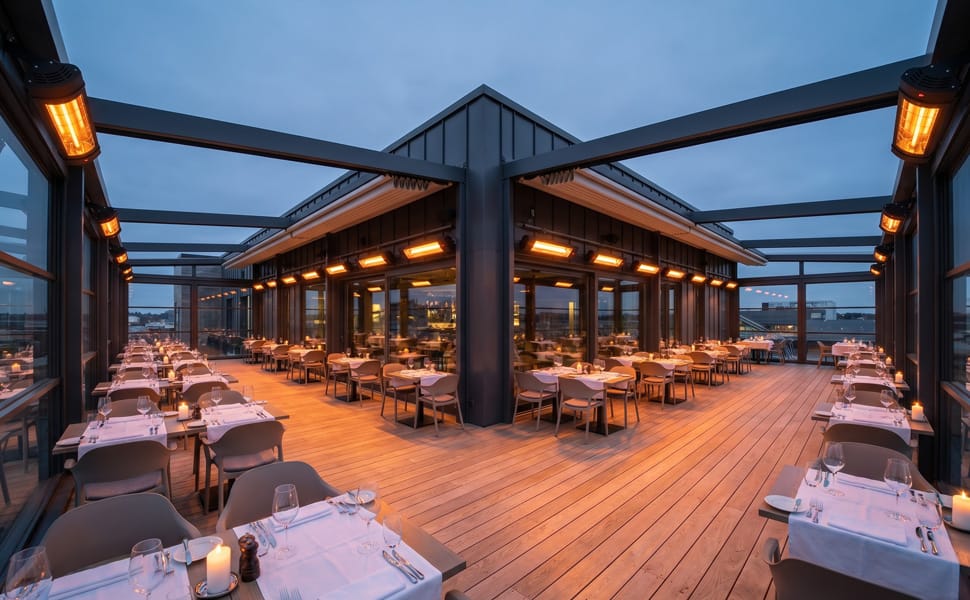
The logic is simple: a restaurant that can welcome guests outdoors in April, May, September and October earns more than one that closes the terrace when it gets chilly. Every extra day with the outdoor area open means more covers, more dishes and more revenue.
How the calculation is made
A patio gas heater of about 12 kW covers 10 to 15 m². For a 60 m² outdoor seating area, you need four. LPG costs an average of SEK 4.7/kg in Sweden (Eurostat H1 2025). A 12 kW burner consumes 0.94 kg/h. That gives 4 × SEK 42/h = SEK 170 per hour for the entire area.
Five Opranic PRO V70 infrared heaters mounted every three metres cover the full 60 m². Operating cost: 5 × SEK 4.6/h = SEK 23 per hour. The difference is SEK 140/h. Based on 4 hours per evening and 180 evenings per season, this provides savings of up to SEK 94,000 compared with LPG.
The sunshine principle: why infrared heat is more efficient
Think of a clear winter day in the mountains. The air temperature is minus ten degrees, yet you open your jacket in the sun because you are too warm. The sun warms you directly without heating the air. That is exactly how infrared radiation works.
LPG and other combustion heaters warm the air. That air rises and is blown away by the next gust of wind. You pay for 12 kW of LPG, but perhaps 2 to 3 kW remains with your guests. The rest heats the sky above the seating area.
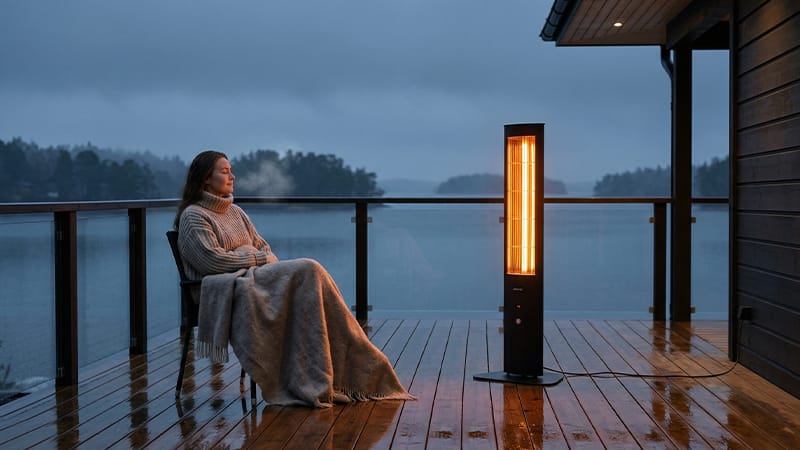
An Opranic PRO V70 emits infrared radiation at 2.4 micrometres. That wavelength is absorbed directly by the body, just like heat from the sun. Each watt performs more useful work, so fewer units are needed to create the same comfort.
The difference between long-, medium- and short-wave infrared technology
Not all infrared technology is the same. Long-wave IR (ceramic, quartz) heats the air more, almost like convection heat. Short-wave IR (halogen) shines brightly but penetrates deeper than necessary.
Medium-wave IR at 2 to 2.5 micrometres is the optimal zone for human absorption. Opranic’s IR-X Carbon Black technology operates in precisely that range.
Infrared heater: how does infrared heat work?
Short-wave, medium-wave, or long-wave: which provides the best heat?
Safety and peace of mind for you and your guests
A patio gas heater has an open flame, a pressurised gas line, and requires regular cylinder changes. In a garden with children and pets, or at a restaurant with guests, staff and narrow walkways, it is a risk that requires active management.
Gas cylinders are classified as flammable goods and require approved storage.
The Opranic PRO V70 infrared heater is mounted on the ceiling or wall, completely out of reach, and has no open flame. There are no cylinders to change, no moving parts, and no exhaust fumes at the table.
The IP65 rating means the unit withstands rain, moisture and the outdoor conditions that an active patio is exposed to throughout the season.
For private individuals with children on the terrace, this is practical peace of mind. For restaurant owners, it is also an insurance matter: electric infrared heat is generally easier to have approved by insurers for restaurant environments than open combustion at the table.
Environment: your guests notice it, and choose accordingly
Sweden is at the forefront in Europe when it comes to clean electricity generation: hydropower, nuclear and wind power mean that electricity in Sweden is already one of the greenest energy choices in the EU. Operating an Opranic PRO V70 on Swedish electricity results in an operational CO₂ impact that is, in practice, zero.
LPG is a fossil fuel. It is burned in front of guests, emits exhaust fumes, and makes the air on the patio worse. At a time when Swedish consumers actively choose away from fossil solutions, it is a signal that does not go unnoticed.
Switching to electricity is not only a financial decision. It is a values-based decision. A restaurant that says it heats with clean Swedish electricity has a story to tell its guests—and that story sells.
Opranic: a Swedish brand with 20 years of infrared engineering expertise
Opranic was founded in Sweden and has offices and customer service here. It is not an import brand that sells other people’s products under its own name.
For more than 20 years, Opranic has developed and refined its own infrared heaters, with its own tooling and production, and Japanese-made IR-X Carbon Black elements that meet requirements most suppliers never test for.
It is the entire system that makes the difference: IR-X Carbon Black element, reflector, metal housing and electronics are optimised and tested together for Northern European outdoor conditions. Not a single component is chosen for the lowest price.
Best infrared heater in test 2026: why Opranic delivers the most heat per watt
When LPG is still an option
We will be direct: if there is no electricity near the patio and the cost of running power is too high, LPG is a practical option. The same applies to pop-up events or temporary areas where a permanent installation is not possible.
However, if you already have an electrical outlet on the terrace, or if you are a restaurant with access to the grid, the financial and operational arguments for infrared heat are clear. In most cases, the switch pays for itself already in the first season.
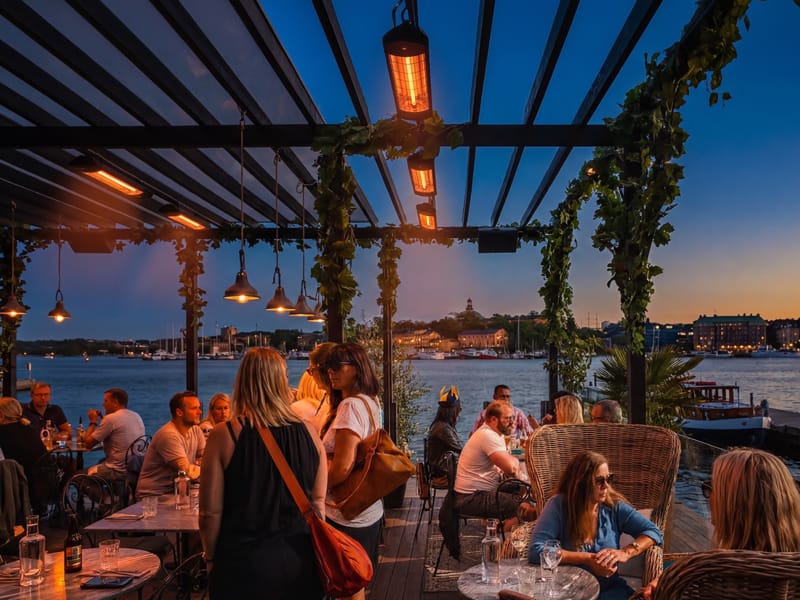
Opranic PRO V70: permanently mounted for wall, ceiling and outdoor seating
The PRO V70 is designed for permanent mounting on a wall, ceiling, or under an awning. The body is made of anodised aluminium with carbon-fibre-reinforced side panels and a brushed stainless steel grille. The design is slim and elongated, blending into the environment as part of the décor.
For restaurants and outdoor seating, the PRO V70 is the obvious choice: five units mounted every three metres cover a 60-square-metre outdoor area. For home use, the PRO V70 works excellently under an awning, on a patio wall, or in the ceiling above an outdoor table.
- Power
- 2,300 W (5 power levels)
- Mounting
- Wall, ceiling, awning
- IP rating
- IP65
- Lifespan
- Up to 12,000 hours
- Timer
- 9 hours
- Warranty
- 3 years
- Material
- Anodized aluminum + carbon fiber panels
- Remote control
- Included
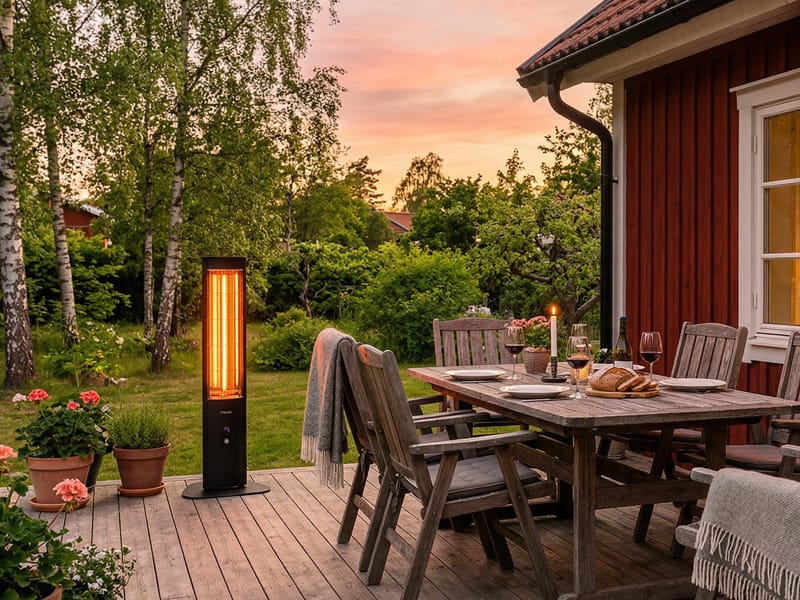
Opranic THOR S70: portable infrared heater for patio, balcony and conservatory
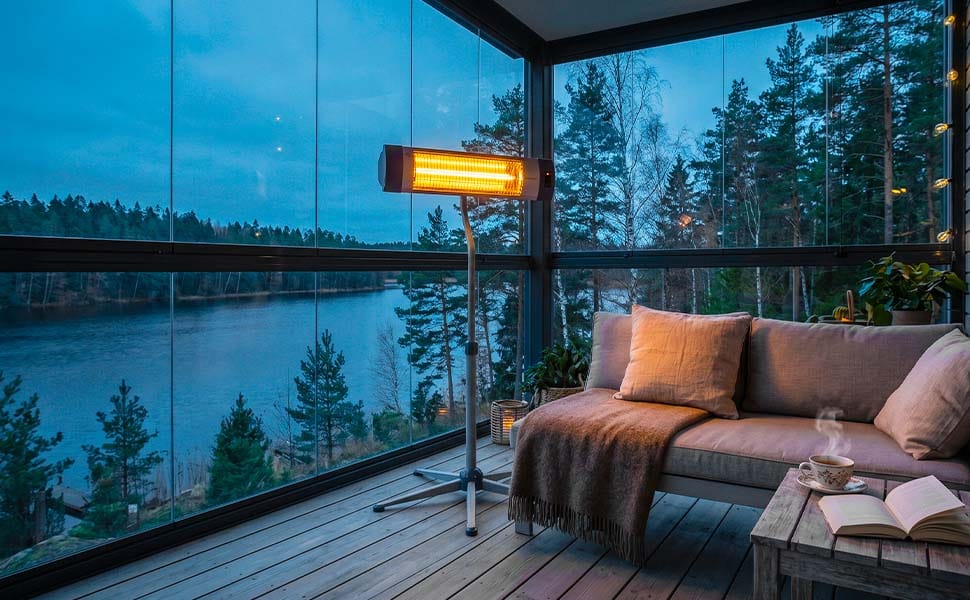
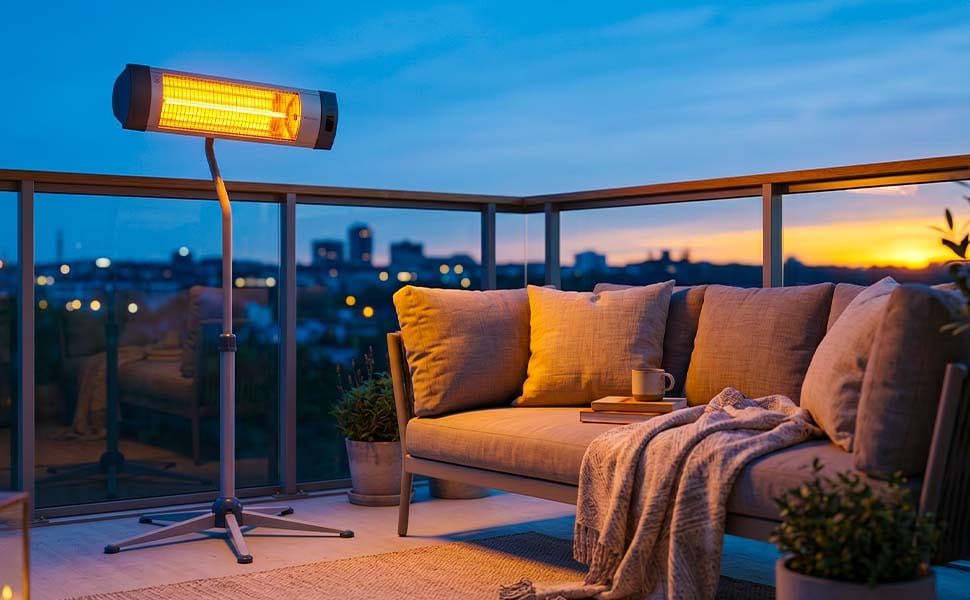
The THOR S70 is the freestanding model in the same technology family. An all-metal construction in powder-coated aluminium with a brushed stainless steel grille, 106 cm tall and 8.1 kg.
You place it next to the dining table on the terrace, move it to the balcony the next day, and bring it into the conservatory when autumn arrives.
The IP65 rating means the infrared heater is completely dust-tight and withstands heavy rain. The remote control regulates both the power level and the built-in 9-hour timer. An electronic tip-over switch shuts the heater off immediately if it falls over.
- Power
- 2,300 W (5 power levels)
- Heating area
- 7–25 m² depending on the environment
- IP rating
- IP65
- Lifespan
- Up to 12,000 hours
- Timer
- 9 hours
- Warranty
- 3 years
- Height / weight
- 106 cm / 8.1 kg
- Colors
- Jet Black, Cloud White
Summary
The choice between an infrared heater and LPG is not about which option delivers the most kilowatts. It is about what you actually pay for—and what you actually get.
LPG heats the air. Infrared heat warms people directly. A PRO V70 costs about SEK 4.60/h to operate. A mushroom-style patio gas heater costs about SEK 30/h.
The gas costs more per season than a PRO V70 costs to buy. For a restaurant with a 60 m² outdoor seating area, the savings are up to SEK 94,000 per season.
No open flame, no cylinders to exchange, no exhaust fumes in front of guests—and a system that lasts a decade without maintenance.
Best infrared heater in test 2026: Opranic THOR and PRO
Buying guide: Outdoor infrared heaters – how to choose the right one