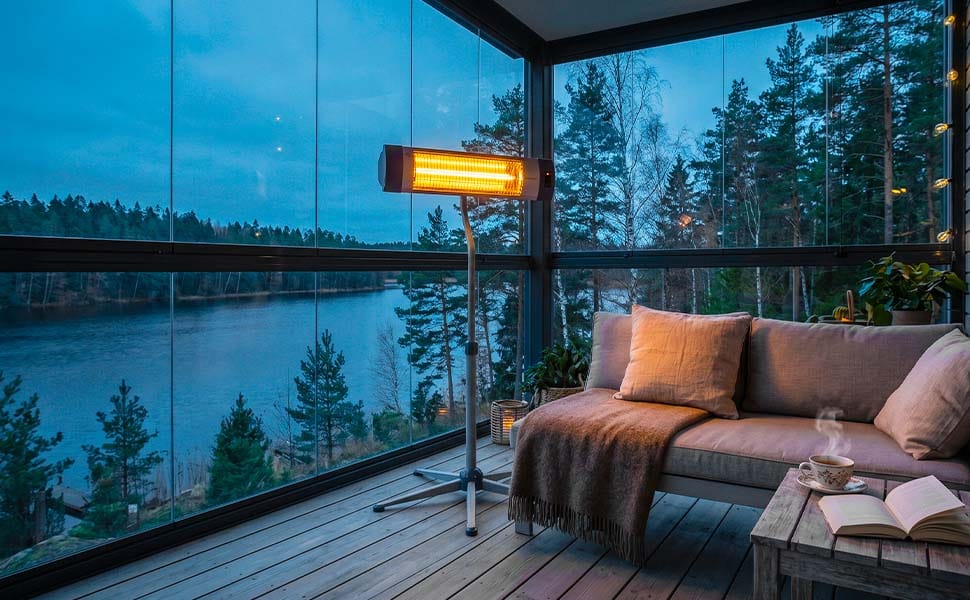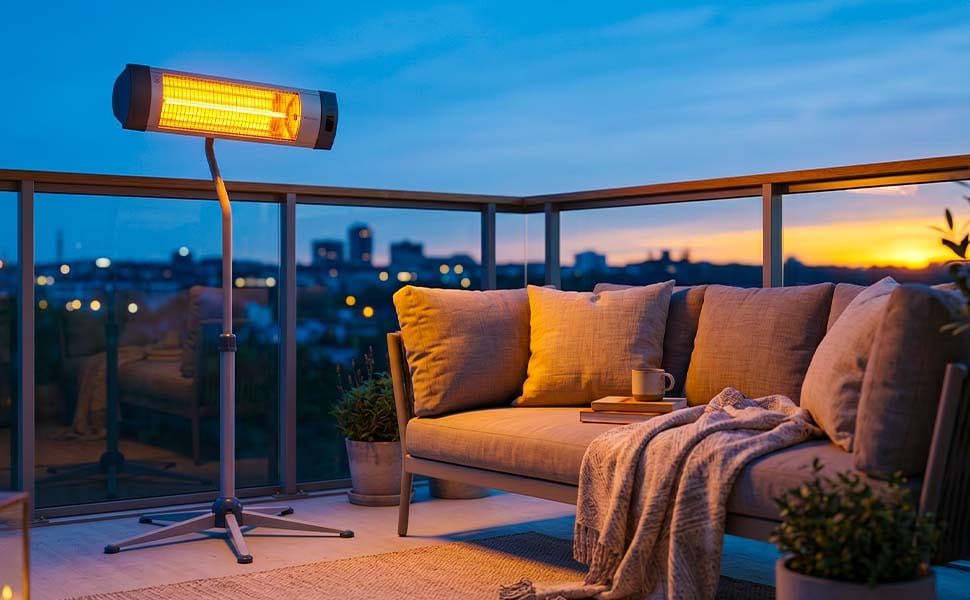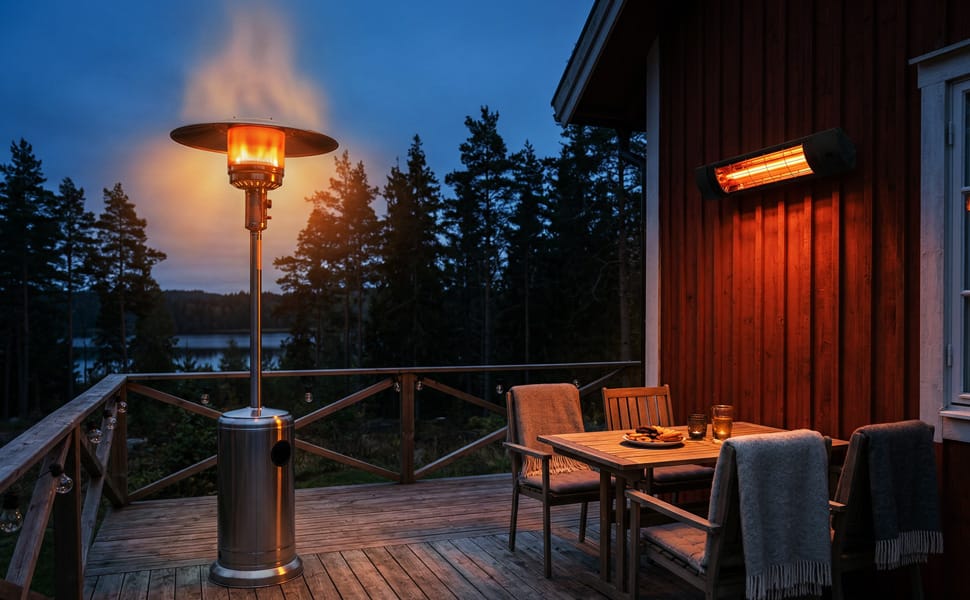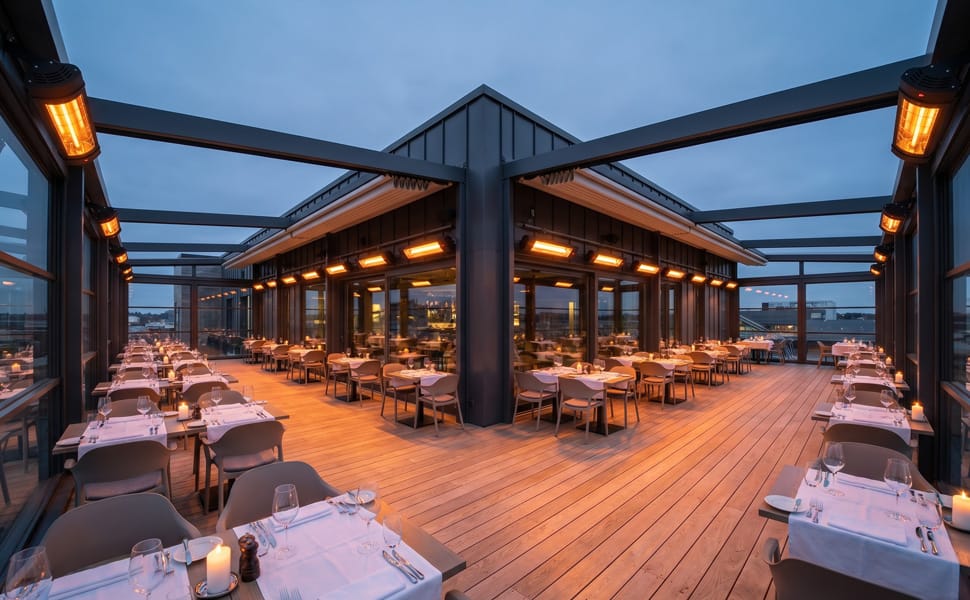
Previously, you had to choose between central power control and individual output settings.
The PRO V70R with Auto-Restart central control combines both in a single heater.
The Dilemma Before Auto-Restart
When a restaurant, café or terrace needs heating installed, the same problem tends to surface. The heating needs central control, ideally through a contactor, a timer, or a master switch behind the bar. Staff want to switch everything on at once, without stepping through five or ten units one by one.
Until now, that meant choosing between two options for PRO V70R-style installations, both with clear drawbacks.
Option 1: Fixed-power heaters
The classic solution for centrally controlled installations is a heater that always starts at the same power level. Power goes on, the heater fires up at its preset output. Simple and reliable.
The problem appears the moment that power level needs adjusting. On a mild spring evening, 2,300 W is too much. On a cold winter night, 1,200 W is too little. The heater has no way of knowing which. The end customer ends up either too warm or too cold, and the installation is hard to correct without rewiring.
Option 2: Remote-controlled heaters with default behaviour
The second option is a standard remote-controlled heater with five power levels to choose from. The problem is that each unit reverts to standby the moment power is cut. The central switch restores power, and nothing happens until staff take out the remote and turn on every heater by hand.
For a venue with ten heaters, that means ten button presses every evening. And the same routine repeats itself whenever the power flickers, the timer switches over, or a fuse trips.
The compromise nobody likesEither flexibility without automation, or automation without flexibility. Both leave the end customer dissatisfied.
How Auto-Restart central control solves both problems
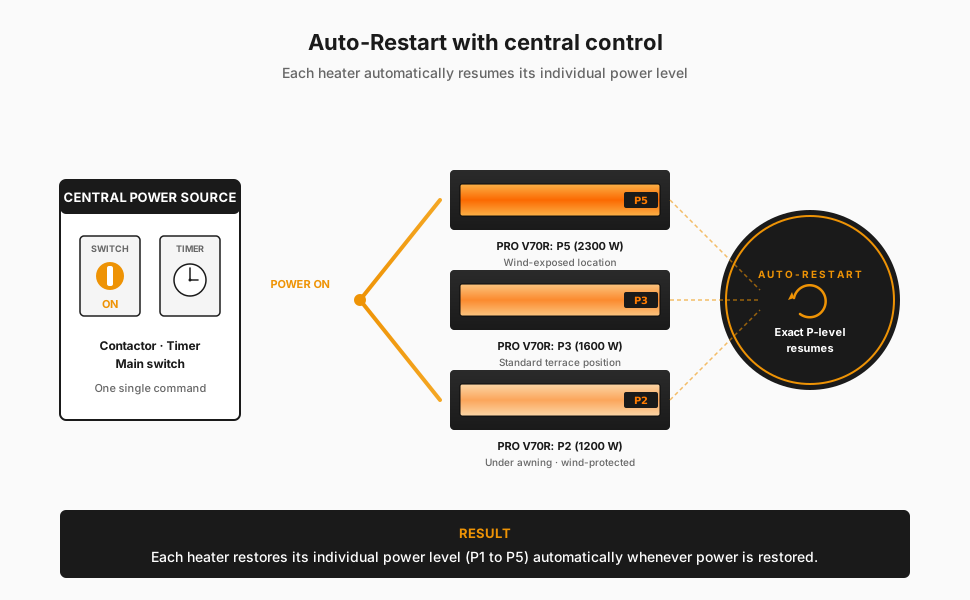
Auto-Restart on the PRO V70R is a memory function built into the heater’s control circuit. When you cut power externally via a contactor, timer, wall switch, or main circuit, the heater saves its current operating state. When power returns, the heater restores itself to exactly that state.
The critical point is that the heater retains its flexibility to change power level via the remote control, while still behaving like a fixed-power unit whenever power is restored.
The end customer gets both flexibility and automation, without compromise
The five power levels on the PRO V70R
The PRO V70R offers five power levels, set via the remote control and shown on the display, giving you PRO V70R individual power level control for every zone:
- P1 · 900 W · gentle warmth for cool evenings, energy efficient
- P2 · 1,200 W · comfort heat in sheltered spots
- P3 · 1,600 W · standard setting for patios and terraces
- P4 · 1,900 W · higher output for colder conditions
- P5 · 2,300 W · full power, maximum warmth
This infrared heater power memory means Auto-Restart recalls exactly which level each individual heater was set to. Was a heater on P3 (1,600 W) before the power cut? It returns to P3 the instant power is back. No button presses required.
This is the whole point in a restaurant setting, where different V70R units may run at different levels depending on their position. The one closest to the wind might sit on P5, the one under the awning on P2, and you want that distribution recreated automatically every time power is restored, whatever restaurant terrace heaters central switch you use.
When Auto-Restart Central Control Actually Solves a Problem
These are the three scenarios where installers and property owners see the most direct benefit from Auto-Restart central control on PRO V70R installations:
1. Restaurant Terrace Heaters with an Evening Start Timer
A typical restaurant runs four to eight PRO V70R heaters across its terrace and wants them switching on automatically at 4pm every day. With an astronomical timer or a standard time switch in the electrical cabinet, staff can set the heating season once and forget it.
With Auto-Restart enabled, the timer switches on the power and all eight heaters start immediately at their individual power levels. Staff never need to touch the remote control.
2. Contactor-Controlled Restaurant Terrace Heaters
Larger installations with ten or more V70R heaters are typically managed through a contactor in the electrical cabinet, often paired with a master switch behind the bar or at the till. Staff flip the switch when service opens, and a single action brings every heater to life.
This is where Auto-Restart proves most valuable. The function turns that central switch into a tool that genuinely controls the heat, exactly as staff expect it to.
3. Seasonal Operation and Planned Shutdown
At the end of the season, power to the heaters is switched off at the main circuit, either to save energy or ahead of winter storage. When the season resumes in spring, flipping the breaker back on is enough: the system returns to operation with the same settings it had before shutdown.
How to Activate Auto-Restart on the PRO V70R
Auto-Restart is switched on or off directly from the remote control supplied with the V70R. It’s a simple button sequence, and the setting is stored permanently in the heater until you change it.
Step by step
1. Make sure the heater is in the correct state. The V70R display should read “- -“ before you start. This indicates standby. If the display shows anything else, put the heater into standby first.
2. Press the remote control buttons in exactly this order:
MAX > P+ > P− > MAX
3. Read the display.
If the display briefly shows “r1”, Auto-Restart is enabled. The heater will now remember its operating mode, including its individual power level, and resume it automatically once power is restored.
If the display briefly shows “r0”, Auto-Restart is disabled. The heater will then always start in standby mode after a power cut, which is the factory default.
Repeat the same sequence to switch between the two modes. The setting is retained even after a power outage, which is the entire point of this infrared heater power memory function.
Important to knowThe sequence only works when the display shows “- -“. If the heater is active or showing a power level, you need to switch it to standby first before you can change the Auto-Restart setting.
Practical benefits for installers
If you install heating systems in commercial settings, Auto-Restart central control on the PRO V70R delivers the following, concretely:
Simpler system design. You can design systems around central power switching, where the mains switch becomes the actual master control for the heating. No fixed-power compromises required.
Fewer support calls. One of the most common calls after an installation is “the heater doesn’t start when I switch the power on”, which almost always means the customer has misunderstood the standby function. With Auto-Restart enabled, that misunderstanding disappears.
A better experience for the end customer. Restaurant staff or a facilities manager only need to manage one command: power on, power off. That is how they expect a heating system to behave.
Adjustable power retained. The end customer keeps full control over power levels via the remote control. On a mild evening, staff can lower the setting to P2; on a cold, windy night, raise it to P5. This is the infrared heater power memory at work: Auto-Restart preserves their choice and restores it the next time power returns.
The standard solution for multi-unit installations. The recommendation is to enable Auto-Restart as standard on every commercial installation with two or more PRO V70R units on the same circuit, particularly where restaurant terrace heaters central switch arrangements are used. Activation takes five seconds per unit.
Why We Could Add Auto-Restart to the PRO V70R
Auto-Restart is a feature that did not exist on the PRO V70R a year ago. It exists now because Opranic owns both the design and the development of its products, which means the range can be iterated year after year based on what installers and end customers actually need.
When dealers and installers began reporting the dilemma of fixed power versus remote control in centrally controlled installations, it was possible to build the Auto-Restart central control solution directly into the next production batch. Not as an accessory, not as a separate module, but as an integrated function within the heater’s own control circuit.
That is the difference between owning a product and simply distributing it. The Opranic PRO V70R is not a standard heater with a badge stuck on it. It is engineered, and continues to be refined, in step with changing market needs, and Auto-Restart is a concrete example of that development model.
Read more about how Opranic develops its heaters
Safety Aspects
Auto-Restart is safe to use in all standard installations that comply with Elsäkerhetsverket regulations. The PRO V70R runs the same protection systems whether the heater starts via remote control or via Auto-Restart. Overheat protection, IP65 enclosure rating, and thermal fuses all function identically in either mode.
In installations where you want the heater to always start manually for safety reasons, for example where the unit is accessible to unauthorised persons or where flammable material is nearby, leave Auto-Restart disabled. This is the original factory setting, so no action is required.
When to Enable Auto-Restart Central Control on the V70R
Enable Auto-Restart central control when your PRO V70R is connected to a central power switch designed to turn several heaters on and off at once. This is typical in restaurants, cafés, patio and terrace settings, and commercial outdoor areas. For installations where the heater is controlled individually and each start should be a deliberate action for safety reasons, leave Auto-Restart disabled.
The feature is hardware-based and requires no apps or additional accessories. It stays with the heater for its entire lifetime, and the setting is retained even after a power cut. This is how Opranic resolves the trade-off between fixed power output and remote control for commercial infrared heating installations.