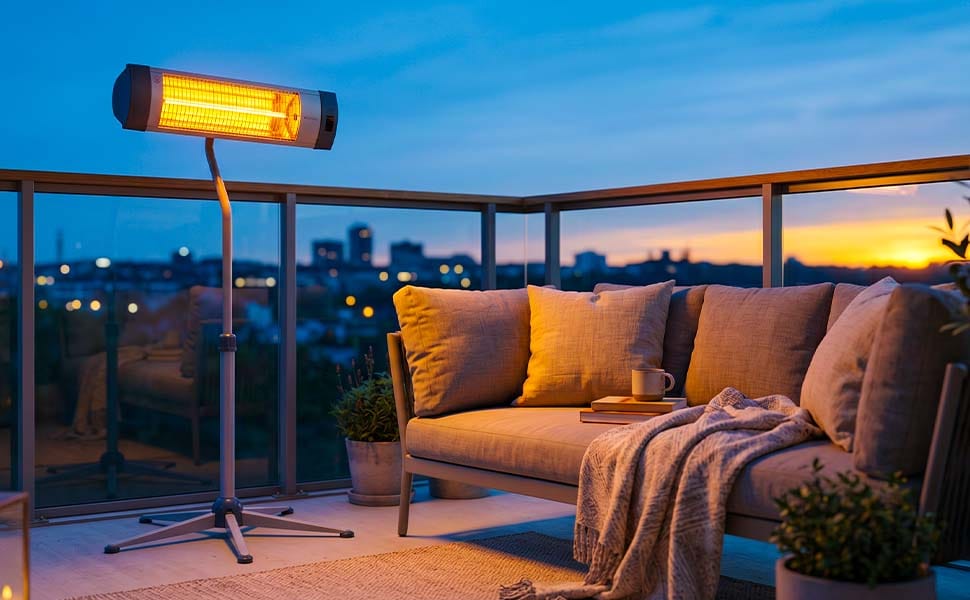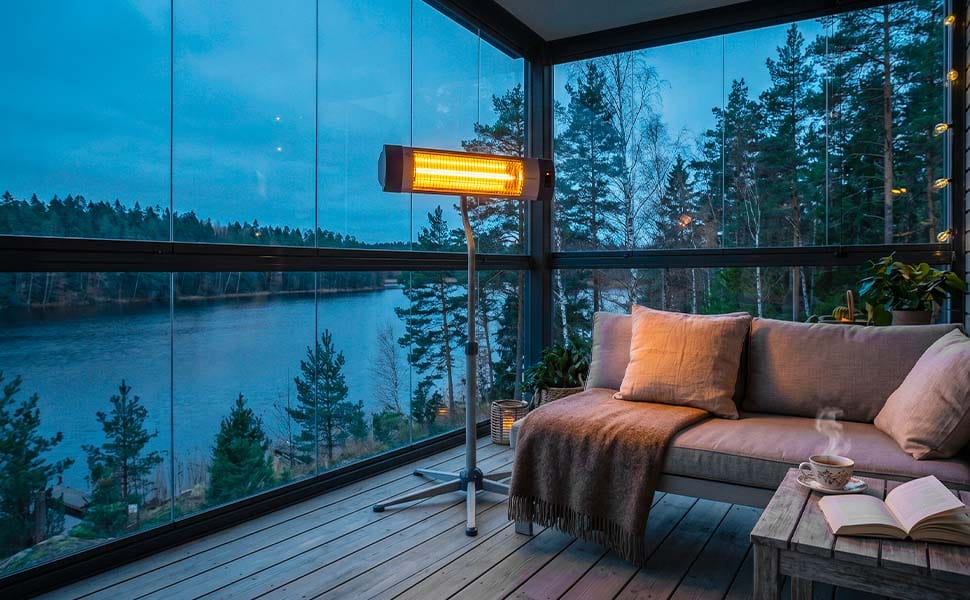
To heat a glazed balcony and use your seating area for more of the year, focus warmth where you sit. The glazing reduces wind exposure, while an infrared heater delivers warmth directly to you. This guide covers model choice, power, placement and running costs for your glazed balcony.
A glazed balcony can lose considerable heat through the glass, floor and gaps. Your choice depends on whether you want warmth where you sit for occasional use or heating that keeps the whole space warm for longer periods. These two needs require different planning.
What affects how you heat a glazed balcony?
Glazing reduces wind chill, but does not necessarily insulate as well as a conventional external wall. Single glazing, gaps, a cold floor and low outdoor temperatures all affect how much power you need. Sunlight can warm the space during the day, but that warmth fades after sunset.
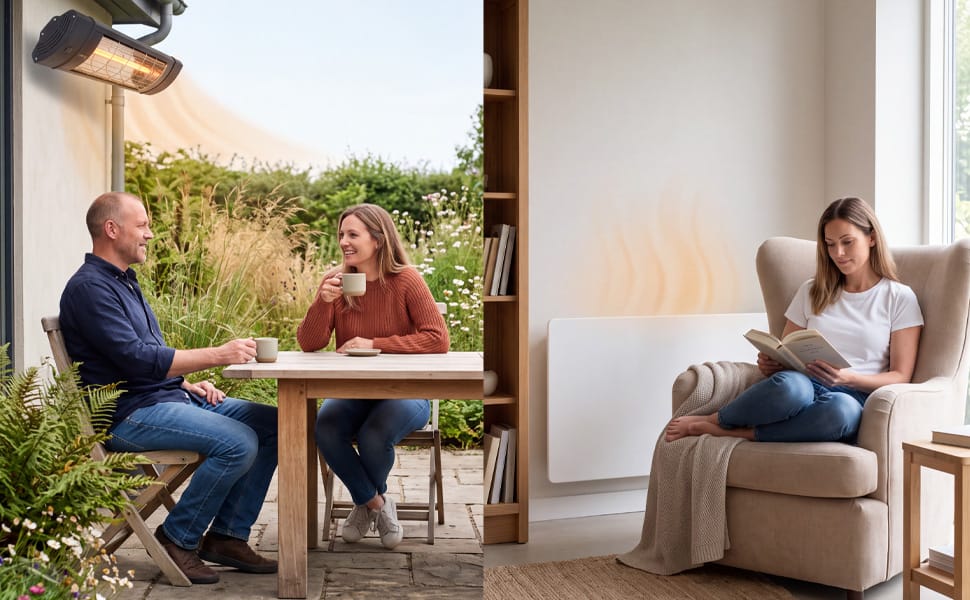
Whether you use your balcony for relaxing in an armchair, dining or working, direct infrared heat can provide comfort while you are there. Direct the heat towards people and seating areas, maintaining the clearances specified in the user manual.
S50R and S70R to heat a glazed balcony
Opranic S50R is the shorter, lighter freestanding option. It is easier to carry between seating areas once you have switched it off, unplugged it and allowed it to cool. Choose either 1,800 W or 2,300 W. Both versions have five power levels, a remote control, a timer adjustable from one to nine hours and an IP65 rating.
Opranic S70R is the taller, more substantial premium model, with a Unibody construction, a premium reflector and 2,300 W of power. It suits a seating area you use regularly and offers five power levels, a remote control, a timer adjustable from one to nine hours and an IP65 rating.
According to their product documentation, S50R and S70R meet the requirements for portable radiant heaters under EU Ecodesign Regulation (EU) 2024/1103. This applies specifically to these models. Remote control, timer and temperature control are separate functions; always check which controls your chosen model provides.
STAR18RS as a stand-mounted alternative
Norveco STAR18RS provides 1,800 W and comes with a stand, remote control and thermostat function, as specified in the product documentation. It has an IP44 rating and a two-year warranty. Follow the product’s own instructions for placement and use in your space.
STAR18RS is included in the clearance sale. See the product page for the current price and availability, and check the operating instructions before you buy.
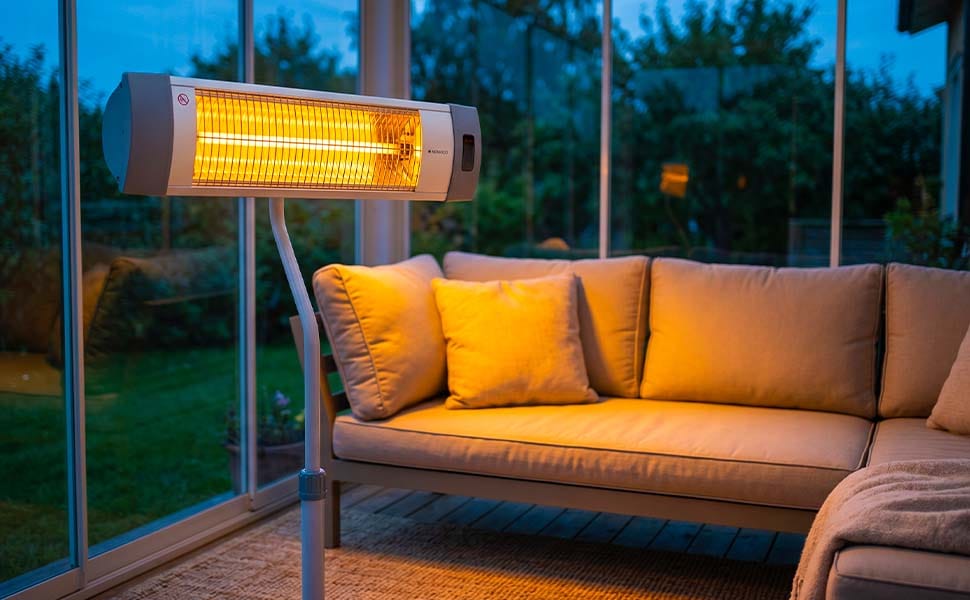
How much power do you need to heat a glazed balcony?
Start with the size of your seating area and how cold the space gets. Glazing that keeps the wind out may allow you to use less power than on an open balcony. It does not, however, guarantee that a given power output will heat the entire balcony.
Choose a model with adjustable power so you can adapt the warmth to mild evenings and colder weather. PRO V70 has a fixed output of 1,800 W and external on/off control; it should not be confused with PRO V70R, which has five power levels. For fixed installation in an enclosed space, you also need to consider the model’s temperature-control requirements.
If you want to maintain a steady room temperature for several hours, you need to assess insulation, heat loss and temperature control. This guide focuses on direct warmth while you use your seating area.
Read the outdoor heating guide for power requirements, placement and model comparisons
Position the infrared heater near your seating area
Keep a clear path between the heater and your seating area. Direct the infrared heater towards the people seated there, rather than towards the glazing. When choosing its position, allow for doors to open fully and consider furniture, curtains and walkways.
Place a freestanding S50R or S70R on a firm, level surface. Maintain clearances of at least 100 cm in front, 70 cm on each side, 50 cm behind and 50 cm above the infrared heater. Switch it off, unplug it and allow it to cool before moving it. Always follow the model’s instruction manual and route the cable so it does not create a trip hazard.
STAR18RS has a different design and must be positioned according to its own instruction manual. IP44 and IP65 describe protection against water and dust; they do not replace the required safety clearances.
Running cost to heat a glazed balcony
For this calculation, we use an electricity price of 0.38 EUR/kWh including network charges and tax. The table shows the cost of continuous operation at each stated power level:
| Power | Cost per hour | Cost for three hours |
|---|---|---|
| 900 W | 0.34 EUR | 1.03 EUR |
| 1,800 W | 0.68 EUR | 2.05 EUR |
| 2,300 W | 0.87 EUR | 2.62 EUR |
The 900 W figure is a calculation example, not a power setting available on every model. If you run a 1,800 W heater at full power for three hours, three evenings a week for 20 weeks, it uses 324 kWh and costs 123.12 EUR. Lower power or shorter running times reduce energy consumption.
A thermostat can reduce running time by switching the heat off when the set temperature is reached. In a space with high heat loss, the heater may still need to run for much of the time. Use your own electricity price and expected running time to calculate your costs.
Warranty and model differences
| Model | Key benefit | Maximum power | Warranty |
|---|---|---|---|
| S50R | Lighter and lower, easy to move once switched off, unplugged and cooled | 1,800 / 2,300 W | 2 years |
| S70R | Premium freestanding construction | 2,300 W | 5 years, heating tube 2 years |
| STAR18RS | Stand and thermostat control | 1,800 W | 2 years |
The S50R has a rated element lifetime of up to 8,000 hours; the S70R is rated for up to 12,000 hours. These figures describe element lifetime, not warranty duration. The S70R heating tube carries a two-year warranty. You can find the full terms in the instruction manual.
Common questions about heating a glazed balcony
Can you use your balcony throughout winter?
That depends on the insulation, outdoor temperature and how you use the space. Infrared heating can make your seating area more comfortable. Adding an infrared heater does not turn an uninsulated glazed balcony into a room insulated for winter use.
Does an infrared heater need to stay on all the time?
For direct radiant warmth, you only need to run it while you are using the space. If you want to maintain a set room temperature when the balcony is empty, heat loss and temperature control need to be assessed separately.
Is the same model suitable for an open balcony?
Wind exposure, weather protection and heater placement differ. Read the guide to infrared heating on a balcony for advice on choosing a model for your open balcony.
To heat a glazed balcony, start by considering how you want to use it.
S50R is designed to be easy to handle, while S70R offers a more substantial, premium build. STAR18RS is the freestanding alternative in the clearance range. Consider your seating area, heat loss and each model’s instructions before deciding on power and placement.
Infrared heating outdoors and indoors: choose the right type for your space