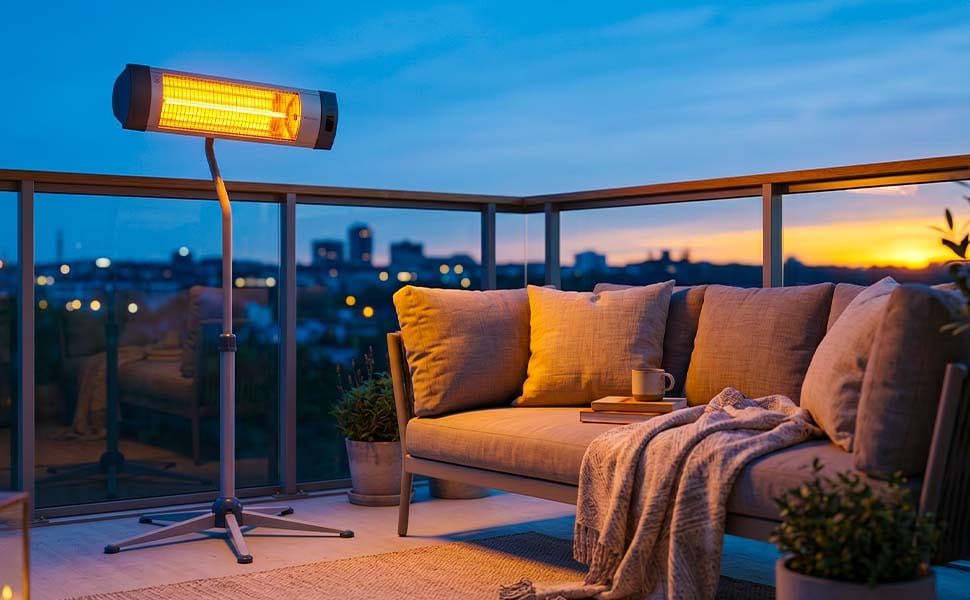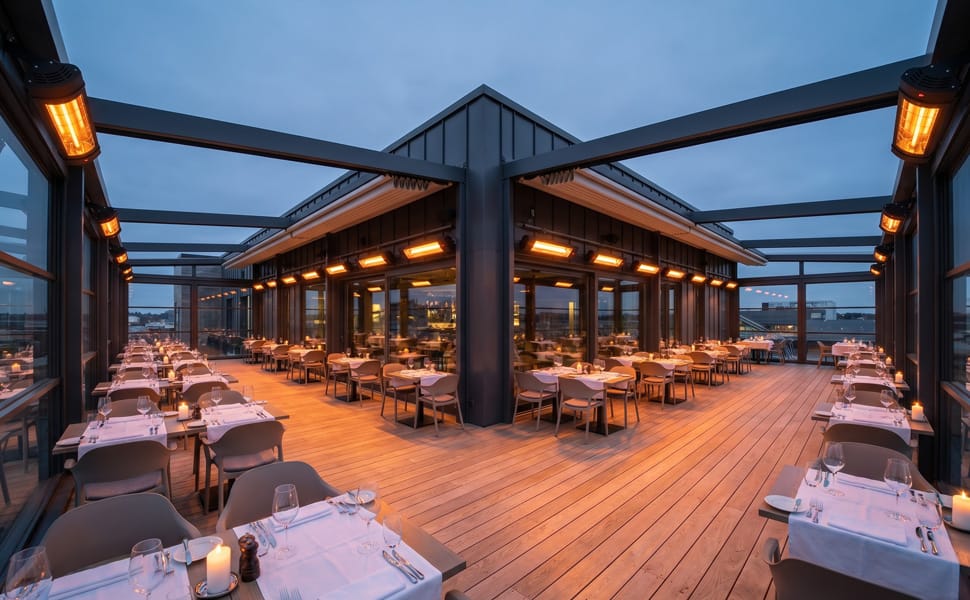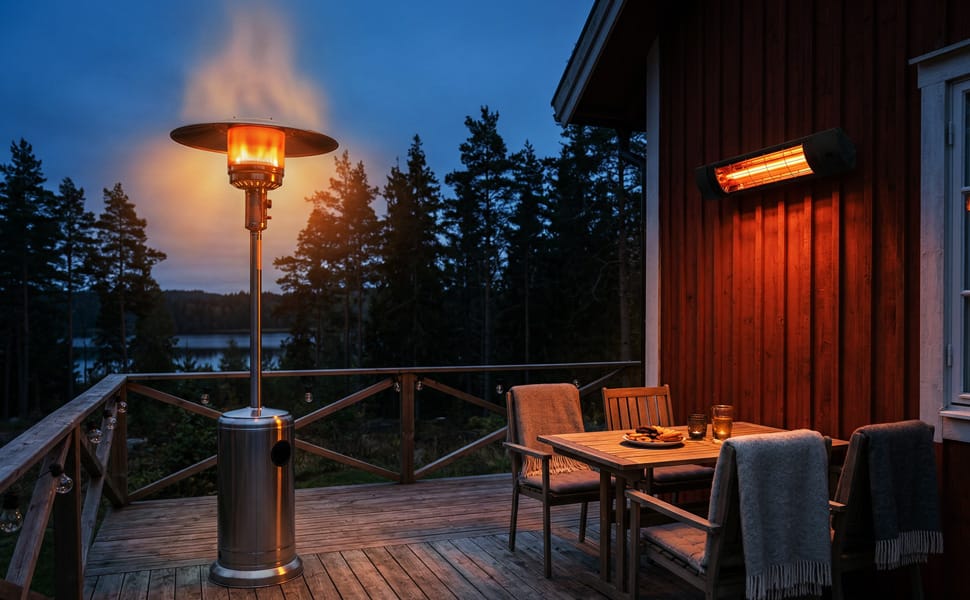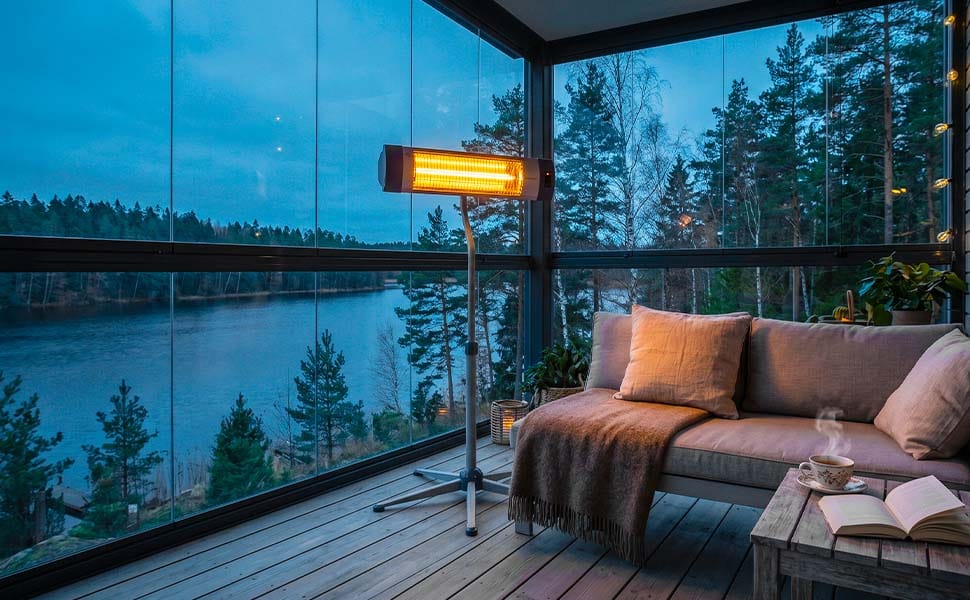
Heating a glazed balcony is easier than most people expect. A glazed balcony is neither fully outdoors nor fully indoors, and that in-between character is exactly what makes it so straightforward to heat. The glazing blocks the wind and holds the warmth in, so you need considerably less power than on an open balcony to reach a comfortable temperature.
This guide explains how to do it, using the STAR V40 (STAR18RS) as the reference product. More people are searching for ways to heat a glazed balcony, and search interest in this type of query has grown by 125% over the past year, according to Google Trends.
That’s no surprise: a glazed balcony heated the right way becomes a room you can use from January through December, not just during the summer months. It’s one of the most underrated ways to extend the outdoor season in a Nordic climate.
Why a glazed balcony heats differently
The difference between heating a glazed balcony and heating an open balcony is bigger than it looks. An open balcony loses heat in three directions at once: upward, outward, and sideways through air movement.
A glazed balcony does none of this. The glazing acts as a passive heating system in its own right, capturing solar radiation during the day and holding onto that warmth into the evening.
In practice, this means you don’t need 1,500 to 2,300 W to heat a glazed balcony. An infrared heater rated at 1,800 W, such as the STAR V40, is if anything more power than many glazed balconies require.
That’s an advantage, not a drawback: you run the heater at lower output, let the thermostat hold a steady temperature, and get cost-effective, comfortable warmth without wasting energy.
Infrared technology suits this setting well. The heat is directed straight at people and furniture, the glass walls hold the radiant warmth in place, and the space reaches a comfortable temperature quickly. It’s the same principle as a greenhouse: glass traps heat.
How Much Power You Need to Heat a Glazed Balcony
A useful rule of thumb for heating a glazed balcony is 80 to 120 W per square metre, compared with 150 to 200 W for an open balcony. That difference is decisive, and it is one of the main reasons a glazed balcony is so rewarding to heat.
| Balcony size | Power requirement (glazed) | STAR V40 (1,800 W) |
|---|---|---|
| Small glazed balcony (4–6 m²) | 320–720 W | Runs on power setting 1 or 2 |
| Medium glazed balcony (6–12 m²) | 480–1,440 W | Runs on power setting 2 or 3 |
| Large glazed balcony (12–18 m²) | 960–2,160 W | Runs at or near full power |
The table shows why the STAR V40, with 1,800 W and three power settings, suits glazed balconies so well. You rarely need full power. The thermostat maintains a steady temperature and switches off automatically, giving you comfortable, cost-effective heating without having to think about it.
For larger, more sheltered spaces, the official datasheet places the STAR V40 near the upper end of its performance range, up to 18 m² in a semi-sheltered environment.
A Glazed Balcony as a Room to Live In
Think of the glazed balcony as half a room, not an outdoor space. That distinction changes how you approach the heat. Rather than temporary warmth for a cold evening, the goal becomes conditioning a room you want to use regularly.
That means placement matters. Position the heater so the radiant heat covers the seating area, not the window surfaces. Angle it downward and inward, toward where you and your guests actually sit. A glazed balcony with the right heat source can double as a reading room, a home office, or a breakfast spot for ten months of the year.
STAR V40 on its stand suits this setup for a simple reason: you can move and adjust it. In a compact space like a glazed balcony, it helps to test a few positions before settling on where the heater makes the biggest difference. The stand adjusts between 1.0 and 1.4 metres, letting you angle the warmth correctly toward the seating area.
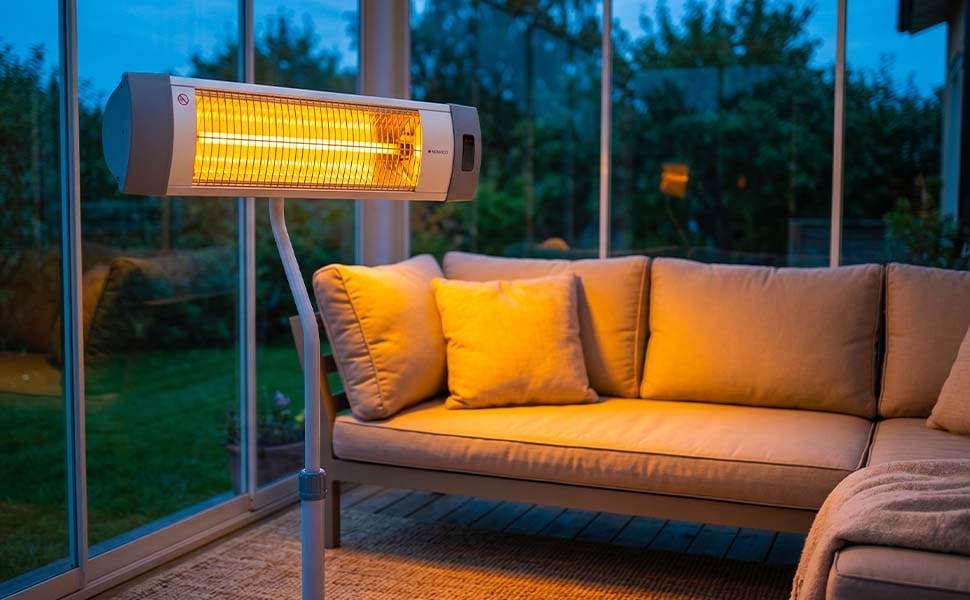
How the STAR V40 performs on a glazed balcony
The STAR V40 arrives with everything you need, with no accessories to buy and no installer to call. The stand is included. The remote control is included and adjusts power, timer and thermostat directly. The built-in thermostat function is particularly useful in a glazed space: you set the temperature you want, and the heater takes care of the rest.
The IP44 rating means the STAR V40 handles moisture and splashing in a wind-sheltered space such as a glazed balcony. It can stay in place overnight without harm, though it is worth bringing indoors during hard winter frost if you are not using it for an extended period.
The automatic tip-over switch cuts power immediately if the heater is knocked over, an extra layer of safety in a room where furniture tends to get moved around.
The STAR V40 weighs 3.85 kg and is easy to relocate. If you want to use the same infrared heater on your glazed balcony through autumn and winter and on the open patio in summer, a single unit does the job.
STAR V40 at a glance. 1,800 W across three power settings, remote control with timer and thermostat, adjustable stand, IP44, automatic tip-over safety switch, 3.85 kg. Carbon short-wave infrared radiation that converts more than 90% of energy into heat, according to the official datasheet.
Running Cost of Heating a Glazed Balcony
A glazed balcony needs less energy than an open balcony to hold a comfortable temperature, thanks to the insulating effect of the glazing. In practice, the STAR V40 runs on power setting 1 or 2 under most conditions, giving a running cost of roughly 1.20 to 2.40 kr per hour.
With the thermostat function active, the heater switches off once the target temperature is reached and starts again as it drops. This is a simple form of smart control that works without an app connection or a smart home system.
Heating a glazed balcony for three to four hours an evening typically costs 4 to 10 kr in electricity, depending on the outdoor temperature and whether the sun has warmed the glass during the day.
Worked example. A typical autumn evening in October on a mid-sized glazed balcony: the STAR V40 on power setting 2 (around 1,200 W) for four hours, with the thermostat stepping down to setting 1 (around 600 W) once it’s warm enough. Average consumption over the evening works out to around 900 W, at a cost of roughly 7 kr.
Based on Eurostat household electricity prices, H1 2025 (SE ~2.00 kr/kWh including network charges and tax). Actual cost varies with local prices and the power setting chosen.
Summary: how to heat a glazed balcony with the right technology
Heating a glazed balcony is straightforward once you choose the right technology and the right power level. The glazing does half the work for you. You don’t need a high-output heater running at full power all evening. You need an infrared heater with good power control and a thermostat that holds a steady temperature without wasting energy.
STAR V40 gives you 1,800 W across three levels, a built-in thermostat, and a remote control that lets you manage everything from your chair. It requires no installation, no holes in the wall, and no special preparation. You’re up and running the same day you bring it home.
With the right infrared heater, a glazed balcony stops being a space you use three months a year and becomes a room you live in for ten.
Buy STAR V40, see the product page for current price and stock status
If you have an open balcony instead, read our guide to infrared heating on a balcony. To understand why infrared technology works so well in Nordic outdoor settings, read how infrared heating works. For a broader buying guide, see outdoor infrared heaters.