
Buying Guide
Indoor Infrared Heating
How to Choose the Right Opranic Panel for Your Home
Indoor infrared heating works by heating people and surfaces directly instead of warming the air in between. The result is a room that feels comfortable at a lower thermostat setting, with no dust circulation and no wasted energy heating ceiling pockets nobody occupies. This buying guide explains the technology, compares the three Opranic panel series, and gives you the facts you need to choose the right model for your home. Straight information, based on infrared expertise since 2011.
The Principle
How indoor infrared heating replaces convection
A conventional radiator or convector heats the air in the room. The warm air rises to the ceiling, circulates, and eventually reaches you. The process is slow, uneven, and wastes energy on volume you do not occupy.
An indoor infrared heating panel works differently. It emits electromagnetic waves in the medium-wave infrared band (around 2.2 µm for Opranic panels) that travel through air without heating it. When the waves reach a surface, a wall, a floor, a person, the energy converts to warmth on contact. The room feels comfortable even though the air temperature is 2 to 3 degrees lower than with convection heating.
Because the air itself is not the heat carrier, there is no convection current stirring up dust. Humidity stays stable. And since walls and furniture absorb the heat and re-radiate it, the warmth lingers even after the panel switches off.
Read more about how infrared heating works.


Comfort
Instant warmth that stays after the panel switches off
An Opranic panel reaches operating temperature within minutes. There is no warm-up lag and no waiting for an entire air volume to heat up. You feel the difference from the moment the panel is switched on.
Equally important is what happens afterwards. Walls, floors, and furniture absorb the radiant energy and store it as thermal mass. When the panel cycles off, those surfaces continue to release warmth into the room. The result is a stable, even temperature without the on-off swings typical of convection systems.
This thermal-mass effect is one of the reasons indoor infrared heating can deliver the same perceived comfort at a lower air temperature, typically 2 to 3 degrees less than a conventional radiator would require for equivalent comfort.
The walls store the warmth. The air stays fresh. That is indoor infrared in one sentence.
Technology
Uniform heat distribution across the entire panel surface
Opranic indoor panels use high-quality heating resistors distributed across the full panel area, including the outer edges. The design eliminates hot spots and cold zones, producing an even surface temperature across the entire front face.
Behind the heating element sits multi-layer rear insulation that directs virtually all energy forward into the room. A panel mounted on an exterior wall will not heat the wall behind it; it heats you and the room in front of it.
The P6 Hybrid series adds a secondary convection channel that gently circulates a small volume of warm air along the wall surface, combining the benefits of radiant and convective heat in a single unit.

Indoor Climate
Allergy-friendly heating that reduces mould risk
Convection heaters create air currents that circulate dust, pollen, and allergens through the room. Indoor infrared heating produces no air movement at all. Dust stays where it is, and indoor humidity remains stable because the air itself is not being heated and dried out.
There is a secondary benefit for building fabric. Mould grows where warm, moist air meets a cold surface and condensation forms. Infrared panels raise the temperature of walls and ceilings directly, reducing the risk of condensation on those surfaces. In rooms prone to damp, such as bathrooms or poorly insulated bedrooms, this can make a measurable difference.
Research by Leeds Beckett and Salford Universities confirms that infrared heating can maintain comfort at lower air temperatures, with the caveat that panels should be positioned to irradiate key wall surfaces as well as occupants.
No dust in the air. No cold walls. No mould risk. Three problems solved by a single change in heating method.
The Range
Opranic Indoor Panels: Three Designs, One Goal
All three Opranic indoor panel series share the same engineering philosophy: even heat distribution, rear insulation that directs energy into the room, built-in overheating protection, and silent operation. What differs is the housing material, the heating method, and the design profile.
P5 Metal is the versatile workhorse: ultra-slim, available in four power levels, and suitable for every room. P6 Hybrid combines infrared and convection in a single unit for rooms that benefit from both. P7 Glass is the design statement: tempered glass, IP44 splash resistance, and a surface that doubles as a minimalist wall element. Below is a side-by-side comparison.
| P5 Metal | P6 Hybrid | P7 Glass | |
|---|---|---|---|
| Type | Infrared panel | Infrared + convection hybrid | Infrared panel (tempered glass) |
| Housing | Powder-coated metal, 2.5 cm | Metal, 4 cm | Tempered glass, ultra-slim |
| Colour | White | White | White or Black |
| Power options | 300 / 450 / 700 / 900 W | 550 / 900 W | 450 / 700 / 900 W |
| IP rating | IP44 | IP44 | IP44 |
| Mounting | Wall + ceiling | Wall | Wall |
| Overheating protection | Yes | Yes | Yes |
| Smart home compatible | Via external thermostat | Via external thermostat | Yes |
| Towel holder option | Yes (700 W / 900 W) | No | No |
| Best suited for | Any room, flexible use | Living spaces, offices | Design-focused rooms, bathrooms |
Product
P5 Metal: Ultra-slim, Versatile, Reliable
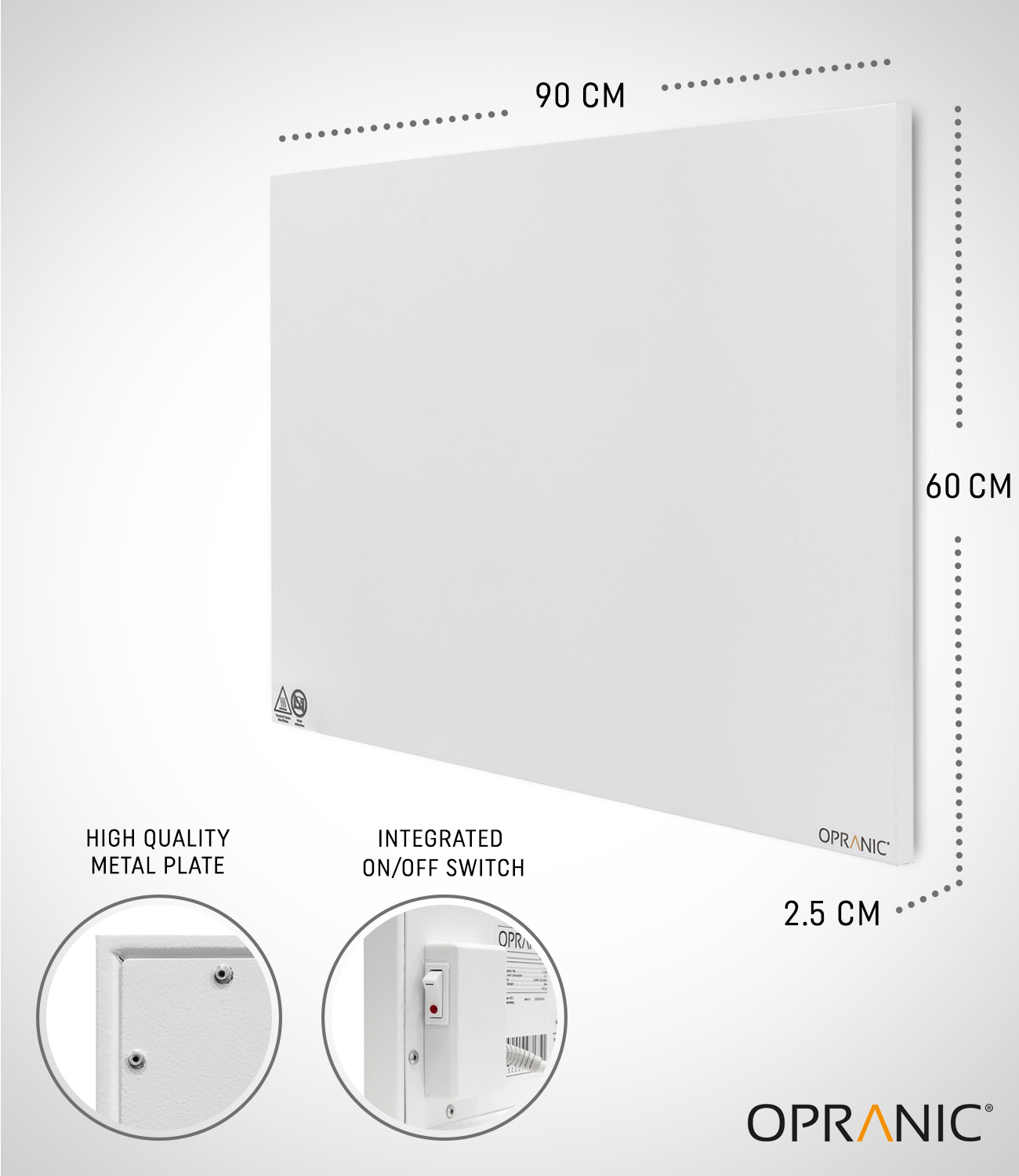
P5 Metal is the foundation of the Opranic indoor range. At 2.5 cm deep, it sits nearly flush against the wall or ceiling. The powder-coated metal housing is robust enough for daily use in any room, from living spaces to utility areas. Four power levels (300 to 900 W) cover everything from a small bathroom to a bedroom or home office.
Rear insulation directs heat forward. Built-in overheating protection switches the panel off automatically if the surface temperature exceeds safe limits. The 700 W and 900 W variants are available with an optional towel holder, making the P5 a practical two-in-one solution for bathrooms.
- Power
- 300 / 450 / 700 / 900 W
- Mounting
- Wall + ceiling
- IP rating
- IP44
- Housing
- Powder-coated metal, 2.5 cm
- Overheating protection
- Yes
- Towel holder
- Optional (700 W / 900 W)
- Colour
- White
Product
P6 Hybrid: Infrared and Convection in One Unit
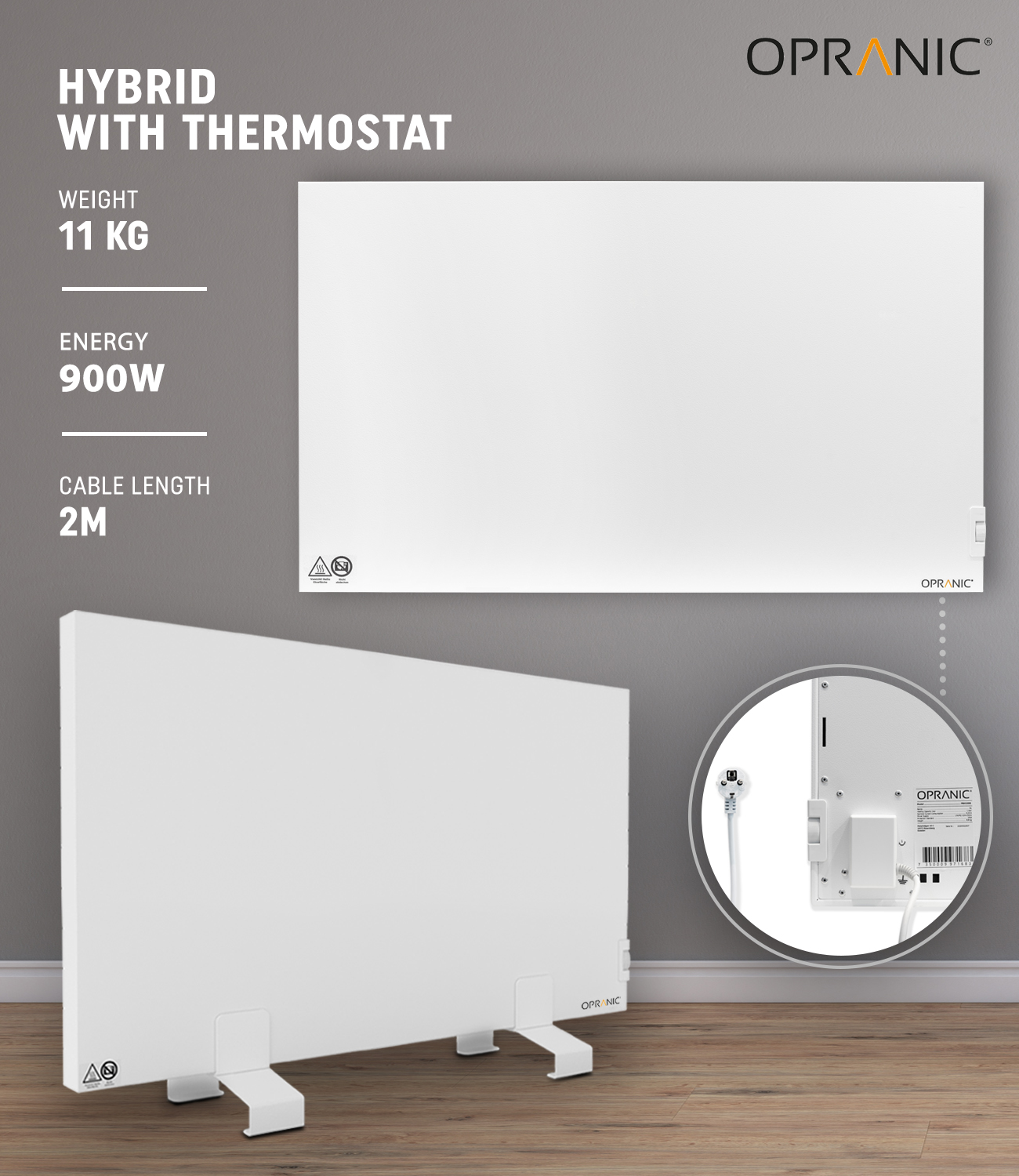
P6 Hybrid combines two heating methods in one housing. The front surface emits infrared radiation that heats people and objects directly. A secondary convection channel along the rear gently warms a thin layer of air that rises along the wall, adding a mild background warmth to the room.
The dual approach makes the P6 particularly effective in living rooms and offices where occupants move around and benefit from both direct radiant comfort and a slightly warmer ambient air temperature. The 4 cm metal housing is wall-mounted and available in 550 W and 900 W.
- Power
- 550 / 900 W
- Mounting
- Wall
- IP rating
- IP44
- Housing
- Metal, 4 cm
- Heating method
- Dual: infrared + convection
- Overheating protection
- Yes
- Colour
- White
Product
P7 Glass: Design Statement with IP44 Protection
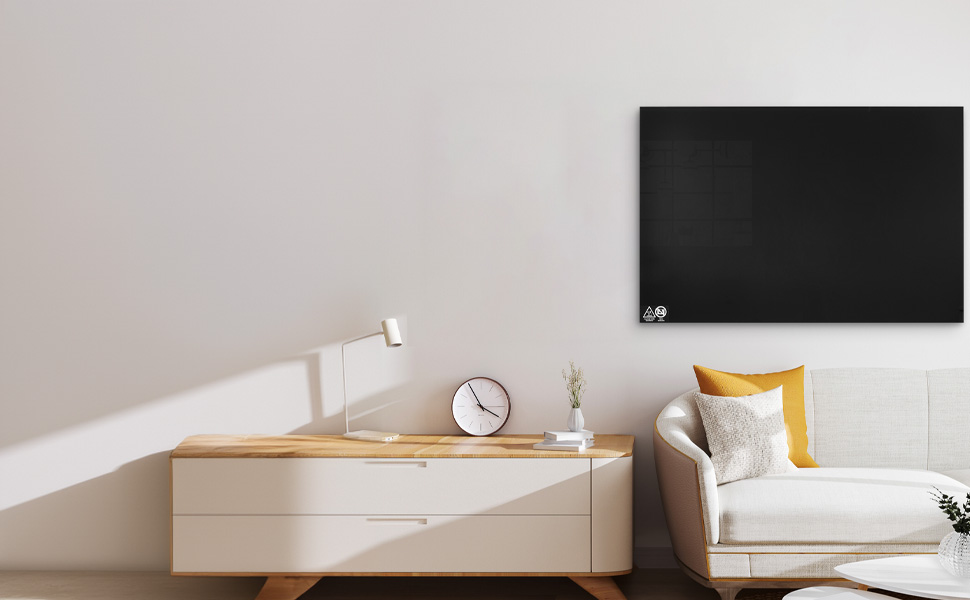
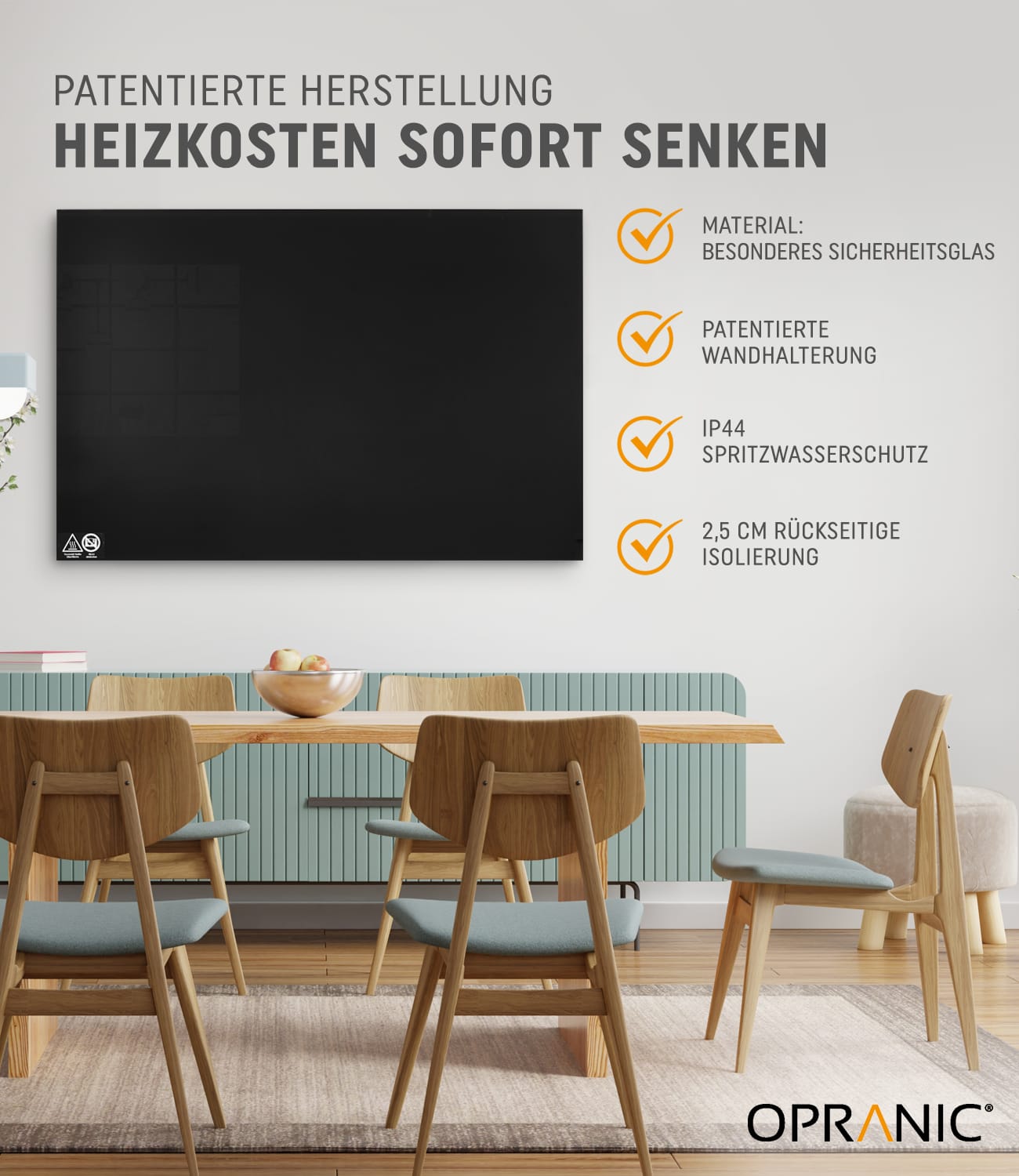
P7 Glass encloses the heating element behind a tempered glass front that is smooth, easy to clean, and available in black or white. The flat surface reads as a wall panel rather than a heater, making the P7 a natural fit for design-conscious spaces.
IP44 splash resistance means the P7 is approved for use in bathrooms and other humid areas. Smart home compatibility is built in, allowing the panel to be controlled via an external thermostat or integrated into home automation systems. Three power levels (450, 700, and 900 W) cover rooms from 5 to 18 m².
- Power
- 450 / 700 / 900 W
- Mounting
- Wall
- IP rating
- IP44 (splash-resistant)
- Housing
- Tempered glass, ultra-slim
- Smart home
- Compatible
- Overheating protection
- Yes
- Colour
- White or Black
Same engineering philosophy. Three housing designs. Choose the one that fits your room.
Swedish Engineering
Infrared specialists in Stockholm since 2011
Opranic is a Swedish company with offices in Stockholm. The founders have worked with carbon infrared heating since 2011, first as resellers, then as designers and producers of their own technology. The Opranic brand was launched in 2015.
Every heater in the range is engineered in-house. Opranic develops and manufactures its own key components, which means full control over heat distribution, insulation, safety systems, and build quality. The result is products that deliver what the specification sheet promises, year after year.
Read more about why Opranic.

Efficiency
Lower air temperature, same comfort, reduced energy use
Because infrared panels heat surfaces and people directly, the air temperature needed for the same perceived comfort is lower. Multiple independent sources report that infrared-heated rooms can feel comfortable at 2 to 3 degrees below the thermostat setting that a convection system would require. In practical terms, that difference translates to measurable energy savings over a heating season.
The saving is context-dependent. It is largest in rooms with high ceilings, poor insulation, or frequent door openings, where convection systems lose heat fastest. In well-insulated modern homes, the advantage lies more in zonal heating: heating the rooms you use, when you use them, rather than maintaining a baseline temperature throughout the house.
A study by Leeds Beckett and Salford Universities, published via GOV.UK, examined indoor infrared heating in residential settings and confirmed the lower-air-temperature comfort thesis. The researchers note that positioning matters: panels should cover key wall surfaces as well as seating areas for optimal results.
Summary
Which Indoor Panel Suits You?
If you want a slim, affordable panel that works in any room and mounts on the wall or ceiling: choose P5 Metal. If you want a single unit that combines radiant and convective heat for living rooms or offices: choose P6 Hybrid. If you want a premium glass panel with smart home compatibility and bathroom approval: choose P7 Glass.
All three series deliver efficient, silent, allergy-friendly indoor infrared heating. The choice comes down to room type, design preference, and budget. Use the Opranic power calculator to find the right wattage for your room size.