
Technology & Science
How infrared heat works
From the electromagnetic spectrum to the skin on your cheek, the physics behind a well-engineered radiant heater
Infrared heat travels as electromagnetic radiation in straight lines from its source, converting to warmth only when absorbed by skin, clothing, or another surface. It is the same principle that warms you when you stand in winter sunshine, and the same principle that industry has relied on for decades to cure paint, heat plastic preforms, and sterilise packaging. What separates a well-engineered radiant heater from an average one has less to do with power output and more to do with the wavelength at which radiation is emitted. This page examines in detail why wavelength is the most underestimated parameter in radiant heating, and why a heating element with a peak emission at 2.2 µm delivers measurably better comfort than one peaking at 1.0 or 1.2 µm.
Where infrared sits in the electromagnetic spectrum
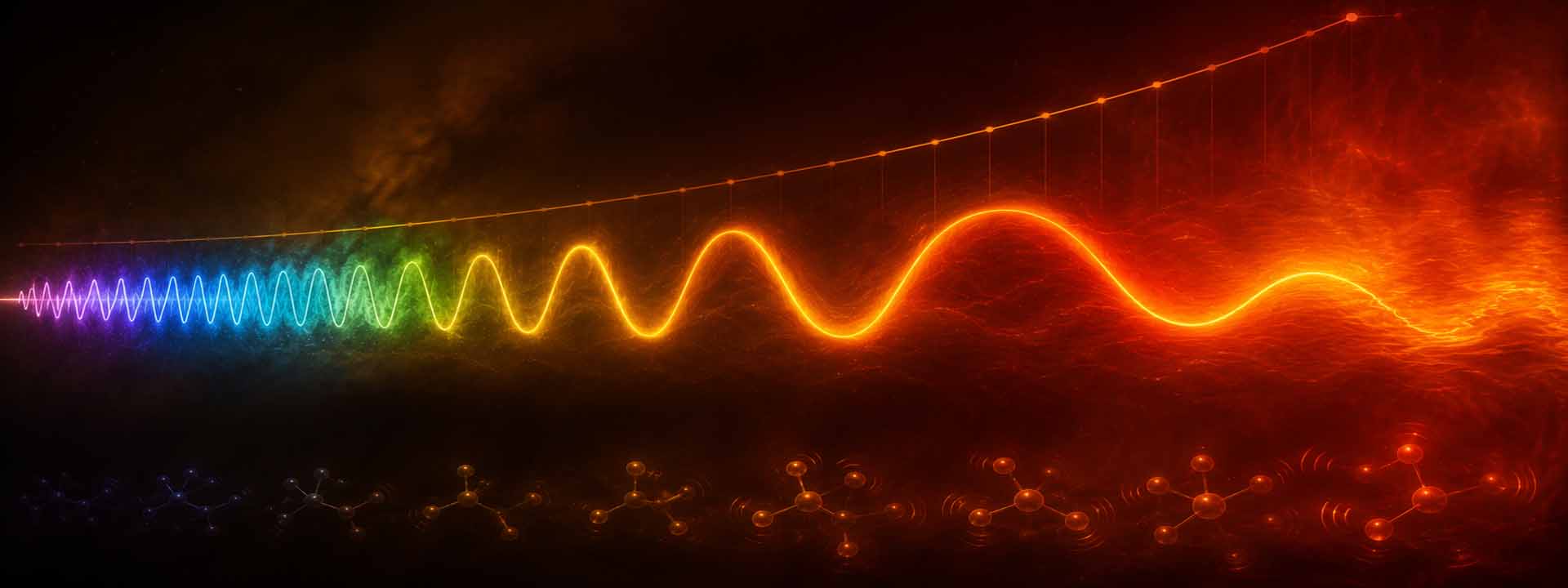
Infrared occupies a low-energy region of the spectrum, the same family as the warmth from an open fire. How it interacts with matter is determined entirely by wavelength, not by power output.
- Infrared spans a wide range with markedly different behaviour across it
- Determines how radiation meets matter
- The discovery on which all radiant heating is founded
Spectral band · Opranic IR‑X
IR‑B 2.2 µm
Between the UV range and microwaves lies the benign radiation family that warms the human body. Opranic operates in the middle of the IR‑B band.
The electromagnetic spectrum
Click on a band to learn more
Click on a band above to learn what happens there.
Infrared radiation sits between microwaves and visible light, in the low-energy, non-harmful part of the spectrum. It belongs to the same family of radiation as the warmth from the sun and a campfire.
The electromagnetic spectrum is a continuous scale of radiation stretching from the longest radio waves, measured in kilometres, to the shortest gamma rays, shorter than a billionth of a millimetre. All of these are the same fundamental phenomenon, electromagnetic waves, but wavelength determines everything about how they behave. Radio waves pass harmlessly through walls. Visible light reflects off coloured surfaces. High-energy X-rays penetrate soft tissue. Wavelength governs how radiation interacts with matter and whether it produces any biological effect at all.
Infrared radiation sits immediately beyond the red end of the visible spectrum, which is precisely where the name comes from. The prefix infra derives from the Latin for below, so infrared denotes radiation at wavelengths just above those of red light, but far below those of microwaves. The visible spectrum runs from roughly 0.4 micrometres at the violet end to 0.7 micrometres at deep red. Where red ends, infrared begins, continuing up to around 1,000 micrometres. One point is worth stating clearly: infrared radiation belongs to the low-energy, biologically benign part of the spectrum, the same family as the warmth from a fire or spring sunlight on your skin. It differs fundamentally from high-energy radiation such as ultraviolet, X-rays, and gamma rays, all of which carry enough energy per photon to break chemical bonds in DNA. Infrared photons carry nothing like that energy. What they do is set molecules into vibrational motion, and it is precisely that vibration that we perceive as warmth.
Saying that a heater emits infrared radiation says very little about how it actually behaves. It is rather like describing a radio transmitter as broadcasting on radio frequencies without specifying whether it is FM or long wave. The infrared band is wide enough that radiation from different parts of it interacts with the human body in meaningfully different ways.
Infrared radiation was first identified by the German-born astronomer William Herschel in 1800. Dispersing sunlight through a prism, he measured the temperature across each colour of the resulting spectrum. He found, to his considerable surprise, that the thermometer reached its highest reading just beyond the visible red, in a region with no colour at all. It was the first evidence that the sun’s radiation extends beyond what the eye can detect, and that these invisible rays carry thermal energy. More than 220 years later, the entire field of radiant heating rests on that observation.
Every object with a temperature above absolute zero, minus 273.15 degrees Celsius, emits some form of electromagnetic radiation. An extremely cold object emits only a faint signal, but the emission is real. The human body at 37 degrees continuously radiates infrared energy into its surroundings, a property that thermographic cameras exploit to detect heat loss in buildings or fever in patients. When you feel the warmth from an oven door at a distance, without touching it, what you are sensing is infrared radiation. It is the standard mechanism by which thermal energy moves between bodies.
Read our introduction to what infrared heat is and the sunshine principle behind the technology.
The source temperature determines the wavelength.
Wien’s displacement law ties temperature to wavelength. The hotter the source, the shorter the dominant spectrum. At 1,300 K, the peak falls at 2.2 µm.
- Temperature locks the dominant wavelength
- Opranic’s carbon element peaks within IR-B
- Higher power shifts the entire spectrum
Wien’s law · λmax = b / T
2.2µm
Peak output at T ≈ 1,320 K (~1,050 °C surface temperature). A halogen element reaches 1.2 µm at 2,500 K. Every emitter is locked to its operating temperature.
Wien's displacement law
Temperature determines wavelength: click on a peak to compare
The same law of nature governs every radiation source. The sun at 5,800 K peaks in visible light, the halogen lamp at 2,500 K in IR-A, the Opranic IR-B emitter at around 1,320 K at 2.2 µm. Wavelength is coupled to temperature.
This is one of the most widely misunderstood aspects of radiation physics. Many assume it is possible to build a short-wave source that simply runs at lower power, or a long-wave source that is pushed harder to deliver more heat. Neither is correct. The wavelength of the emitted radiation is physically bound to the surface temperature of the source, through a relationship the German physicist Wilhelm Wien established in 1893.
Wien’s displacement law states that the wavelength at which a heated body emits maximum radiation is inversely proportional to its absolute temperature. In plain terms: the hotter the source, the shorter the dominant wavelength. This is why a heat source glowing red has a longer dominant wavelength than one glowing yellow or white. A blacksmith heating iron sees it move from a dull red at around 800 °C, through orange-red at 1,000 °C, to yellow at 1,300 °C, and finally to white above 1,500 °C. The material is unchanged; the spectrum shifts towards shorter wavelengths as the temperature rises.
For a radiant heater, this means that the design of the heating element, the material chosen, and the temperature at which it operates together lock the manufacturer to a specific spectral profile. A halogen heater with a tungsten filament glowing at roughly 2,200 °C has its peak output at around 1.2–1.4 µm. That cannot be changed. A carbon-based element of the type Opranic uses operates at a surface temperature of around 950–1,050 °C at full power, placing its peak squarely in the optimal range at around 2.2 µm. The technology and the temperature define the spectrum together.
Mathematically, Wien’s displacement law expresses the peak wavelength in micrometres as approximately 2,898 divided by the temperature in Kelvin. A few concrete examples: the sun has a surface temperature of around 5,800 K, giving a peak wavelength of around 0.5 µm, in the yellow-green region of visible light. It is no coincidence that the human eye is most sensitive to green; we evolved under the solar spectrum. A halogen filament at 2,500 K peaks at around 1.16 µm. A carbon or NiCr IR-B emitter at around 1,320 K peaks at 2.2 µm. A ceramic long-wave panel at 600 K peaks at 4.8 µm. And a warm interior wall at 300 K peaks at nearly 10 µm.
The same principle explains why an infrared source cannot be made more effective simply by increasing its power input. If more current is supplied to a long-wave source to extract more heat, its surface temperature rises and the spectrum shifts towards shorter wavelengths; the product changes character. Equally, if the current to a short-wave emitter is reduced to lower its intensity, the surface temperature falls and the spectrum shifts towards longer wavelengths, though nowhere near enough to constitute true mid-wave output. Emitter elements are engineered around a narrow operating temperature; deviating from it introduces compromises in both lifetime and spectral quality.
For a consolidated buying guide comparing our models side by side, see infrared heaters for outdoor use.
Where radiation goes in the skin.
IR-A penetrates 3–5 mm and can feel sharp. IR-B (Opranic) is absorbed precisely where the thermal receptors lie. IR-C stops at the clothing.
- IR-A penetrates deep; IR-C stops at the surface
- IR-B is absorbed where the thermal receptors sit
- Medium-wave meets skin and heat perception
IR-B in skin · depth
0.3mm
Precisely the depth at which thermal receptors are most densely concentrated. IR-A passes beyond them; IR-C is stopped by clothing.
Infrared wavelengths and water absorption
Select IR-X power level
Power
100 %
Heating element
1.050 °C
Peak wavelength
2,2 µm
Opranic IR-X operates with continuous voltage regulation; as a result, the temperature of the heating element and the wavelength of the radiation shift with the selected power level. Click the buttons above to see how IR-X traverses the optimal water absorption range, from 2.2 µm at P5 to 2.7 µm at P1. The curves are calculated according to Planck's radiation law.
The infrared region is conventionally divided into three principal bands. The classification reflects how radiation behaves when it meets matter, and human tissue in particular.
Short-wave infrared, IR-A, spans 0.78 to 1.4 micrometres and requires very high-temperature sources with surface temperatures above 1,700°C. The sun is the natural example; halogen lamps and short-wave emitters are the artificial equivalents. Medium-wave infrared, IR-B, falls between 1.4 and 3 micrometres and is produced by sources in the 600–1,700°C range. Opranic’s IR-X Carbon Black operates in this band, with a peak emission of 2.2 µm at full power. Long-wave infrared, IR-C, extends from 3 micrometres up to 1,000 micrometres and originates from cooler sources: ceramic panels, heated surfaces, the human body itself. The boundaries at 1.4 and 3 micrometres follow ISO 20473 and are conventions rather than sharp physical thresholds, but they capture a genuine difference in behaviour.
When an infrared beam strikes the skin, three things happen simultaneously: a portion is reflected back into the surrounding space, a portion is transmitted deeper into the tissue, and a portion is absorbed and converted to heat. The distribution between these three outcomes depends entirely on wavelength. That is where the choice of technology acquires its practical significance for anyone who wants to sit comfortably on a terrace on a cold autumn evening.
The outermost layer of skin, the stratum corneum, is roughly 10–20 micrometres thick and consists of dead keratin cells and lipids. Beneath it lies the epidermis, approximately 100 micrometres deep, and below that the dermis, which contains blood vessels, nerve endings, and the thermosensitive receptors responsible for perceiving warmth. For radiation to generate a comfortable sensation of heat, it must be absorbed at the right depth: far enough to reach the dermis where the receptors sit, but not so far that it passes straight through without warming anything of consequence.
Short-wave IR-A, from 0.8 to 1.4 micrometres, has high transmission through skin. A significant proportion of the radiation passes straight through the epidermis and can reach several millimetres into the dermis and subcutaneous tissue. At the same time, skin reflects up to half of short-wave radiation back into the air. The net result is that energy transfer per incident watt is less efficient for comfort heating, despite the deep physical penetration. It is precisely this deep penetration that can feel sharp or prickling at high doses from artificial sources at close range: the radiation reaches layers beneath the skin and generates heat there without directly activating the superficial thermal receptors.
Medium-wave IR-B, around 2–3 micrometres, behaves differently. Skin reflectance is considerably lower in this band, and absorption is high in the uppermost skin layers where thermal receptors are most densely concentrated. The radiation penetrates no deeper than approximately 1 mm, but that is precisely where it needs to be absorbed to produce a comfortable sensation of warmth without burning the surface. The circulatory system then distributes the heat through the body in a natural and gradual way.
Long-wave IR-C, above 3 micrometres, is absorbed almost entirely within the outermost skin layers, often within less than 0.1 mm. The result is a sensation of surface warmth that is perfectly agreeable indoors, but outdoors the intensity from long-wave sources is generally too low to provide any meaningful comfort against wind and cold.
The absorption profile of medium-wave radiation coincides with the anatomy of human skin in a way that is not coincidental. The thermal receptors in the epidermis and dermis sit at exactly the depth at which IR-B radiation is absorbed efficiently, while IR-A passes beyond them and IR-C is arrested in the dead surface cells before any signal reaches the nervous system. For a radiant heater intended for human use, the IR-B band is therefore the functional sweet spot where radiation, skin, and heat perception converge.
IR-B is also well established in physiotherapy and is used in medically approved heat sources for newborns in neonatal units. Infrared radiation is not an exotic technology; it is a thoroughly characterised form of heat with a well-understood emission and absorption profile.
The body is mostly water.
Water molecules peak in absorption at 1.9 and 3.0 µm. Between them lies a sweet spot at 2.2 µm: high absorption without discomfort.
- The body’s water content governs absorption
- 2.2 µm weighs absorption against power density
- Lower output shifts the peak towards 2.7 µm
Body water content · adult
80%
The human body is largely water. That means water’s absorption spectrum is, in effect, the body’s absorption spectrum.
Three technologies compared
When we talk about how infrared radiation warms a person, we are really talking about how it warms water. The adult human body is approximately 60–70% water by mass. Every skin cell, every blood vessel, every muscle fibre contains water, and that water dominates how the body interacts with electromagnetic radiation in the infrared range.
Water’s absorption curve is well characterised, and it is anything but flat. It has distinct peaks and troughs. Water absorbs poorly at visible wavelengths and at the shorter IR-A wavelengths around 1 µm, which is why the ocean is transparent to visible light and why short-wave radiation transmits readily through skin. Around 1.45 µm, absorption begins to rise sharply. Between 1.9 and 3.0 µm lies an absorption band so strong that a water film only a few tenths of a millimetre thick will absorb almost all incident radiation. The absorption peak itself sits at around 2.9–3.0 µm.
A subtle but important question follows: if 3.0 µm is the absorption peak, why does an optimised heating element emit at 2.2 µm rather than 3.0 µm? The answer lies in balancing two competing requirements.
On one side, you want the radiation to be absorbed by water in the skin, which argues for a longer wavelength. On the other, the source must produce sufficient power density to feel genuinely warm in wind and cold, which argues for a shorter wavelength where the emitter surface temperature is higher, as Wien’s displacement law dictates. At 2.2 µm on full output, these demands meet most favourably. Water absorption remains high, while power density is sufficient for commercial outdoor use.
At lower output levels, the emission peak shifts towards longer wavelengths, moving closer still to water’s absorption maximum and producing a softer thermal sensation. The interactive graph above shows how the peak wavelength moves between 2.2 and 2.7 µm as output level changes. This entire range sits within a window where skin reflectance is low, as discussed in the previous section, giving a double optimisation: against both the outer skin layer and the water molecules within the tissue.
At wavelengths above 3 µm, the emitter surface temperature falls low enough that power density drops sharply. Power density is the quantity of watts per square metre of radiating surface, and it follows directly from the Stefan-Boltzmann law: radiated power per unit area scales with the fourth power of temperature. An emitter at 400 °C radiates less than one-sixth of the power per unit area of an emitter at 900 °C.
Long-wave IR-C therefore performs well indoors, where moderate power density is sufficient and there is no wind to contend with, but it is inadequate for open terraces where convective cooling is high.
In severely wind-exposed environments and at very low ambient temperatures, a short-wave emitter with high power density can feel more immediately intense than a mid-wave emitter at the same distance. This is not because short-wave radiation is better suited to the skin; it is because the emitter surface temperature is so high that raw watts per square metre overwhelm any absorption optimisation. The trade-off is poorer skin habituation, a higher proportion of reflected energy, and a sensation that tends to feel harsh and prickling over prolonged exposure.
For well-designed outdoor spaces with moderate wind protection, a mid-wave IR-B emitter with a peak around 2.2 µm is almost always the more balanced choice, both for comfort and for long-term skin wellbeing. Short-wave is a legitimate option in extremely wind-exposed, industrial-grade environments with short exposure times, but it represents a deliberate compromise in skin comfort in exchange for raw power density.
Vibrations become heat.
Radiation excites vibrational modes in molecules. The energy converts directly into thermal motion, without heating the air in between.
- Heat is only produced when radiation is absorbed
- Water molecules vibrate and warm
- Heats bodies and surfaces, not the air between them
Conversion efficiency · IR‑X to radiant heat
96%
Every watt drawn from the wall converts directly into radiant heat. No moving parts, no losses to air circulation.
A common misconception is that infrared radiation is itself heat travelling through space. It is not. Infrared is electromagnetic energy propagating as waves, and heat is only produced once that energy is absorbed by matter and converted into molecular motion. This distinction is the foundation of radiant heating technology, and it explains why radiant heat behaves so differently from convection heating.
Every molecule consists of atoms held together by chemical bonds. Those bonds behave like small springs, allowing atoms to oscillate around their equilibrium positions. Each molecule has specific vibrational frequencies determined by its structure. When an electromagnetic wave arrives at a frequency that matches one of a molecule’s natural vibrational frequencies, energy transfers resonantly and the molecule begins to vibrate more intensely. This process, vibrational resonance, is the mechanism by which infrared radiation becomes heat.
The water molecule, H2O, has three principal vibrational modes: symmetric stretching, asymmetric stretching, and bending of the hydrogen-oxygen bond angle. These modes have resonant frequencies corresponding to wavelengths of approximately 2.7, 2.9, and 6.3 micrometres. This is why water absorbs so strongly in the 2–3 micrometre band: the incoming infrared waves match the molecule’s own vibrational frequencies, and energy transfer is highly efficient. When a water molecule vibrates more intensely, that increased molecular motion is precisely what we define as a higher temperature. The energy has moved from an electromagnetic state into thermal energy within the material.
This also explains why infrared radiation can warm a surface without warming the air in between. The principal components of air, nitrogen and oxygen, are homonuclear molecules with very few vibrational modes that fall within the infrared spectrum. Nitrogen absorbs almost nothing in the band where comfort heaters operate. Radiation therefore passes through air with negligible loss until it reaches a water-bearing surface — a person, a plant, a timber floor — where it is absorbed and becomes heat.
One elegant consequence is that the air between the heater and you remains relatively cool even when the warmth within the radiant field is genuinely comfortable. One practical nuance deserves emphasis here. The infrared radiation itself is unaffected by wind, because it travels in straight lines regardless of air movement. The skin, however, simultaneously loses heat to the surrounding air through convection, and that convective loss increases sharply with wind speed — the same principle that makes a breezy day feel far colder than a still day at the same air temperature. In windy conditions, higher radiant intensity or a shorter working distance is needed, not because the radiation is degraded, but because the body is losing more heat to the moving air. This is a significant distinction from convection heaters, which are rendered largely ineffective in wind. A well-positioned radiant heater continues to deliver warmth even in a breeze; it simply needs to supply a little more energy to offset the increased heat loss from the skin.
Carbon dioxide and water vapour in the air do make a small difference. These molecules have vibrational modes in the infrared range and absorb certain portions of the spectrum — the same property responsible for the atmospheric greenhouse effect. Over the distances involved in a typical application, however, a few metres at most, this absorption is entirely negligible. In practice, radiation reaches you essentially undiminished.
The same physics industry has relied on for decades.
IR-B drives PET forming, plastics processing, food sterilisation, and paper drying. Opranic applies that industrial knowledge to comfort heating.
- The same physics that dries paint and forms PET
- Wavelength is chosen to match the material
- Decades of industrial technology applied to comfort heating
Industrial IR · years in use
60+ years
Medium-wave IR is not a new phenomenon. It has been standard technology in process industries since the 1960s.
The same physical principle determines the choice of IR band in industry as on the terrace. IR-B at around 2.2 µm matches the resonance frequency of OH bonds in organic materials; water, plastic, paper, and human skin respond in an identical manner.
It would be easy to dismiss the discussion of wavelength and absorption as academic. It is not. The same wavelength selection that makes 2.2 µm optimal for human comfort heating makes other wavelengths optimal for entirely different industrial applications. IR technology is deployed at scale to dry paint, form plastic bottles, sterilise packaging, cure adhesives, and much more. In every case, the wavelength is chosen to match the specific material being heated.
Plastics, for example, absorb infrared radiation primarily above 2 µm. Thin plastic film for food packaging absorbs short-wave radiation from halogen lamps very poorly, but absorbs medium-wave efficiently. This is precisely why modern PET bottle-forming machines use medium-wave IR to heat preforms before blow moulding. Textiles, paper, and timber — all organic materials containing water or OH bonds — absorb most effectively in the same band as human skin, because they share molecular structures similar to water and other vibration-sensitive bonds.
Short-wave radiation is used industrially where the requirement is to heat thick, pigmented materials that absorb across a broad range of wavelengths: steel sheet, dark rubber, or automotive body panels, for instance. There, the high intensity and deep penetration of short-wave energy are exactly what is needed. For a terrace where people are sitting outdoors, the requirement is the opposite: energy should be retained at the surface of the skin, not driven deep into tissue. Using a short-wave emitter for comfort heating is, from an engineering standpoint, much like selecting an industrial plastics-curing lamp because you want to read by it.
Heraeus, one of the world’s leading manufacturers of industrial IR systems, publishes technical data that reflects precisely the same physics Opranic applies on the consumer side. When a business owner installs an Opranic heater on their outdoor terrace, the optical principles at work are the same ones heating PET bottles in a German factory or drying printing ink on a Belgian press — applied, in this case, to an outdoor setting and the human body.
Assessed by international expertise.
ICNIRP has established exposure limits for infrared radiation. Comfort levels sit well within those limits. Mid-wave infrared is inherently safer than short-wave.
- Lacks the energy to damage DNA
- International safety thresholds with substantial margin
- Mid-wave spares deeper tissue
Margin to ICNIRP limit
3.3×
At 1.5 m, Opranic operates at roughly one third of the skin exposure limit. Mid-wave infrared is absorbed entirely within the outermost layer of the skin.
The International Commission on Non-Ionizing Radiation Protection, ICNIRP, is the global reference authority for safety guidelines covering electromagnetic radiation below ionising levels. Its exposure limits are used as the regulatory benchmark by national health authorities worldwide, and its guidelines on infrared exposure are well established.
Infrared radiation sits in the non-ionising portion of the electromagnetic spectrum. That means its photons carry insufficient energy to break chemical bonds in DNA, which is a fundamental distinction from ultraviolet radiation, which is ionising and can cause skin cancer at elevated doses. Infrared at comfort levels has no such mechanism. The only safety parameters ICNIRP addresses are thermal effects: the question of whether skin or eye tissue might be overheated by excessive irradiance.
For a typical installation, the irradiance from a correctly mounted heater, such as a PRO V70 at 2.5 m, falls well below the ICNIRP thresholds set for several hours of daily exposure. Product geometry, mounting distance, and power distribution work together to ensure this. Eye safety is equally well documented. Whereas looking directly into a very hot short-wave source at close range can cause discomfort, the diffuse radiation from a correctly installed mid-wave heater at comfort levels has been assessed as safe for normal use.
There is a subtle physical advantage to mid-wave infrared at 2.2 µm with respect to ocular exposure. At those wavelengths, absorption by the anterior structures of the eye, the cornea and aqueous humour, is very high. Radiation therefore penetrates far less deeply into the eye than short-wave IR-A does. Short-wave IR-A, in the 0.8–1.4 µm band, passes through the cornea and can reach the retina at substantially higher intensity, which is one reason ICNIRP applies stricter limits to short-wave exposure. In practice, all comfort-heating scenarios are far removed from these thresholds, but as an engineering principle it is rational to favour a technology that sits naturally on the safer side of the spectrum.
On the question of skin health, there has been scientific discussion in recent years about whether intense IR-A exposure may contribute to oxidative stress and collagen degradation. The evidence is not settled. Dermatological consensus holds that the sun’s natural IR-A is not harmful at normal doses, and infrared radiation has been used in medical wound-healing and skin-care applications for decades. Some studies do suggest, however, that artificial short-wave sources at close range can generate free radicals in the deeper layers of the skin. This is a further reason to favour mid-wave at 2.2 µm for comfort heating. Radiation at that wavelength is absorbed within the outermost millimetre of the skin and does not penetrate to the fibroblasts of the dermis in the same way.
Luleå University of Technology, under arctic conditions.
An independent study at LTU confirmed that medium-wave IR delivers more even, comfortable warmth than short-wave at equivalent power output.
- Independent study, 2019
- Published, openly accessible research
- Even warmth without hot spots
Preferred medium-wave IR
100%
Every participant rated IR-B as more even and comfortable than IR-A at identical power output, tested under real outdoor conditions.
Infrared radiation for de-icing wind turbine blades under Arctic conditions
Longer wavelengths are more effective at confining energy to the surface, as absorption is higher in this spectral range. A combination of infrared heaters with different wavelengths delivers a broader spectrum and therefore a more efficient result.
Conclusion, Journal of Wind Engineering and Industrial Aerodynamics, 2019
In April 2019, an independent experimental study was conducted at Luleå University of Technology in collaboration with Vattenfall’s research and development division. The objective was to determine whether infrared radiation could be used to de-ice wind turbine blades under arctic conditions, a problem that costs the Scandinavian wind energy industry significant production losses every winter. Opranic supplied the radiation sources for the study: two distinct types, IR-X emitters with a peak output at 2.4 micrometres and halogen emitters with a peak output at 1.4 micrometres.
The study was published in the Journal of Wind Engineering and Industrial Aerodynamics and is openly available as peer-reviewed research. Tests were carried out in climate chambers at the Arctic Falls facility in Piteå, where ambient temperature could be controlled between 0 and minus 30 degrees Celsius. Blade surfaces were coated with soft rime frost using snow machines, then heated using various combinations of IR emitters at distances of 1.0 and 1.5 metres.
The results are technically significant and confirm several principles that Opranic has built its products on for over 20 years. First, the study showed that a combination of IR-X and halogen emitters produced the most effective de-icing result at 1.5 metres, with a melt rate of 0.20 kg of ice per minute. IR-X emitters alone at the same distance achieved 0.13 kg per minute. Second, the study demonstrated that the IR-X emitter produces a broader heat distribution, while the halogen produces more concentrated heat, precisely as Wien’s law and radiation physics predict. Third, and this is the finding most relevant to comfort heating, the researchers concluded that longer wavelengths are more effective at depositing energy into a surface, because absorption is higher across that part of the spectrum.
One additional observation deserves attention. At the shorter distance of 1.0 metre, surface temperatures on the blade rose high enough to risk overheating. At 1.5 metres, even heat distribution was achieved without that risk. The lesson transfers directly to comfort heating: the distance between an infrared heater and the people beneath it matters, and a unit positioned at the correct height delivers consistent warmth without hot spots.
The study also noted an interesting difference in how the two wavelengths performed against different ice types. The IR-X emitter at 2.4 micrometres was more effective against light snow and rime frost, whose porous crystal structure contains a high proportion of air and less densely packed water. The halogen emitter at 1.4 micrometres performed marginally better against clear glaze ice, which has a different optical structure. The combination of both achieved the best overall performance, with the two wavelengths addressing the distinct absorption characteristics of each ice type. It is an elegantly engineered solution, built on a precise understanding of wavelength’s role.
The researchers’ closing statement in the publication is worth highlighting: a combination of two types of infrared emitter operating at different wavelengths produces a broader spectrum and therefore more effective de-icing, outperforming any combination of a single emitter type alone. For a comfort heater, the conclusion is that a well-engineered medium-wave emitter delivering a moderately broad spectrum centred around 2.4 micrometres represents a technically well-balanced choice, neither so narrow that it misses adjacent wavelengths, nor so broad that energy is lost on wavelengths where skin and water absorb poorly.
How to read a product specification.
Check the stated peak emission wavelength, not just the wattage. Where the energy is delivered matters more than how much is drawn from the wall.
- Look for the spectrum peak in micrometres
- Carbon mid-wave for outdoor use
- Reflector and housing determine comfort
When you are evaluating an infrared outdoor heater, wavelength is rarely the first thing a product page highlights, yet it is the most important figure to find. The following framework is grounded in the physics covered throughout this article.
First, look for a stated spectrum peak or dominant wavelength. A manufacturer that understands and stands behind its technology will specify that the emitter peaks in the IR-B band, ideally with a precise figure in micrometres. If the specification lists only wattage, or uses phrases such as “warm heat” or “deep-heating” without numerical support, there is no technical basis on which to evaluate the product. That is not necessarily a warning sign, but it provides no data for an informed decision.
Second, identify the emitter technology. Halogen and short-wave quartz elements operate in the IR-A band, with a peak broadly between 1.0 and 1.4 µm. They are appropriate where rapid heating of dense materials is required, or in severely exposed environments where raw power density takes precedence over absorption quality. Carbon and NiCr-based emitters operate in the mid-wave region around 2.0–2.5 µm and are engineered for comfort, with skin absorption and long-term wearability as the primary design criteria. Ceramic and far-infrared emitters operate in the long-wave region above 3 µm and are well suited to indoor applications where wind and large volumetric losses are not a factor.
Third, consider the system around the emitter. The geometry, material, and surface finish of the reflector determine how much of the radiated energy is directed towards you and how much is dissipated sideways or upwards. A technically correct IR-B element paired with a poorly designed reflector will deliver less comfort than a well-engineered system using the same element. Opranic has spent more than 20 years developing emitter, reflector, housing, and electronics as a single integrated system.
Fourth, account for the installation environment. For sheltered patios, restaurant terraces, and residential gardens, a mid-wave IR-B radiant heater is almost always the strongest choice, both for immediate comfort and for skin health over extended use. For heavily exposed industrial environments with short dwell times, such as open port facilities or exposed rail platforms, short-wave technology can be a legitimate option because of its high power density; in those contexts, however, users should be aware that the radiation is more demanding on skin and that prolonged direct exposure should be avoided.
Finally, do not let price be the deciding factor in isolation. A heater operating at the wrong wavelength will never deliver the same comfort, regardless of how affordable it is. The analogy holds precisely: an FM radio cannot receive long-wave transmissions no matter how high the volume is turned. Physics sets the boundaries, and the physics of infrared radiation have been understood for well over a century. It is worth choosing a product that is designed with that knowledge at its core.
To understand how wavelength affects real-world efficiency, read more about the principles behind Opranic technology, explore our buying guide for outdoor heaters, or see how IR-X Carbon Black is integrated into the PRO V70.