

The Fundamentals
What is infrared heat?
The same warmth as the sun. Delivered directly to you.
Infrared heat is not an invention. It is a force of nature. The same invisible warmth the sun casts on a clear winter’s day, the same radiant heat you feel from an open fire or a campfire, that is infrared. An Opranic infrared heater does exactly the same thing, on your terrace, in your conservatory, or beneath your pergola. The warmth travels directly from the source to you, with no need to heat the air in between.
That single property is what makes infrared heating the only form of outdoor heating that genuinely works.
A force of nature
Infrared heat warms you, not the air
Infrared radiation is not an invention. It is a force of nature. The sun produces infrared radiation, and these invisible rays convert to heat the moment they are absorbed by an object, having travelled through space and atmosphere without warming either. When infrared rays strike a surface, thermal energy is released regardless of the surrounding air temperature. The clearest way to understand this is to stand outside on a cold winter morning when the sun breaks through. You feel the warmth immediately. Every surface around you absorbs that radiant energy and reflects it back, and the perceived temperature rises.
Just as sunlight does, an infrared heater produces electromagnetic waves that warm bodies and objects directly, not the air between them. This is radiant heat: the direct transfer of thermal energy via invisible electromagnetic waves from the source to whatever lies in its path. Conventional heaters work by convection, using air as the intermediary. That principle leads to energy losses and poor efficiency, particularly outdoors where moving air carries the warmth away almost as fast as it is produced.

Infrared radiation warms you directly. Not the air. You.
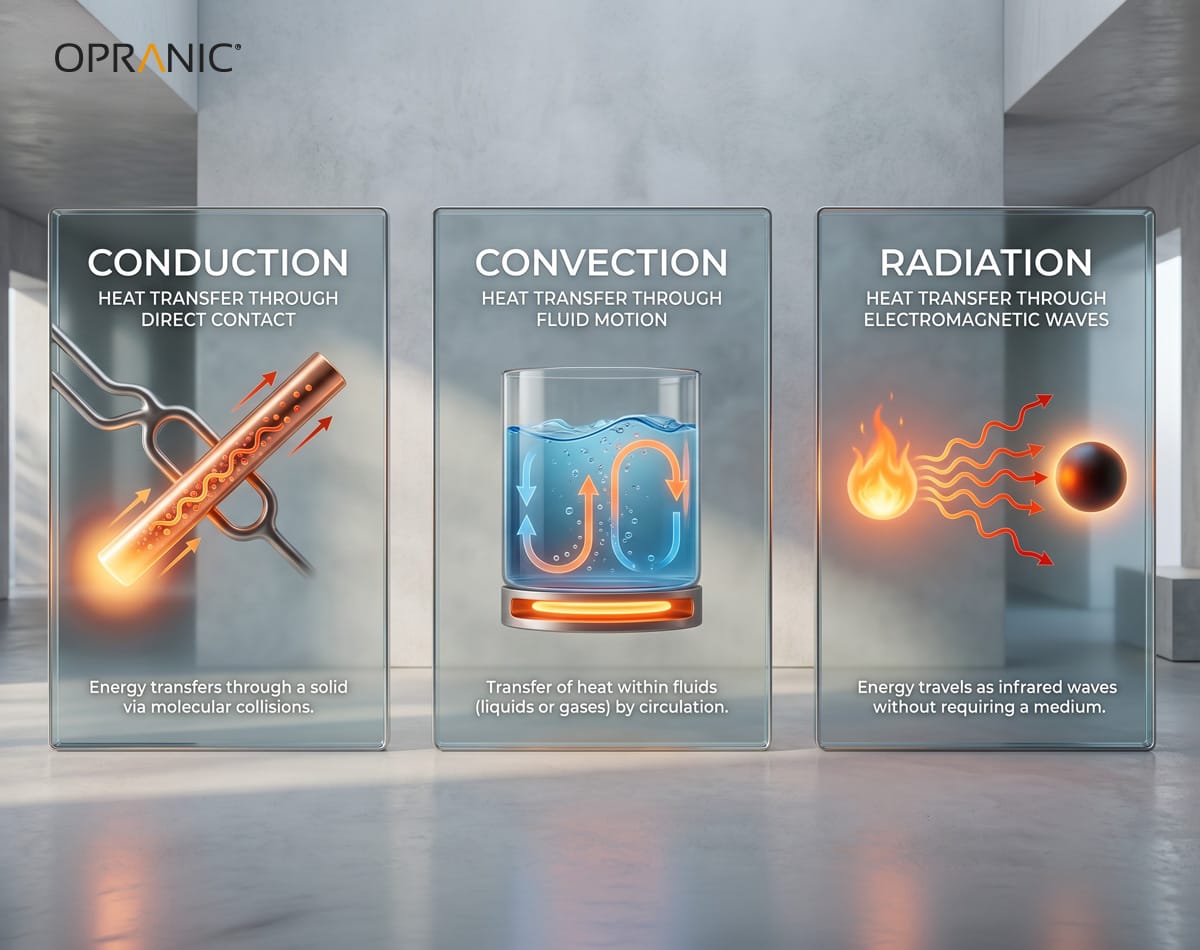
Three methods
Infrared vs convection: three ways to heat, one that works outdoors
Heat always moves in one of three ways. Conduction is direct contact: hold a warm mug and your hand warms with it. It works between surfaces that touch, but it has no role on a patio or terrace. Convection heats the air. Warm air rises, cools, and falls again. It is how most heaters work indoors, where walls and a ceiling trap the air in place. Outdoors, that logic collapses: the warm air lifts straight into the sky, wind sweeps in cold air to replace it, and you are paying to heat air that has already left.
Radiation is direct energy transfer from a source to a surface, with nothing in between. It is precisely how the sun warms the earth, across 150 million kilometres of near-absolute-zero space without a single air molecule involved. Infrared radiation travels, meets a surface, and is absorbed as heat. That is the only effective way to heat in an open outdoor environment, and it is the principle behind every Opranic heater.
If you want to go deeper on choosing the right model for your outdoor space, read our buying guide for outdoor infrared heaters
The sunshine principle
Why you feel warm on a mountain in sub-zero temperatures
Infrared radiation is part of the electromagnetic spectrum, the same family as visible light, radio waves, and X-rays. It sits just below visible red light, which is where the name infrared comes from: literally “below red.” The faint warm glow you see when an Opranic patio heater is running is the visible edge of that spectrum. What you feel is the infrared radiation itself, absorbed by the skin and converted into warmth inside the body.
The infrared band is wide, and different parts of it behave very differently. Some wavelengths are absorbed almost entirely by the skin, producing a gentle, comfortable warmth. Others are reflected away or felt as an unpleasant sting. The choice of wavelength is the single most critical design parameter in an outdoor infrared heater, and it is where Opranic’s more than twenty years of engineering work has its foundation.

The body is 80 per cent water.
That determines which wavelength works.

The spectrum
Where infrared sits in the electromagnetic spectrum
Infrared is part of the electromagnetic spectrum, the same family as visible light, radio waves, and X-rays. It sits just below visible red light, which is precisely where the name comes from: infrared, meaning “below red.” When an Opranic patio heater is running, you see a soft orange glow, much like the embers of an open fire. What you feel is the heat itself, infrared radiation that the skin absorbs and converts into warmth inside the body.
The infrared region is broad, and different parts of it behave very differently. Some wavelengths are absorbed almost entirely by the skin, producing a gentle, comfortable warmth. Others are reflected away or felt as a sharp, unpleasant sensation. Selecting the right wavelength is the single most critical design parameter in any infrared outdoor heater, and it is where Opranic’s more than twenty years of engineering work has its roots.
For a deeper look at the physics of wavelength, emitter surface temperature, and absorption, read our technical guide on how infrared heating works.
Water content
Why 2.2 micrometres is the right wavelength for infrared heating
The human body is approximately 70% water. That single fact determines which type of infrared radiation actually heats you and which does not. If the radiation is not absorbed by the water in your skin, its intensity is irrelevant; it passes through or reflects away without converting to warmth.
Water absorbs infrared radiation most efficiently in the 2.2–3.0 micrometre range. Radiation at 2.2 micrometres is absorbed directly in the outer layers of the skin, precisely where the thermal receptors are located, and converts into comfortable body warmth rather than bouncing away. That is why the Opranic IR-X Carbon Black element is engineered with its output peak at exactly this wavelength. Every joule of energy goes where it should.
IR-X Carbon Black peak output

Mid-wave is absorbed. Short-wave reflects away.

The skin’s defence
The skin’s natural reflectivity: a defence mechanism
Skin is not a passive receiver of heat. It has evolved over millions of years under the sun and is therefore selective about which radiation it absorbs and which it reflects. This is a defence mechanism that serves us well in nature, but it also means that the character of an infrared heater has a direct bearing on how much comfort you actually receive.
Infrared that is too intense, or of the wrong wavelength, largely bounces off the skin, much as the harshest midday sun reflects from a pale t-shirt. It may feel hot at close range, but most of the energy never reaches the layers where it can do any good. Infrared of the right character, such as that produced by an Opranic infrared heater, is absorbed directly into the outer layers of the skin. The sensation is the same gentle, penetrating warmth as a September afternoon sun, the kind that makes you close your eyes and tilt your head back.
100% natural
Infrared warmth is 100% natural for the body
Infrared warmth is entirely natural for the body. It is the same form of heat the sun delivers on a spring afternoon, the same warmth that soaks through your t-shirt on a July jetty, the same radiant heat that lingers in a sun-warmed stone long after dusk. Sitting beneath an Opranic patio heater is to borrow exactly that sensation and carry it forward into September, October, and beyond.
The warmth is soft, even, and felt directly on the skin. It creates no warm draughts, does not dry the air, and requires no warm-up time. Switch it on and the heat is there from the first second. The air around you stays as fresh as any ordinary evening outdoors, with the quiet radiance that makes you stay for another hour.

Air quality
Infrared heating and air quality: better for allergy sufferers
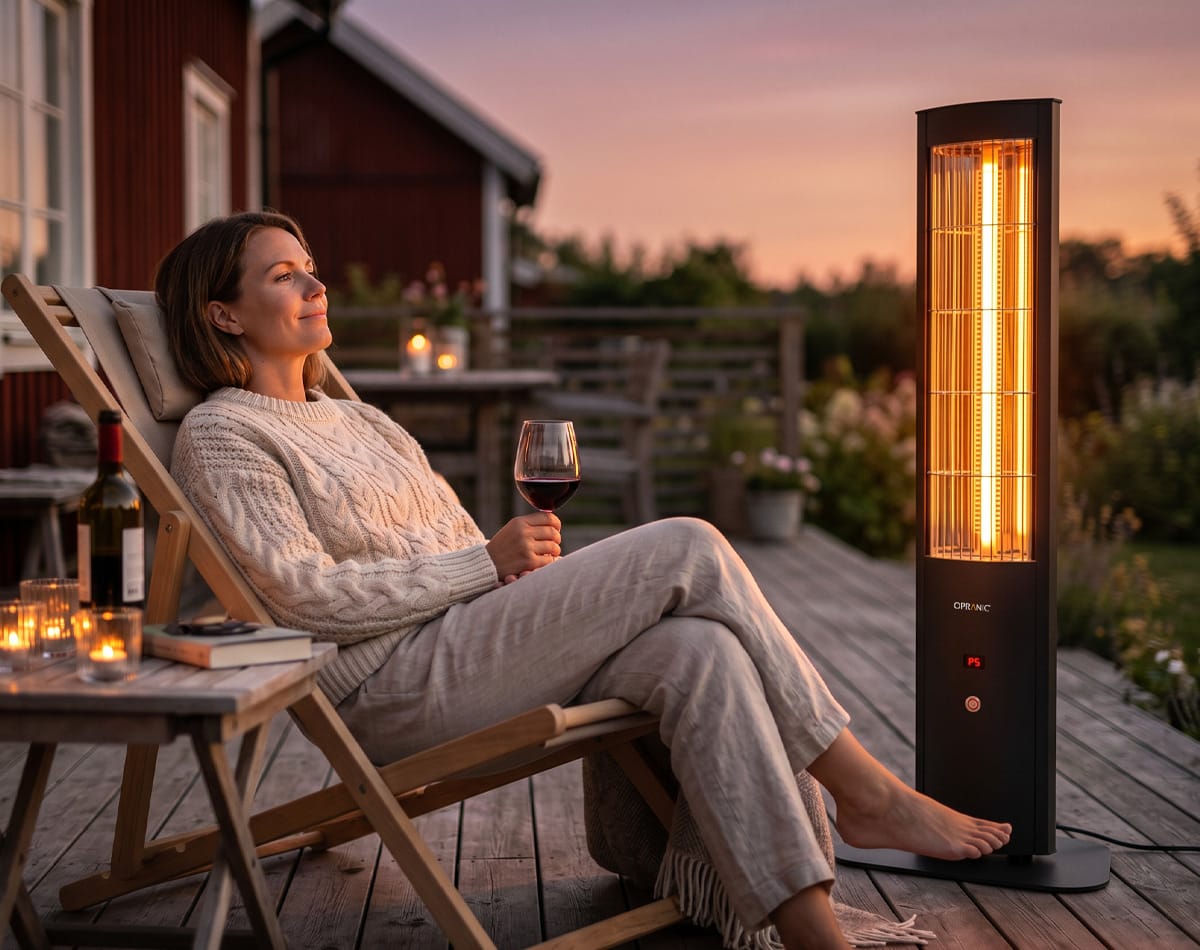
One detail that is easily overlooked is air quality. Infrared heating does not disturb the air. There is no fan, no airflow, no circulating dust or pollen. For anyone who suffers from allergies, this can make a meaningful difference, both indoors and out on the patio.
Indoors, an Opranic infrared heater delivers quiet, comfortable warmth that never dries out the air. It does not stir up dust, it does not push pollen around from open windows, and you avoid the dry, stifling atmosphere that radiators often produce when running at full output. The air stays fresh to breathe, and the room climate feels closer to a mild spring day than a sealed, overheated space.
Outdoors, the contrast with a gas patio heater is particularly clear. An Opranic outdoor heater produces no combustion gases, no water vapour, and no odour. There is no open flame, nothing that affects the air around the table. The fresh outdoor air stays exactly that, fresh, while the radiant heat warms you directly.
Infrared is the only heating technology that is rational outdoors.
Outdoor performance
Why infrared heating outperforms outdoors
Infrared is the only heating technology that is genuinely built for outdoor use. The difference is not simply a matter of physics; it is also about how an infrared heater behaves when wind and weather are exactly what they tend to be in northern Europe.
When wind sweeps across a terrace, warm air disperses immediately. That is how nature equalises temperatures. An infrared heater is indifferent to it. The radiation travels in straight lines from the source to you, regardless of whether the surrounding air is moving or completely still. You can sit in a gusty crosswind and still feel the warmth across your shoulders and on the backs of your hands.
An Opranic infrared patio heater is also built to live outdoors year-round. The IP65 rating means it handles rain, sleet, and salt-laden coastal winds without compromise. No warm-up time, no gas cylinder to replace, no flame to shelter from the breeze. Switch it on and you are warm from the first second, through the full season from early spring to late autumn and, in many climates, well into winter.


Independent research
Independent research behind Opranic infrared heating: LTU and Vattenfall 2019
In 2019, an independent study was carried out at Luleå Tekniska Universitet in collaboration with Vattenfall’s research division and Opranic. The study, subsequently published in the peer-reviewed Journal of Cold Regions Engineering, investigated how infrared heating can be used to de-ice wind turbine blades in Swedish winter conditions. Testing took place in a climate chamber at the Arctic Falls facility in Piteå, at temperatures down to minus 30 degrees Celsius.
The researchers compared different types of infrared heating and established that wavelength and distance are the two parameters that matter most to performance. Longer wavelengths, specifically the medium-wave technology that Opranic uses, proved most effective at transferring heat into the target surface rather than reflecting away from it. That is precisely the engineering logic on which Opranic infrared heaters have been built for over 20 years, now independently confirmed by academic research. Read the full thesis as a PDF.
Infrared heating at comfort levels is also subject to independent safety assessment by ICNIRP, the international authority on non-ionising radiation. Their guidelines underpin radiation protection recommendations across Europe and confirm that infrared heating of the kind used in an outdoor patio heater is entirely safe for daily use.
Sources & partners
- Luleå Tekniska Universitet
- Vattenfall R&D
- Journal of Cold Regions Engineering (ASCE, 2022)
- ICNIRP (safety guidelines)
Energy efficiency
Infrared heating converts 96% of energy into warmth
An Opranic outdoor heater converts up to 96% of the electricity you pay for directly into infrared warmth. The remaining fraction is emitted as the soft orange glow you see when you switch it on, exactly the kind of radiance that makes the skin feel at home even on a cold evening.
No warm-up time, no energy carried away by the wind, no idle running. Press the button and the warmth arrives immediately, directed precisely where it is needed. On a typical patio, that translates to an operating cost of a few kronor per hour, often a fraction of what a gas patio heater costs to run.
That is the difference between running a heater at full power and hoping the space warms up, and directing exactly the right amount of radiant heat to exactly where it does its work.
converted into infrared warmth
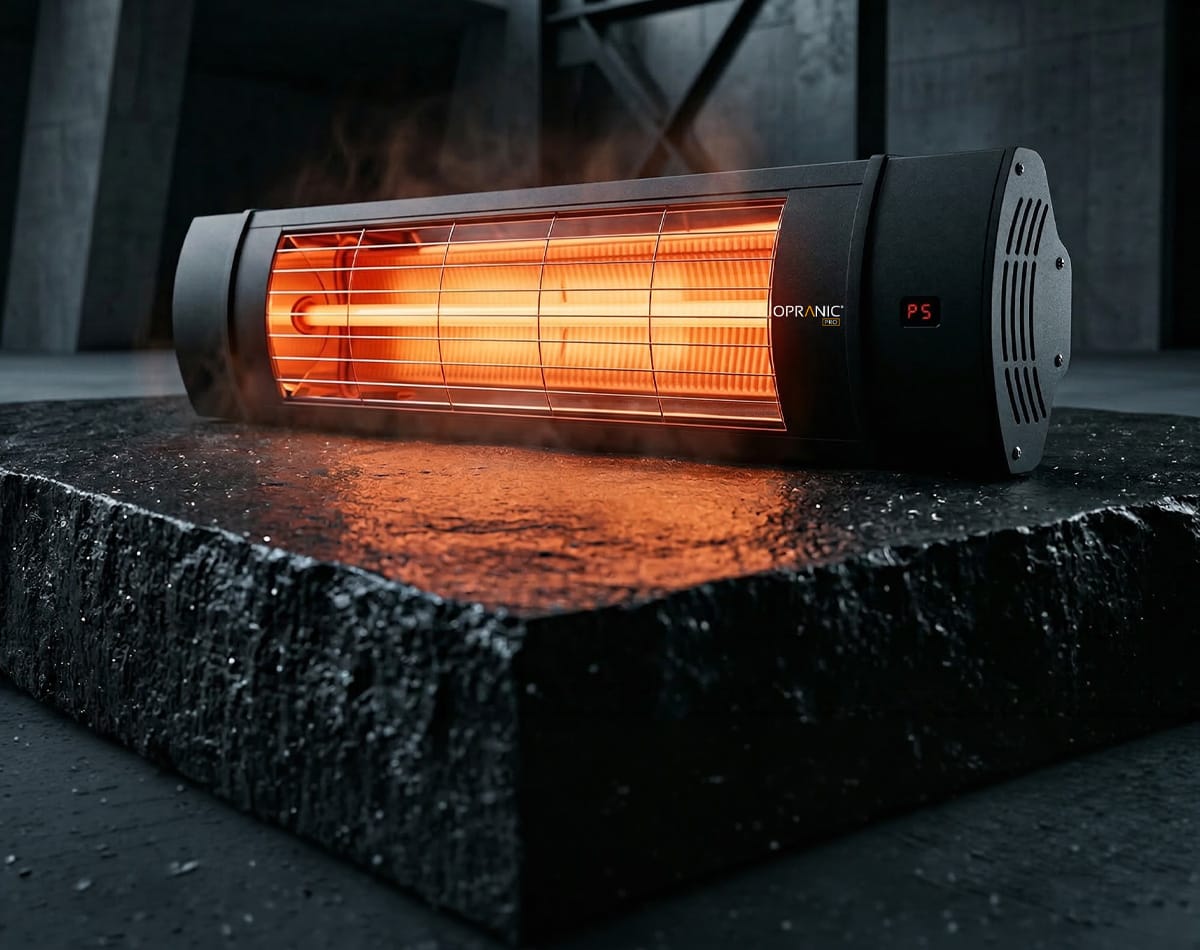
96% of the energy you pay for is converted into warmth felt directly by the body.
The system
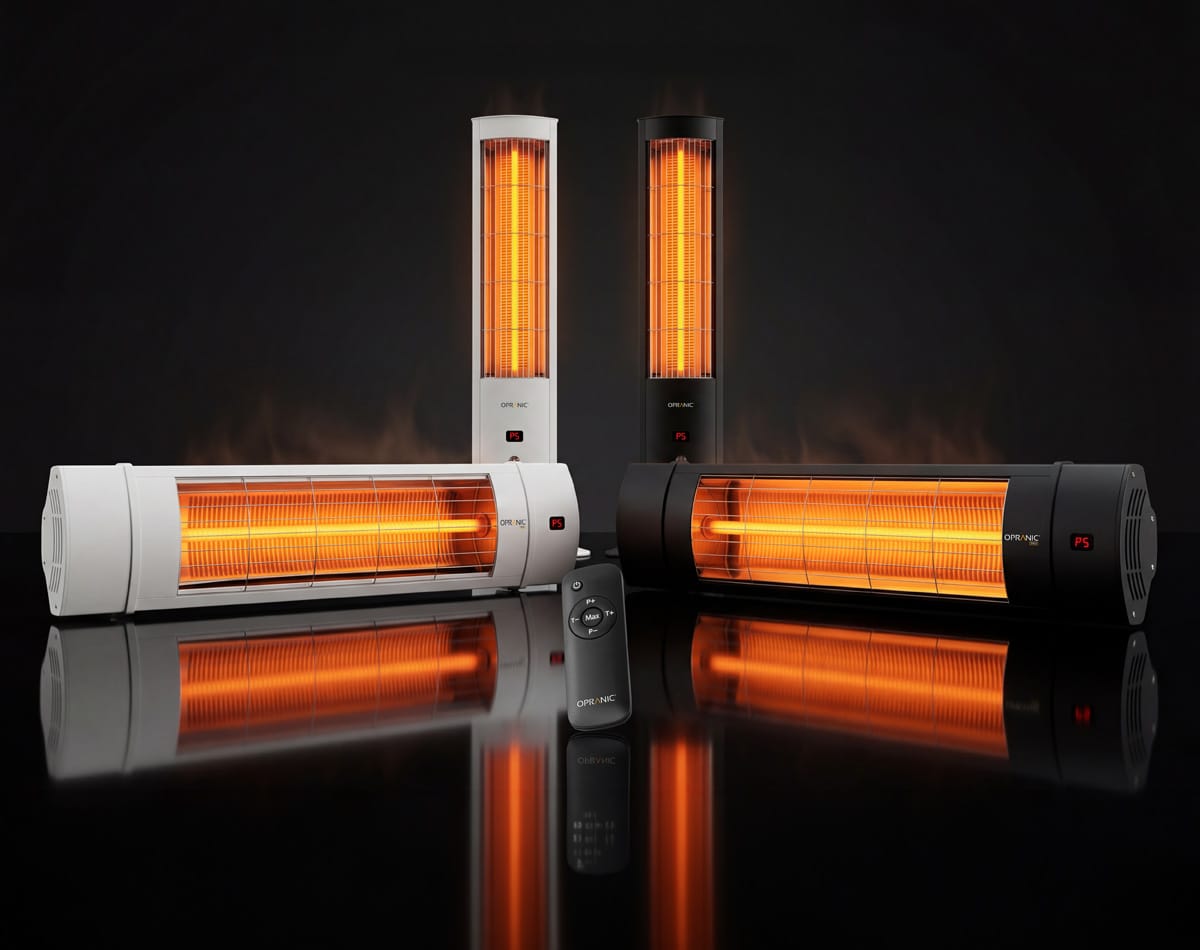
Opranic infrared heating is a system, not just a heater
At the heart of every Opranic outdoor heater is the IR-X Carbon Black element. But the element alone is never enough. It must sit within a precision-engineered parabolic reflector that directs radiant energy exactly where it is needed, housed in a stainless steel shell with side reflectors that contain and concentrate that energy, and governed by electronics that hold the surface temperature precisely within the optimal wavelength range.
For over 20 years, Opranic has developed and refined every one of these components as an integrated system rather than a collection of separate parts. That engineering philosophy is why Opranic infrared patio heaters consistently outperform alternatives, in independent academic research and on real terraces from Scandinavia to the Mediterranean. No single component makes the difference; the system as a whole does.
To find the right infrared heater for your outdoor space, read our outdoor heater buying guide. To learn more about the company and the engineering tradition behind the products, visit