
Knowledge base
Frequently asked questions
Everything about infrared heating, Opranic technology and how to choose the right heater.
Everything you need to know about how infrared heating works, what makes Opranic different and how to choose the right heater for your space.
How does infrared heating work?
Infrared heating works by emitting electromagnetic waves that travel through air without losing energy, then warm objects, surfaces and people on contact. It is the same mechanism that makes sunlight feel warm on your skin, just without the ultraviolet component.
This is fundamentally different from convection heating. A traditional radiator warms the air, which then rises, mixes with cooler air and slowly raises the room temperature. An infrared heater bypasses the air entirely and delivers warmth directly to whatever is in front of it.
The result is immediate, focused warmth with very little energy wasted on heating empty space.
How do infrared heaters compare to traditional heaters?
The difference comes down to what you heat. Traditional heaters warm the air. Infrared heaters warm objects and people directly.
For outdoor use the contrast is decisive. Outdoors, heat carried by warm air is quickly taken away by wind and open sides. Infrared keeps working because the radiation reaches you regardless of what the air around you does.
Indoors, infrared panels heat walls, floors and furniture, which then re-radiate stable warmth. This avoids the temperature stratification of convection systems where warm air collects at the ceiling.
For most use cases infrared is faster, puts the heat where people are, and produces no air movement that stirs up dust.
What are the benefits of Opranic infrared heaters?
At the heart of every V- and S-Line heater is IR-X Carbon Black, peaking at approximately 2.2 µm at full power, a wavelength the body absorbs well, so the energy you pay for is felt as warmth.
- Designed in Sweden for a Nordic climate: IP65, with wall heaters designed to stay mounted all year round
- Up to 96% of the electrical energy becomes radiant heat, with full heat in 3 to 5 seconds
- Silent, with no fan and no moving parts
- Five heat levels and a remote control on V50R, Pro V70R, S50R and S70R; a fixed 1800 W on Pro V70 for central control
- No combustion and no direct CO₂ emissions in use
What is the difference between Opranic’s indoor and outdoor heaters?
They are built for different jobs.
Outdoor heaters (V70-Line, V50-Line, S70-Line, S50-Line) use the IR-X Carbon Black element, peaking at approximately 2.2 µm in the medium-wave band, at 1800 to 2300 W and rated IP65. They reach people across open, moving air and are for outdoor use only.
P5 indoor panels have a steel front at 95 to 115 °C and emit long-wave infrared above 3 µm. At 300 to 900 W and IP44, they warm walls, floors and people evenly in a closed room without moving the air.
Pro I90 is a medium-wave heater for halls and workshops with high ceilings.
Are Opranic heaters suitable for commercial use?
Yes. The outdoor heaters are built for restaurants, cafés, hotels and event venues.
- Pro V70 has a fixed 1800 W output and a rear on/off switch, made for restaurants that control their heaters centrally; the fixed load lets more heaters share the same supply.
- Pro V70R adds five heat levels, a remote control, a timer and Auto-restart mode, which resumes heating when a central supply is switched back on.
- S70R is the floor-standing choice where the heater needs to move.
All are rated IP65 and designed in Sweden. For halls, workshops and warehouses, Pro I90 delivers up to 9,000 W from a wall or ceiling at 3 to 10 m. For offices and other indoor spaces, the P5 panels heat silently with no moving parts.
Do infrared heaters emit harmful radiation?
No. The radiation infrared heaters emit is electromagnetic radiation in the infrared band, which sits just below visible light on the spectrum. It is the same type of warmth you feel from sunlight, fireplaces and any heated object.
It does not contain ultraviolet (UV), which is the part of sunlight responsible for skin damage. It does not contain ionising radiation. At the intensities used for heating, it does not damage cells or DNA.
Infrared is also widely used in medicine, food warming and industrial drying.
Where can I buy Opranic products?
Outside Sweden, Opranic products are sold directly at opranic.com and on Amazon. In Sweden they are also available through electrical wholesalers and retailers. We are building a network of resellers across Europe. For projects, volume orders or reseller enquiries, contact info@opranic.com.
What is the difference between Opranic’s indoor and outdoor heaters?
They are built for different jobs.
Outdoor heaters (V70-Line, V50-Line, S70-Line, S50-Line) use the IR-X Carbon Black element, peaking at approximately 2.2 µm in the medium-wave band, at 1800 to 2300 W and rated IP65. They reach people across open, moving air and are for outdoor use only.
P5 indoor panels have a steel front at 95 to 115 °C and emit long-wave infrared above 3 µm. At 300 to 900 W and IP44, they warm walls, floors and people evenly in a closed room without moving the air.
Pro I90 is a medium-wave heater for halls and workshops with high ceilings.
How energy efficient are Opranic indoor panels?
About 99% of the electricity a P5 panel uses becomes heat; there is no fan and no combustion. The running cost therefore depends on how much heat the room needs: its insulation, a correctly sized panel (about 100 W per square metre) and a thermostat that switches the panel off when the room is warm.
Example: a P5 900 suits an insulated room of 9 to 12 m². At full power for 6 hours it uses 5.4 kWh; at €0.30 per kWh that is about €1.62 a day, and less once a thermostat holds the temperature.
What are the benefits of infrared heating indoors?
Infrared warms people and surfaces directly instead of heating and circulating the air, and that changes how a room feels:
- No fan and no convection currents, so less dust is carried around the room.
- No stream of hot air blowing across the room.
- Even warmth from walls, floor and furniture, without a warm layer under the ceiling and cold feet.
- Silent, with no moving parts, for bedrooms, studies and quiet rooms.
- No combustion, so no fumes or carbon monoxide indoors.
Are Opranic panels suitable for bathrooms?
Yes. The P5 panels are rated IP44, protected against splashing water. Infrared warms you directly as you step out of the shower, and it warms walls and mirrors, which helps them dry.
The electrical rules in your country decide in which bathroom zone a heater may be installed and how it must be connected. P5 is a plug-in panel, and sockets are restricted near baths and showers, so have an electrician check the installation.
How do infrared heaters work as supplementary heating to central heating?
Infrared heaters complement central heating by solving the specific problems central systems are bad at: zone heating, fast response and targeted comfort.
Zone heating. Most homes have rooms that are used a few hours per day (home office, guest room, basement workshop). Heating these to comfort via central heating means heating the whole house. An infrared panel in the room handles only that space, while central heating runs at a lower baseline.
Fast response. Central heating has to warm the air in a cold room first. Infrared is felt sooner because it warms people and surfaces directly. Useful for autumn/spring shoulder seasons when you do not want to start the main system.
Targeted comfort. Bathrooms, conservatories, rooms with large windows or exposed corners often have cold spots central heating cannot fix. A single infrared panel in those zones is more efficient than raising the thermostat for the whole house.
Used this way, you typically lower the central heating set point by 1-2 °C and use infrared where you actually are. You add heat only where and when you need it.
What affects the energy consumption of an infrared panel?
A P5 panel turns about 99% of the electricity it uses into heat, so the running cost depends on how much heat the room needs and for how long:
- Room size and insulation: allow about 100 W per square metre in an insulated room with a 2.4 m ceiling; older houses, glazed walls and high ceilings need more.
- Control: a plug-in thermostat or smart plug switches the panel off when the room is warm.
- Placement: a clear view of the room lets the radiation reach people and surfaces.
- The electricity price, including any cheaper off-peak hours.
How can I reduce the running cost of my infrared panel?
- Size it correctly: about 100 W per square metre in an insulated room. An undersized panel runs constantly without reaching comfort.
- Control it: P5 has no built-in thermostat, so use a plug-in thermostat or smart plug to hold the temperature you want.
- Heat the rooms you use, when you use them. Infrared is felt quickly, so there is no need to keep empty rooms warm.
- Stop draughts: door and window seals make a real difference.
- Face the panel towards where you sit or work, with nothing in front of it.
- If your electricity supplier offers cheaper off-peak hours, use them for background heat.
Are Opranic indoor panels safe to use?
Yes. The P5 panels are TÜV Süd certified and meet CE, EMC, REACH and RoHS.
- Overheat protection: a thermal switch keeps the surface within its temperature range.
- Overvoltage protection for the electronics.
- IP44, protected against splashing water.
- No exposed heating element, no combustion and no emissions.
The steel front runs at 95 to 115 °C, so it becomes hot: keep furniture and textiles clear of it and follow the guidance on children in the manual.
Where should I place an indoor infrared panel?
Place the P5 panel so it faces the area where people sit, stand or work: the warmth is felt where the radiation lands.
- Mount it on a wall or ceiling, horizontally or vertically, with the supplied safety bracket.
- Keep the space in front of the panel free of furniture and curtains.
- In larger or irregular rooms, several smaller panels spread around the room give more even warmth than one large one.
- Allow about 100 W per square metre in an insulated room with a 2.4 m ceiling; older houses, glazed walls and high ceilings need more.
How quickly do Opranic infrared heaters warm up the room?
You feel an Opranic heater before the room gets warm. Infrared warms people and surfaces directly instead of first heating the air, so the warmth is noticeable as soon as the heater reaches its operating temperature: within seconds for the IR-X Carbon Black heaters outdoors, and within minutes for a P5 panel as its surface reaches 95 to 115 °C.
The room itself warms more gradually. Walls, floor and furniture absorb the radiation and give it back, so the room holds the warmth evenly without draughts of warm air. How long that takes depends on the room’s size and insulation and on the panel’s output; allow about 100 W per square metre in an insulated room.
What is the difference between Opranic’s indoor and outdoor heaters?
They are built for different jobs.
Outdoor heaters (V70-Line, V50-Line, S70-Line, S50-Line) use the IR-X Carbon Black element, peaking at approximately 2.2 µm in the medium-wave band, at 1800 to 2300 W and rated IP65. They reach people across open, moving air and are for outdoor use only.
P5 indoor panels have a steel front at 95 to 115 °C and emit long-wave infrared above 3 µm. At 300 to 900 W and IP44, they warm walls, floors and people evenly in a closed room without moving the air.
Pro I90 is a medium-wave heater for halls and workshops with high ceilings.
What is IR-X Carbon Black?
IR-X Carbon Black is the complete radiant system inside Opranic’s V- and S-Line heaters. It brings together a premium-grade carbon-fibre element sealed in a high-quality quartz glass tube, the element’s operating temperature and the reflector geometry.
- Spectral peak of approximately 2.2 µm at full power
- Up to 96% of the electrical energy converted into radiant heat
- Full radiant heat 3 to 5 seconds after switching on
- Very low visible glare
The quartz transmits the radiation; the reflector shapes it and directs it towards the people you want to warm.
What wavelength do Opranic outdoor heaters emit?
At full power the IR-X Carbon Black element peaks at approximately 2.2 µm, in the medium-wave IR-B band. It is a balanced wavelength for outdoor comfort:
- the radiation reaches people and surfaces directly, without first warming the air
- skin and clothing absorb it well, so it is felt as warmth
- visible glare is very low, only a soft orange glow
Short-wave emitters run hotter and lose more of their output as visible light. Emitters below approximately 700 °C give no glow, but a larger share of their energy leaves as convection, which the wind carries away.
Are Opranic outdoor heaters waterproof?
They are weatherproof, not submersible. Every V70-Line, V50-Line, S70-Line and S50-Line heater is rated IP65: dust-tight and protected against low-pressure water jets from any direction, including rain and splashes.
- Wall and ceiling heaters (Pro V70, Pro V70R, V50R) are designed to stay mounted outdoors all year round.
- Floor-standing heaters (S70R, S50R) cope with rain while in use, but should be unplugged, allowed to cool and stored in a dry place when not in use.
The rating does not cover the remote control, the plug or the socket; an ordinary socket does not have the heater’s protection, so keep connections dry. Do not use the heaters in a bathroom or beside a swimming pool. Pro I90 for halls and workshops is rated IP34, for covered spaces.
Can I use my Opranic heater in winter and in the rain?
Yes. Every V70-Line, V50-Line, S70-Line and S50-Line heater is rated IP65, and the wall heaters are designed to stay mounted outdoors all year round, through rain, snow and frost. Full heat comes 3 to 5 seconds after switching on, with no gas to replace and no flame for the wind to blow out.
Floor-standing S70R and S50R can be used in the rain, but unplug them, let them cool and store them in a dry place when they are not in use. Keep the plug, socket and remote control dry in all weather.
How long is the power cable on Opranic outdoor heaters?
Every V70-Line, V50-Line, S70-Line and S50-Line heater has a 1.9 m cable with plug: an earthed EU plug (Schuko), or a UK plug on the UK versions (article numbers ending in -GB). Connect it to an earthed socket on a circuit fused at 10 A or more, with no other appliance on the same circuit. From a heater mounted at 2.2 m the cable reaches a wall socket; keep the plug and socket outside the heating area and never directly below the heater. Pro I90 has a fixed connection made by an electrician.
What is the recommended installation height?
V70-Line and V50-Line heaters (Pro V70, Pro V70R, V50R): mount at 1.8 to 2.5 m and angle the heater 30 to 45 degrees towards the seating area. The minimum is 180 cm from the floor to the lowest outer edge of the heater, measured after the angle is set.
- Near a ceiling, aim the heater 45° downwards and keep at least 10 cm to the ceiling.
- Keep 100 cm clear in front of the heater, 70 cm from combustible material to the sides and below, 30 cm to side walls and 10 cm to the wall behind.
Pro I90 mounts horizontally at 3 to 10 m, normally 4 to 6 m, and at least 300 cm above the floor.
Floor-standing S70R and S50R need no mounting: place them upright on a firm, level surface with 100 cm clear in front, 70 cm at the sides and 50 cm above and behind.
Can I use the same remote control for several Opranic heaters?
Yes. V50R, Pro V70R, S50R and S70R all use the same remote control. A command reaches every heater in the remote’s line of sight, so point it at the heater you want to control and move closer if other heaters respond too. Strong light or sunlight can shorten the range.
A spare remote can be ordered at opranic.com, where remotes for older Opranic models are also available.
How do Opranic outdoor heaters perform in wind?
Wind does not weaken infrared radiation. The heat travels straight from the heater to people and surfaces, so unlike a gas or convection heater it is not carried away with the air. What wind does is cool your skin, so on an open, windy patio you feel less of the warmth.
IR-X Carbon Black is built around the right balance. At full power the element peaks at about 2.2 µm in the medium-wave band, a wavelength the body absorbs well, with very low visible glare. Short-wave emitters run hotter and lose more of their output as visible light; low-temperature emitters give no glow, but a larger share of their energy leaves as convection, which the wind takes away.
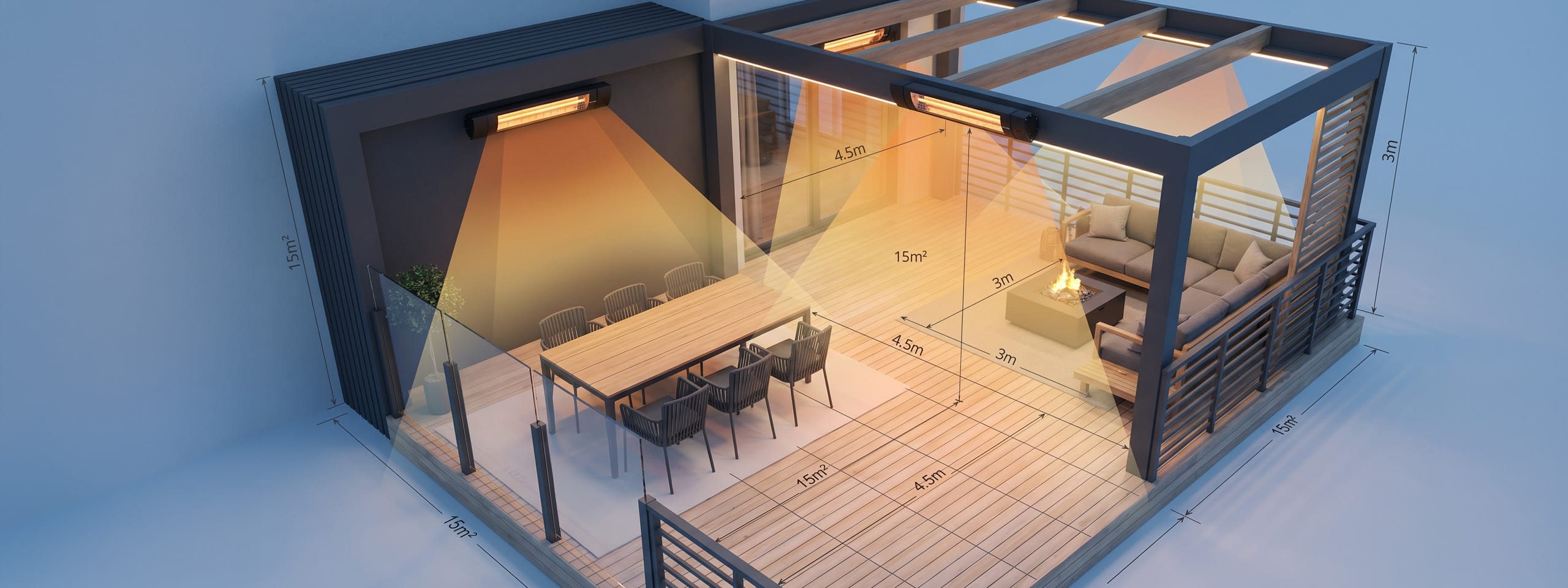
Plan for more heat in an exposed spot. Shelter from a wall, screen or roof makes the biggest difference, and two heaters facing each other across a table give the most even warmth. As a rule of thumb, allow up to 200 W per square metre outdoors; one 2300 W heater warms about 11 m² of sheltered patio. The heat calculator at opranic.com adjusts for shelter and wind.
Is there a stand for Opranic wall-mounted heaters?
No. Pro V70, Pro V70R and V50R are designed, tested and certified for fixed wall or ceiling mounting, and we advise against improvising a stand. A stand changes where the heat goes and how stable the heater is, and it is not an installation the manual or the warranty covers.
If you want a heater you can move, choose a floor-standing model:
- S70R: 2300 W, five heat levels, remote control and tip-over protection, 8.2 kg.
- S50R: 1800 W or 2300 W, the same controls, lighter at 4.5 to 4.7 kg.
Both use the same IR-X Carbon Black element as the wall heaters.
Are Opranic heaters resistant to rust and corrosion?
Yes. The outdoor heaters are rated IP65, and the V70-Line and V50-Line wall heaters are designed to stay mounted outdoors all year round.
- Housing: anodised aluminium, highly resistant to corrosion.
- Front grille: chrome-plated steel. In coastal or industrial air it can develop some patina over time.
- Side covers: fibreglass-reinforced plastic, resistant to UV, frost and weather.
On a heater mounted outdoors, light surface marks and a finish that dulls over time are normal wear; rust caused by a defect is covered by the warranty. To keep the heater looking its best, wipe the cooled, unplugged heater with a soft, lightly damp cloth, especially near the coast, and use the weather cover when it is not in use. Store the floor-standing S70R and S50R indoors when you are not using them. Spare grilles and side covers are available on request from info@opranic.com.
What is the recommended installation height?
V70-Line and V50-Line heaters (Pro V70, Pro V70R, V50R): mount at 1.8 to 2.5 m and angle the heater 30 to 45 degrees towards the seating area. The minimum is 180 cm from the floor to the lowest outer edge of the heater, measured after the angle is set.
- Near a ceiling, aim the heater 45° downwards and keep at least 10 cm to the ceiling.
- Keep 100 cm clear in front of the heater, 70 cm from combustible material to the sides and below, 30 cm to side walls and 10 cm to the wall behind.
Pro I90 mounts horizontally at 3 to 10 m, normally 4 to 6 m, and at least 300 cm above the floor.
Floor-standing S70R and S50R need no mounting: place them upright on a firm, level surface with 100 cm clear in front, 70 cm at the sides and 50 cm above and behind.
Can I use an extension lead with my Opranic heater?
Avoid extension leads: at 1800 to 2300 W a lead can overheat and cause a fire. If one cannot be avoided, use a lead that is:
- at least 1.5 mm² in conductor cross-section
- rated at least 10 A
- suitable for outdoor use
- fully unwound and as short as possible
Never connect another appliance to the same lead or circuit. For a permanent installation, have an electrician fit an outdoor socket close to the heater.
How do Opranic outdoor heaters perform in wind?
Wind does not weaken infrared radiation. The heat travels straight from the heater to people and surfaces, so unlike a gas or convection heater it is not carried away with the air. What wind does is cool your skin, so on an open, windy patio you feel less of the warmth.
IR-X Carbon Black is built around the right balance. At full power the element peaks at about 2.2 µm in the medium-wave band, a wavelength the body absorbs well, with very low visible glare. Short-wave emitters run hotter and lose more of their output as visible light; low-temperature emitters give no glow, but a larger share of their energy leaves as convection, which the wind takes away.
Plan for more heat in an exposed spot. Shelter from a wall, screen or roof makes the biggest difference, and two heaters facing each other across a table give the most even warmth. As a rule of thumb, allow up to 200 W per square metre outdoors; one 2300 W heater warms about 11 m² of sheltered patio. The heat calculator at opranic.com adjusts for shelter and wind.
Are Opranic heaters resistant to rust and corrosion?
Yes. The outdoor heaters are rated IP65, and the V70-Line and V50-Line wall heaters are designed to stay mounted outdoors all year round.
- Housing: anodised aluminium, highly resistant to corrosion.
- Front grille: chrome-plated steel. In coastal or industrial air it can develop some patina over time.
- Side covers: fibreglass-reinforced plastic, resistant to UV, frost and weather.
On a heater mounted outdoors, light surface marks and a finish that dulls over time are normal wear; rust caused by a defect is covered by the warranty. To keep the heater looking its best, wipe the cooled, unplugged heater with a soft, lightly damp cloth, especially near the coast, and use the weather cover when it is not in use. Store the floor-standing S70R and S50R indoors when you are not using them. Spare grilles and side covers are available on request from info@opranic.com.
Do infrared heaters emit harmful radiation?
No. The radiation infrared heaters emit is electromagnetic radiation in the infrared band, which sits just below visible light on the spectrum. It is the same type of warmth you feel from sunlight, fireplaces and any heated object.
It does not contain ultraviolet (UV), which is the part of sunlight responsible for skin damage. It does not contain ionising radiation. At the intensities used for heating, it does not damage cells or DNA.
Infrared is also widely used in medicine, food warming and industrial drying.
What is IR-X Carbon Black?
IR-X Carbon Black is the complete radiant system inside Opranic’s V- and S-Line heaters. It brings together a premium-grade carbon-fibre element sealed in a high-quality quartz glass tube, the element’s operating temperature and the reflector geometry.
- Spectral peak of approximately 2.2 µm at full power
- Up to 96% of the electrical energy converted into radiant heat
- Full radiant heat 3 to 5 seconds after switching on
- Very low visible glare
The quartz transmits the radiation; the reflector shapes it and directs it towards the people you want to warm.
What wavelength do Opranic outdoor heaters emit?
At full power the IR-X Carbon Black element peaks at approximately 2.2 µm, in the medium-wave IR-B band. It is a balanced wavelength for outdoor comfort:
- the radiation reaches people and surfaces directly, without first warming the air
- skin and clothing absorb it well, so it is felt as warmth
- visible glare is very low, only a soft orange glow
Short-wave emitters run hotter and lose more of their output as visible light. Emitters below approximately 700 °C give no glow, but a larger share of their energy leaves as convection, which the wind carries away.
Are Opranic outdoor heaters waterproof?
They are weatherproof, not submersible. Every V70-Line, V50-Line, S70-Line and S50-Line heater is rated IP65: dust-tight and protected against low-pressure water jets from any direction, including rain and splashes.
- Wall and ceiling heaters (Pro V70, Pro V70R, V50R) are designed to stay mounted outdoors all year round.
- Floor-standing heaters (S70R, S50R) cope with rain while in use, but should be unplugged, allowed to cool and stored in a dry place when not in use.
The rating does not cover the remote control, the plug or the socket; an ordinary socket does not have the heater’s protection, so keep connections dry. Do not use the heaters in a bathroom or beside a swimming pool. Pro I90 for halls and workshops is rated IP34, for covered spaces.
How energy efficient are Opranic indoor panels?
About 99% of the electricity a P5 panel uses becomes heat; there is no fan and no combustion. The running cost therefore depends on how much heat the room needs: its insulation, a correctly sized panel (about 100 W per square metre) and a thermostat that switches the panel off when the room is warm.
Example: a P5 900 suits an insulated room of 9 to 12 m². At full power for 6 hours it uses 5.4 kWh; at €0.30 per kWh that is about €1.62 a day, and less once a thermostat holds the temperature.
Are Opranic panels suitable for bathrooms?
Yes. The P5 panels are rated IP44, protected against splashing water. Infrared warms you directly as you step out of the shower, and it warms walls and mirrors, which helps them dry.
The electrical rules in your country decide in which bathroom zone a heater may be installed and how it must be connected. P5 is a plug-in panel, and sockets are restricted near baths and showers, so have an electrician check the installation.
What affects the energy consumption of an infrared panel?
A P5 panel turns about 99% of the electricity it uses into heat, so the running cost depends on how much heat the room needs and for how long:
- Room size and insulation: allow about 100 W per square metre in an insulated room with a 2.4 m ceiling; older houses, glazed walls and high ceilings need more.
- Control: a plug-in thermostat or smart plug switches the panel off when the room is warm.
- Placement: a clear view of the room lets the radiation reach people and surfaces.
- The electricity price, including any cheaper off-peak hours.
Are Opranic indoor panels safe to use?
Yes. The P5 panels are TÜV Süd certified and meet CE, EMC, REACH and RoHS.
- Overheat protection: a thermal switch keeps the surface within its temperature range.
- Overvoltage protection for the electronics.
- IP44, protected against splashing water.
- No exposed heating element, no combustion and no emissions.
The steel front runs at 95 to 115 °C, so it becomes hot: keep furniture and textiles clear of it and follow the guidance on children in the manual.
Where should I place an indoor infrared panel?
Place the P5 panel so it faces the area where people sit, stand or work: the warmth is felt where the radiation lands.
- Mount it on a wall or ceiling, horizontally or vertically, with the supplied safety bracket.
- Keep the space in front of the panel free of furniture and curtains.
- In larger or irregular rooms, several smaller panels spread around the room give more even warmth than one large one.
- Allow about 100 W per square metre in an insulated room with a 2.4 m ceiling; older houses, glazed walls and high ceilings need more.
Can I mount an Opranic heater on a wooden wall?
Follow the manual: choose a solid supporting surface and use fixings suitable for that surface and the load. Do not mount the heater on plastic, nylon, vinyl or cardboard. On any wall, keep these clearances:
- 10 cm between the heater and the wall behind it
- 30 cm to side walls outside the radiant area
- 70 cm to combustible material to the sides and below the heater
- 100 cm to combustible material in the direction the heater faces
The manual for each model is at opranic.com/doc.
How long is the power cable on Opranic outdoor heaters?
Every V70-Line, V50-Line, S70-Line and S50-Line heater has a 1.9 m cable with plug: an earthed EU plug (Schuko), or a UK plug on the UK versions (article numbers ending in -GB). Connect it to an earthed socket on a circuit fused at 10 A or more, with no other appliance on the same circuit. From a heater mounted at 2.2 m the cable reaches a wall socket; keep the plug and socket outside the heating area and never directly below the heater. Pro I90 has a fixed connection made by an electrician.
What warranty does Opranic offer?
The warranty depends on the model:
- Pro V70, Pro V70R and S70R: 5 years on the heater and its electronics, 2 years on the heating tube.
- V50R and S50R: 2 years.
- P5 indoor panels: 5 years.
- A70R fan: 5 years, including the power adapter.
- Pro I90: 3 years.
The warranty runs from the date of delivery and covers defects in design, materials and workmanship. It does not cover normal wear, or damage caused by misuse, incorrect installation or improper maintenance. On a heater mounted outdoors, light surface marks and a finish that dulls over time are normal wear.
To make a claim, contact your retailer or info@opranic.com with the model or article number, proof of purchase and a description of the fault. Full terms are at opranic.com/doc. The warranty does not affect your statutory rights.
What is included in the box?
- V70-Line and V50-Line (wall and ceiling): the heater, mounting brackets and hardware, and the user manual. V50R and Pro V70R also include the remote control.
- S70-Line and S50-Line (floor-standing): the heater body, a separate base with fixing screws, the remote control and the user manual.
If anything is missing, contact your retailer or info@opranic.com.