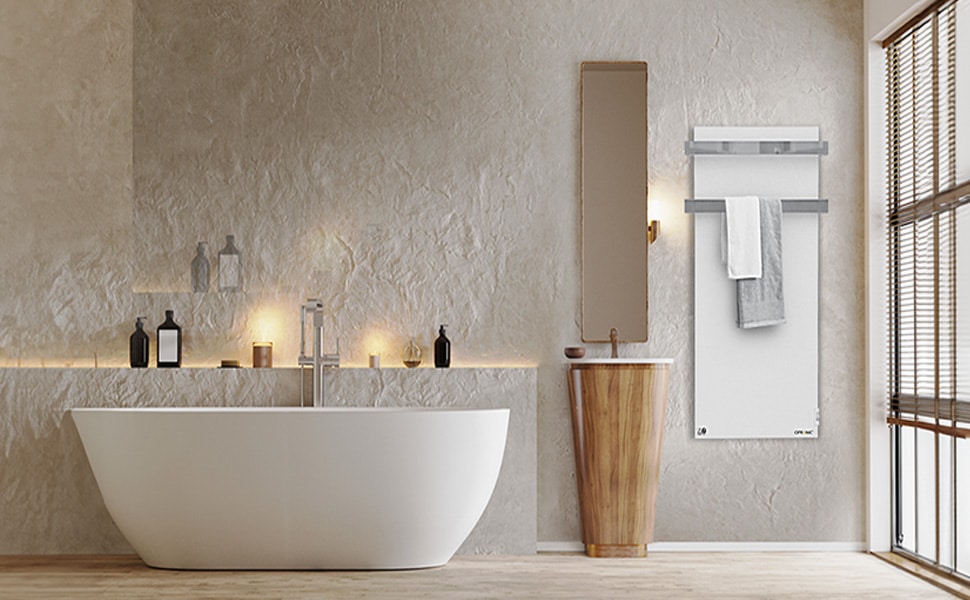
An infrared bathroom heater gives you warmth for the minutes you spend in the room: stepping out of the shower, getting ready in the morning, bathing the children in the evening. This guide shows which Opranic panels suit a bathroom, which size to choose, where to place the panel and what it costs to run.
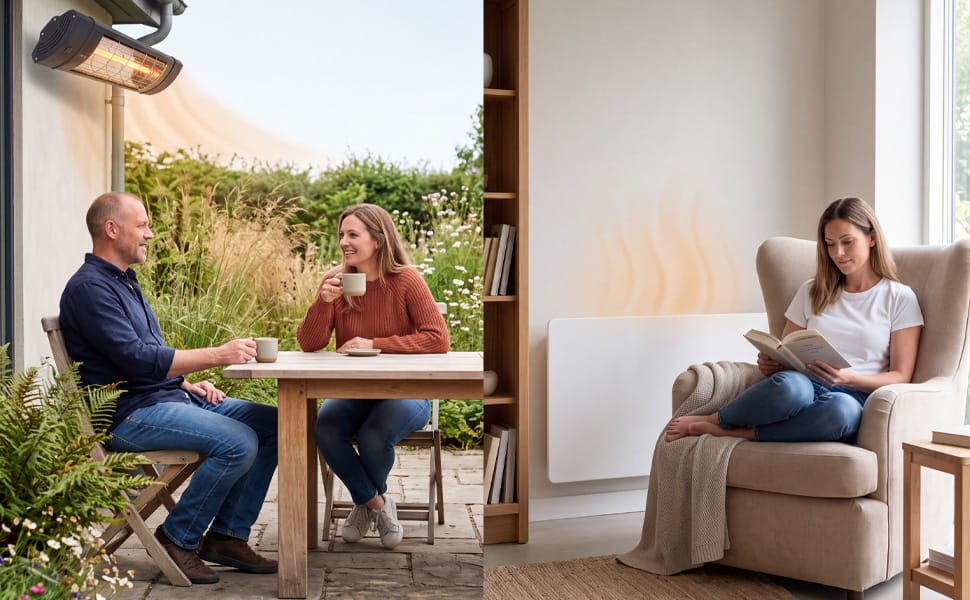
A bathroom is used for short periods and wants more warmth than the rest of the home while you are in it. An infrared panel fits that pattern. It is slim, silent and fixed to the wall or ceiling, and it warms the people and surfaces in front of it.
Which infrared heater is suitable for a bathroom?
A heater for the bathroom needs protection against splashing water. All three Opranic indoor panels have it. The IP rating tells you how well the housing is protected: IP44 and IP24 both mean protection against splashing water from any direction.
| Model | Protection | Mounting | Control | Warranty |
|---|---|---|---|---|
| P5 Metal, 300 to 900 W | IP44 | Wall or ceiling | External thermostat, sold separately | Five years |
| P6 Hybrid, 550 or 900 W | IP24 | Wall, horizontal | Built-in thermostat dial | Three years |
| P7 Glass, 450 to 900 W | IP44 | Wall, horizontal or vertical | External thermostat, sold separately | Five years |
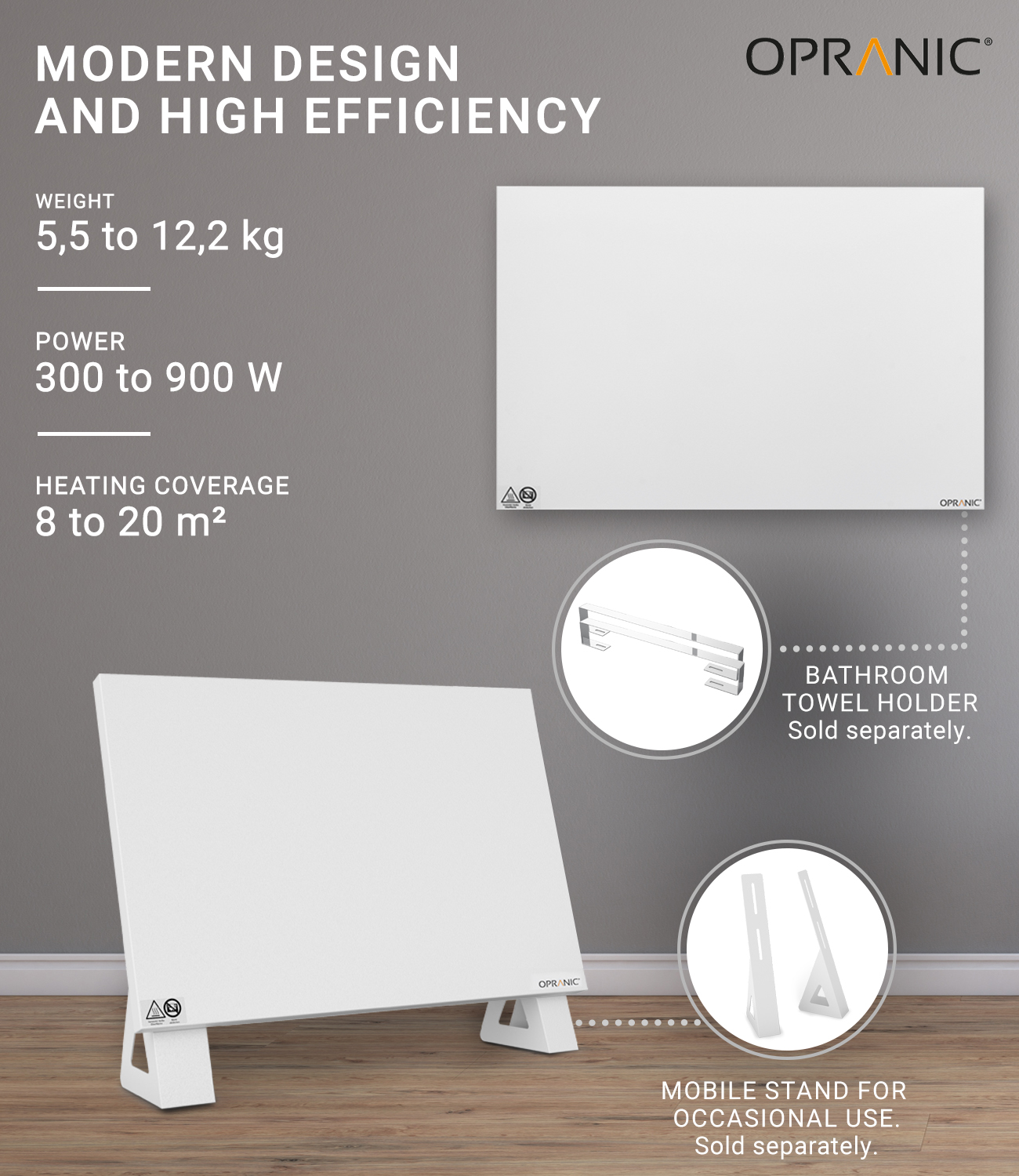
The P5 is the most flexible choice, because it mounts on the wall or on the ceiling and takes an optional towel holder. The P6 Hybrid adds gentle convection and has its thermostat built in. The P7 has a front of toughened safety glass in black or white that you wipe clean with a damp cloth once the panel has cooled.
What size infrared heater does a bathroom need?
As a starting point, allow around 100 W per square metre in an insulated room with a 2.4 m ceiling. Bathrooms often need a little more than that, because you want a higher temperature than in other rooms and because tiles, an outside wall or a window take up heat. If your bathroom falls between two sizes, choose the larger one. The thermostat keeps it from heating longer than needed.
| Bathroom floor area | Suitable panel | Dimensions |
|---|---|---|
| 3 to 4 m² | P5 300 | 60 × 40 cm |
| 4 to 6 m² | P5 450 or P7 450 | 60 × 60 cm |
| 5 to 6 m² | P6 550 | 60 × 60 cm |
| 7 to 9 m² | P5 700 or P7 700 | 90 × 60 cm |
| 9 to 12 m² | P5 900, P6 900 or P7 900 | 120 × 60 cm, P6: 100 × 60 cm |
These are guide values for an insulated room. An older building, a large window or a high ceiling calls for more output, and a large bathroom is often better served by two panels than by one.
Where to place the panel in the bathroom
Radiant heat travels in a straight line, so place the panel where it can reach you. A good position is a free wall facing the spot where you stand after the shower or in front of the basin. Keep the panel no more than 3 to 4 m from that spot.
- Mount the panel outside the splash zone of the bath and the shower.
- Keep combustible materials at least 30 cm from the front and 10 cm from the edges of the panel.
- On the wall, mount the P5 and the P7 at least 15 cm above the floor.
- Do not place the panel behind a door, a shower curtain or a row of hanging towels.
Electrical rules divide a bathroom into zones around the bath and the shower. Which zone a heater may be installed in depends on its IP rating and on how it is connected. Follow the manual for your model, and ask an electrician if you are unsure where the zones end in your bathroom.
On the ceiling
In a small bathroom the walls are often taken up by the mirror, the cabinet and the towel rail. The P5 can then go on the ceiling, where it sends its warmth down over the floor and over you. Use the supplied locking bracket and fixings that suit the ceiling. The P6 and the P7 are made for the wall only.
Infrared bathroom heater with towel holder
The optional towel holder turns the P5 into a place for warm towels. The set is made of brushed aluminium, holds two towels and fits the P5 700 and the P5 900. The holders keep the towels at a distance from the surface, so the panel can still give off its heat.
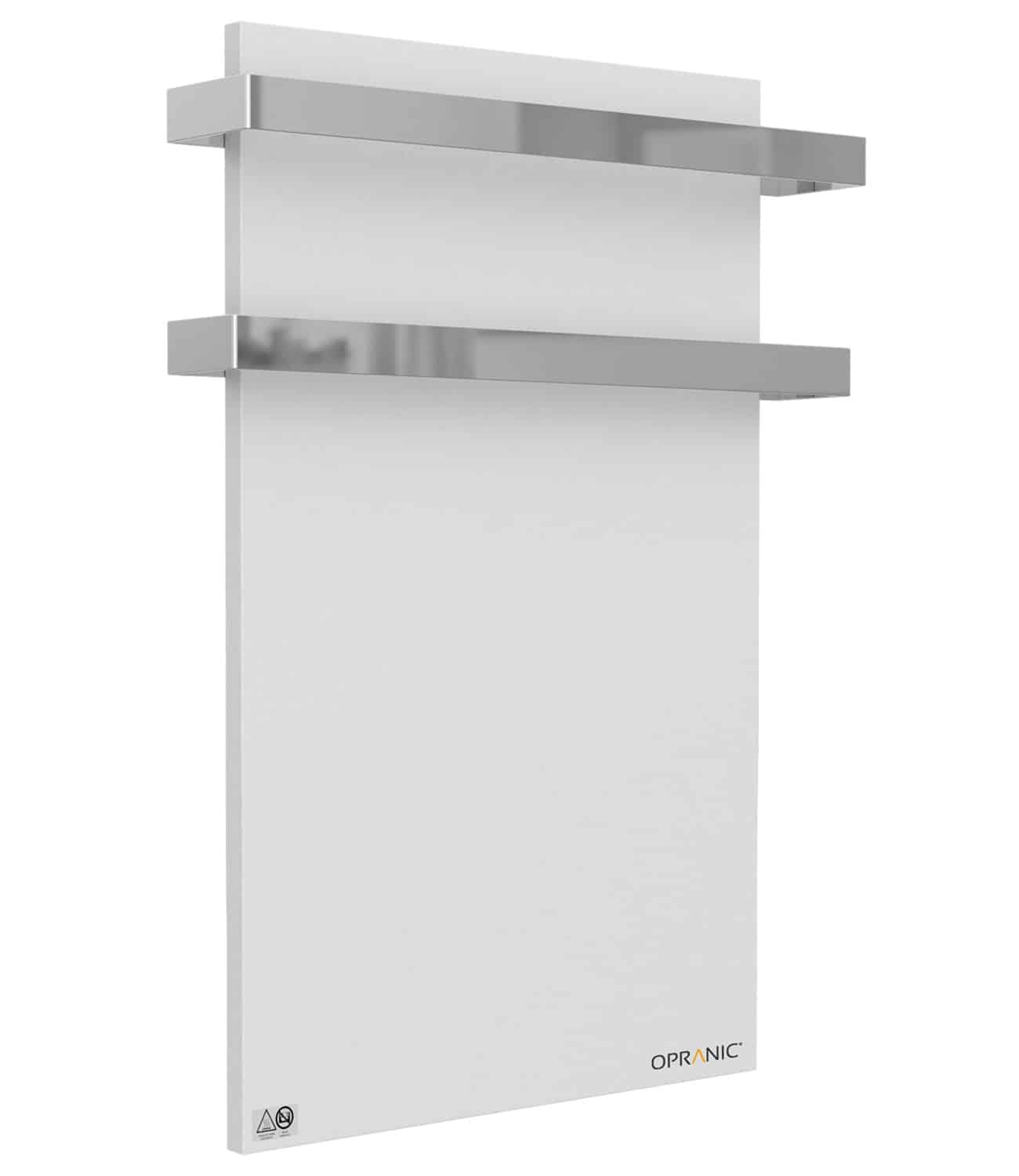
Never lay towels or clothes directly on a panel, and never cover it. The surface gets hot while it heats, between 95 and 115 °C on the P5.
Thermostat: how to control the heat
A thermostat switches the panel off when the bathroom is warm and on again when it cools. That keeps the temperature even and stops the panel from running longer than needed.
- The P6 Hybrid has a built-in thermostat. You turn the dial to the level you like.
- The P5 and the P7 need an external room thermostat, sold separately. A thermostat with a weekly schedule can warm the bathroom before you get up.
- The plug-in thermostat OT50 is rated IP20. Use it only at a socket in a dry position, away from the bath and the shower.
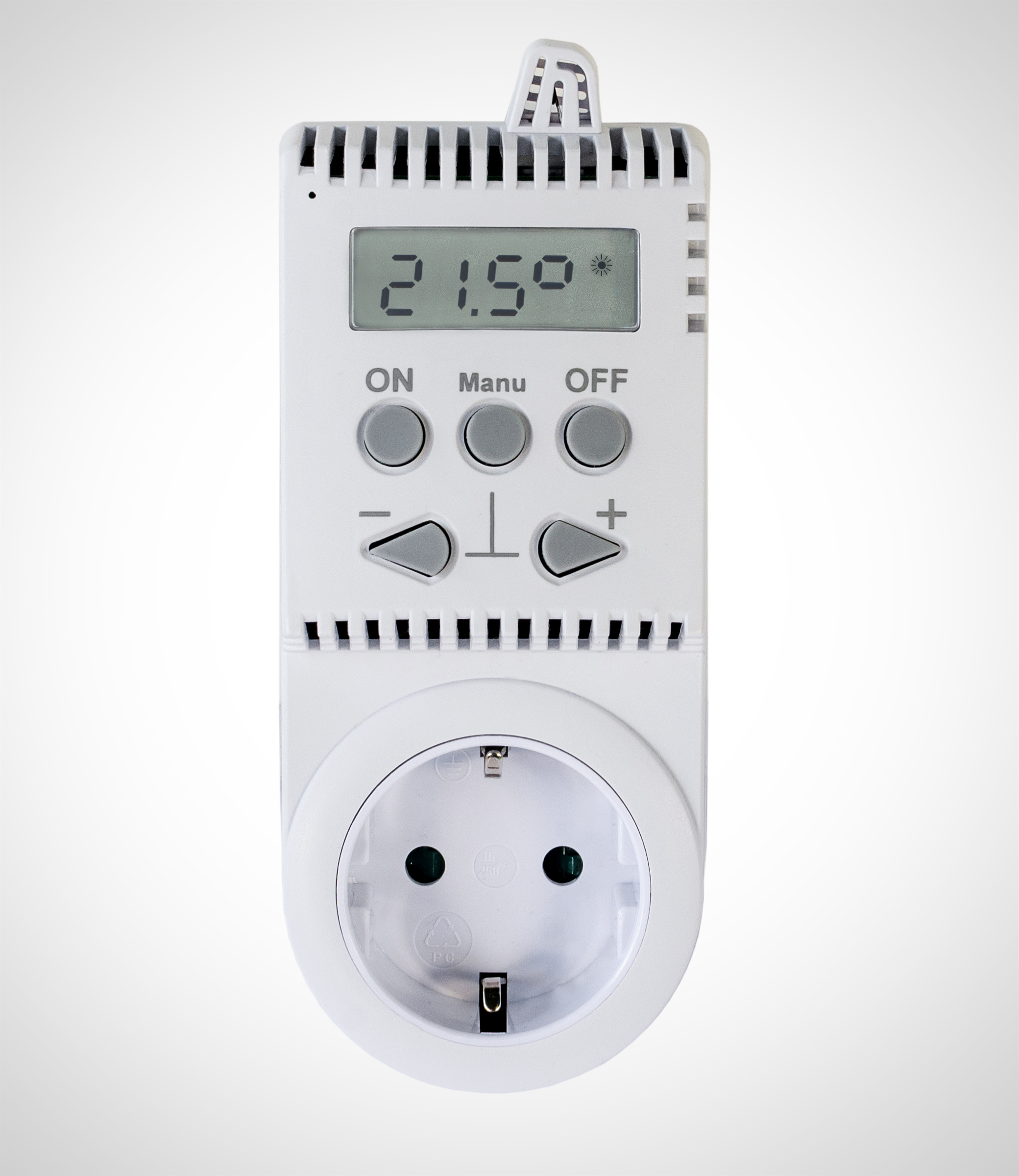
Read more in the guide to thermostats for infrared heaters.
What does an infrared bathroom heater cost to run?
A panel draws its rated output while it heats. Multiply the output in kilowatts by the hours and by your electricity price. The table uses €0.38 per kWh and one hour of heating at full output a day.
| Panel | Per hour | Per month at one hour a day |
|---|---|---|
| 300 W | about €0.11 | about €3.40 |
| 450 W | about €0.17 | about €5.10 |
| 550 W | about €0.21 | about €6.30 |
| 700 W | about €0.27 | about €8.00 |
| 900 W | about €0.34 | about €10.30 |
With a thermostat the panel does not heat at full output for the whole hour, so the real figure depends on your bathroom, on the temperature you choose and on the hours you heat. The panels turn about 98 to 99% of the electricity into heat. That figure describes the conversion and is no promise of a lower bill.
The full calculation is in the guide to infrared heater power consumption.
Questions about infrared heaters in the bathroom
Is IP44 enough for a bathroom?
IP44 means protection against splashing water from any direction, which is the protection a bathroom heater outside the splash zone needs. It does not make the panel suitable for a position where water jets or standing water can reach it. The manual states where your model may be installed.
Do I need an electrician?
The panels come with a 1.9 m cable and a plug, so the panel itself needs no electrician. If your bathroom has no suitable socket, fitting a new one is work for an electrician.
Can I dry towels on the panel?
Only on the towel holder made for the P5 700 and the P5 900. Towels laid directly on the surface cover the panel, and a covered panel can overheat.
Can an infrared panel be the only heating in the bathroom?
That depends on the room. These products are only suitable for well-insulated spaces or occasional use. In a well-insulated bathroom a correctly sized panel can keep the room comfortable. In an older or poorly insulated bathroom it works best as extra warmth for the times you are in the room.
Does the mirror stay clear with an infrared panel?
An infrared panel warms the surfaces in front of it, and a warm surface collects less condensation than a cold one. How much difference you see depends on the position of the panel, the ventilation and the size of the room.
Find the right panel for your bathroom
Measure the floor area, note the free wall space and check where the nearest socket is. With those three details the choice is quick: the P5 for wall or ceiling and for the towel holder, the P6 Hybrid for a built-in thermostat, the P7 for a glass front.
Model details are based on the current product information for the Opranic P5, P6 Hybrid and P7. Checked in October 2026. For installation, always follow the manual that belongs to your panel.