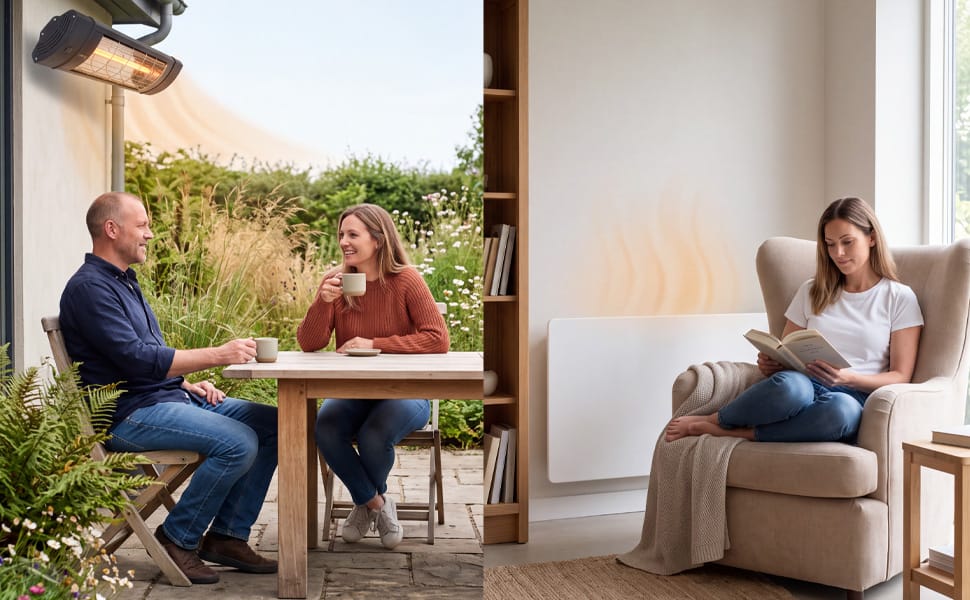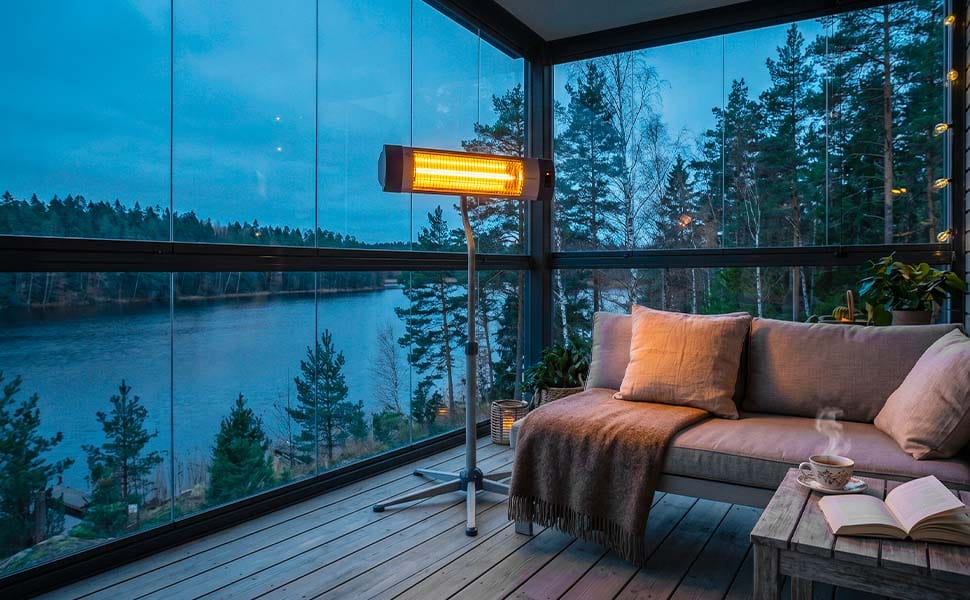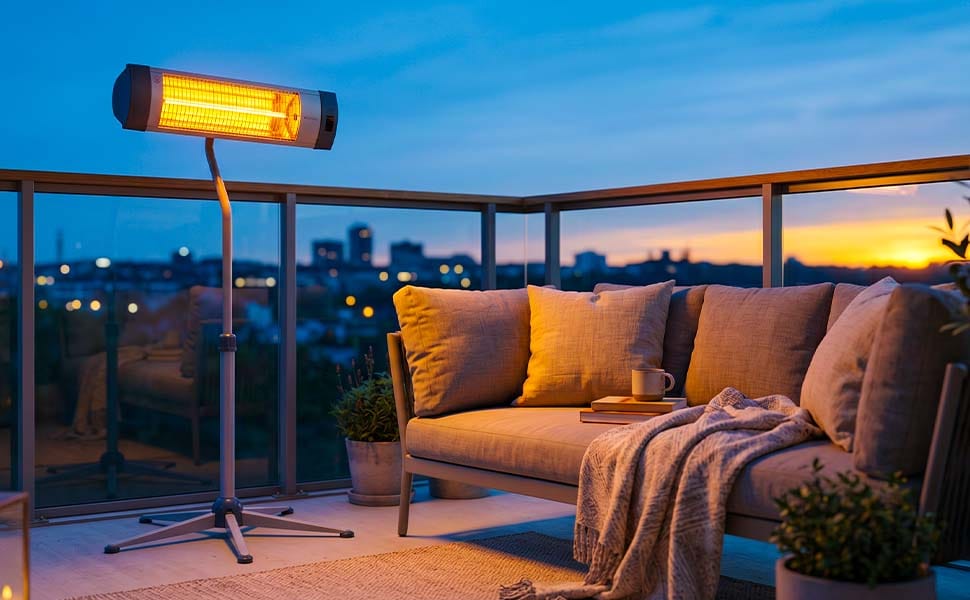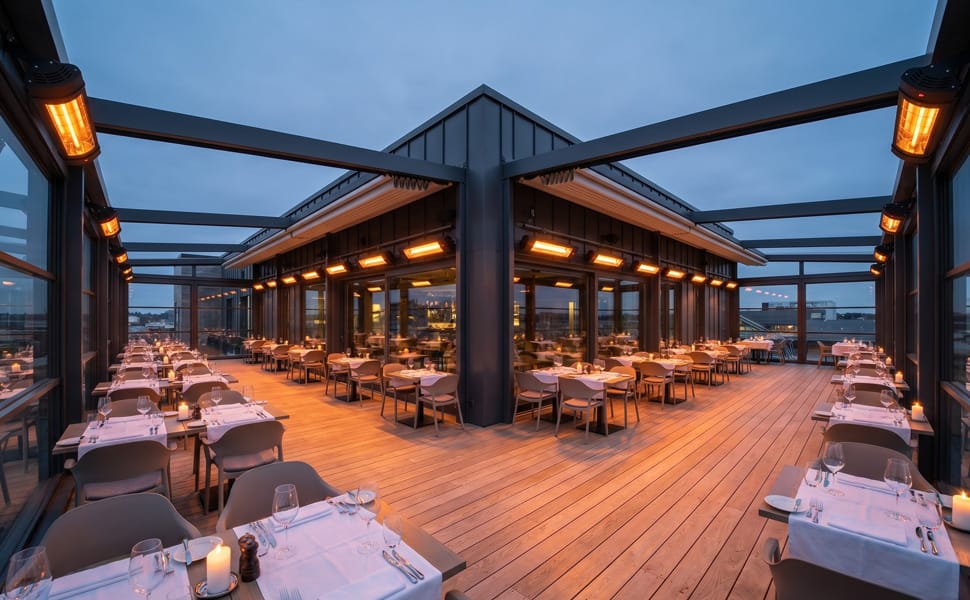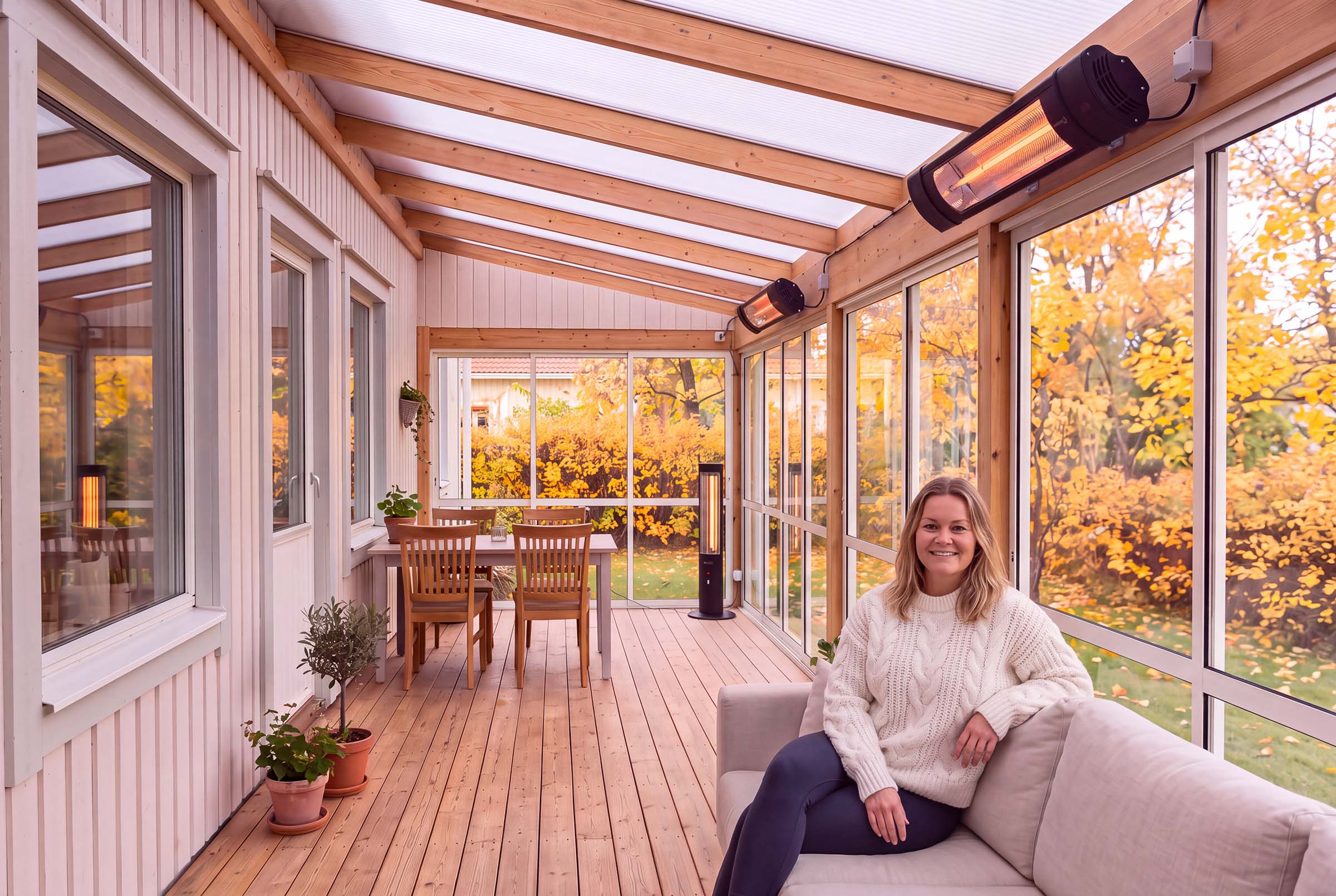
An infrared heater for a conservatory with the right power and positioning lets you enjoy your seating area on cooler spring and autumn evenings. It warms you and the seating area directly, within seconds, without first heating all the air behind the glass.
This guide explains how much power your conservatory needs, where to position your heater, the electrical and safety requirements, and which Opranic model suits your space. For a flexible seating area, the freestanding Opranic S70R is a practical choice. If you have a permanent roof and want to keep the floor clear, choose the wall-mounted or ceiling-mounted Opranic Pro V70R.
Quick answer: Allow around 200 W per m² of sheltered seating area. On that basis, a 2,300 W heater covers approximately 11 m². Choose S70R if you want to move your heater, or Pro V70R to keep the floor clear. At full power, one heater costs 4.60 SEK per hour to run, based on an example electricity price of 2.00 SEK/kWh.
1. Conservatory heating: warmth when you sit down
Many conservatories are uninsulated. The glazing keeps out the wind, but heat escapes quickly as the outdoor temperature falls. Heating all the air with a radiator or fan heater can therefore take time and use a considerable amount of energy.
An infrared heater directs warmth towards people and surfaces. The radiation is absorbed by what it reaches: your skin, clothing, table and chairs. The principle is the same as sunshine on a clear spring day, when you feel warm in the sun even though the air is cold. You can switch the heater on when you sit down and off when you go inside.
Start with your seating area and the hours you use it. Positioning determines how much warmth reaches you. Our guide to infrared heating outdoors and in enclosed spaces covers the science in more detail.
Dark radiant panel or IR-X?
In a conservatory in a northern European climate, you want to feel strong, direct warmth even when the air is cool. Opranic recommends S70R or Pro V70R with IR-X Carbon Black for targeted warmth on spring and autumn evenings. The heating element and reflector work together to direct heat towards your seating area.
A dark radiant panel, often marketed as dark infrared or a no-light infrared heater, has a large heated surface with little or no visible glow. Its surface operates at a considerably lower temperature than the glowing element in an IR-X heater. These panels can provide comfortable warmth in a suitably designed installation. However, a panel that feels very warm when you stand close to it may still provide too little warmth at the sofa in a cold conservatory. Panel size and power alone do not tell you how much radiant heat will reach you.
Warm-up times also vary. Some dark radiant panels may need around 10 to 20 minutes to reach operating temperature, depending on the model and conditions. S70R and Pro V70R deliver full heat in under five seconds, so you can take your coffee out or sit down to eat straight away. Even once a dark radiant panel reaches operating temperature, you may feel less warmth at your seat if the radiant intensity there is too low.
What matters is the warmth where you sit. The temperature of the radiating surface, the reflector, distance and direction all affect the intensity at your seat. When the air is cold and the glass surfaces are cool, you need enough directed heat to feel comfortable. A dark radiant panel with a lower surface temperature is therefore not always suitable for an uninsulated conservatory on a cool northern European autumn evening.
| What to compare | Dark radiant panel | Opranic S70R and Pro V70R |
|---|---|---|
| How warmth reaches your seating area | A large warm surface. Check the heating range and recommended positioning for the specific model. | IR-X Carbon Black with a reflector that directs warmth towards your seating area. |
| Cool spring and autumn evenings | Check that the model provides enough warmth at the temperature and distance you expect to use it. | Five power settings, from 920 to 2,300 W, to adjust directed warmth as the evening cools. |
| Warm-up time | Some models need around 10 to 20 minutes to reach operating temperature. Check the model’s specification. | Full heat in under five seconds. |
| Light and atmosphere | Little or no visible glow, depending on the model. | A soft, warm glow that adds to the atmosphere of the room. |
Ask your retailer to demonstrate the heater at the distance you expect to sit from it. Also ask what air temperature the stated coverage area is based on. Compare the same seating area under similar conditions, and check that your conservatory can accommodate the required mounting clearances.
Directed warmth for skin, wood and the materials around your seating area
IR-X Carbon Black uses medium-wave infrared radiation. Your skin and many materials around your seating area, including wood and many plastics, absorb this radiation and convert it into heat at the surface. This lets you feel warmth quickly without waiting for all the air in your conservatory to warm up. The amount absorbed depends on the material, surface finish and direction of the radiation.
The same basic principle is used in industry to heat and process wood and plastics with infrared radiation. Noblelight explains the technical background in its guide to wavelength and material absorption. In your conservatory, the aim is comfortable warmth where you sit. Always observe the model’s specified safety clearances from furniture and other materials.
A soft glow, like the embers of a fire
Opranic’s warm glow provides soft ambient light, reminiscent of the embers left after a fire has burned down. Its subdued light suits evenings spent talking around the dining table or relaxing on the sofa. Adjust the power setting to the level of warmth you want as the evening cools.
The right technology depends on the warmth you want and on the room itself. For spring and autumn use, Opranic recommends a directed heating solution that you can adjust to suit your seating area. For steady background warmth in an insulated conservatory, the heating system needs to be sized to account for heat loss from the entire room.
A glazed patio, seasonal conservatory or insulated extension?
A typical seasonal conservatory is an outdoor seating area enclosed by glazing and a roof. Its temperature can change quickly with the weather. Directed infrared heating is suited to shorter periods when you want to sit comfortably at the table or on the sofa. If your conservatory is insulated and needs to maintain a steady room temperature around the clock, you also need to assess the building’s insulation and other heating provision.
Plan around how you use the room: warmth where you sit during dinner, or heating for the whole room even when it is empty. That distinction affects both your choice of heater and how long it needs to run.
2. Infrared heater for a conservatory: size the power to your seating area
As a guide, allow 200 W per square metre of seating area in a sheltered spot with little wind. A 2,300 W infrared heater can then cover approximately 11 square metres, enough for a sofa arrangement or a dining table and chairs. Air temperature, distance from the heater and the layout of your conservatory all affect how warm you feel.
Base your calculation on the seating area. If you sit at one end of a 20-square-metre conservatory, the area that needs directed warmth may be considerably smaller. For S70R, a distance of approximately 1.5 to 4 metres from your seating position is a useful guide for comfortable warmth.
| Seating area and use | Recommendation |
|---|---|
| Up to approximately 11 m² | One Opranic S70R rated at 2,300 W. Adjust the power setting to suit the temperature and distance. |
| 12 to 20 m² or an L-shaped seating arrangement | Two heaters directed towards the seating can distribute warmth more evenly. Plan the electrical supply for both. |
| Small conservatory, one or two people | S70R at a lower setting, 920 or 1,265 W, or the lighter Opranic S50R. |
| Fixed roof, with the floor kept clear | Pro V70R for approximately 6 to 11 m² at a mounting height of 1.8 to 2.5 m. This guideline applies at around 10 °C and varies with conditions in your conservatory. |
Worked example: an 8 m² seating area
An 8 m² seating area × 200 W gives an estimated power requirement of 1,600 W. The 1,610 W setting is therefore a practical starting point. Adjust it up or down according to how warm you feel where you sit. This calculation is a guide to personal comfort, not a guarantee of a particular air temperature.
Five power settings from 920 to 2,300 W let you adjust the warmth as the evening cools. A lower setting may be enough on a cool September evening, while colder weather may call for more power. For more on the calculation, read our article on infrared heating and electricity consumption.
3. Freestanding or ceiling-mounted infrared heater?
Choose the model that suits how you use your conservatory. Both S70R and Pro V70R feature IR-X Carbon Black™, five power settings, remote control, a 1–9 hour timer and an IP65 rating. Both reach full heat in under five seconds, so you can sit down straight away.
Opranic S70R: freestanding, portable and award-winning
S70R lets you direct warmth where you need it. It stands 106 cm tall on a cast iron base and has electronic tip-over protection. Place it beside your sofa one evening and by your dining table the next, without drilling into walls or ceilings. Switch it off, unplug it and allow it to cool before moving it.
Aftonbladet named the S70R best in test, and it won Inspekto awards during the period from 2022 to 2025. You can also use it in a fully enclosed conservatory, following the model’s instructions for portable radiant heaters. The heater carries a five-year warranty, with two years for the heating tube, and the element is rated for a lifetime of up to 12,000 hours. For more detail, see our guide to how infrared heaters perform in independent tests.
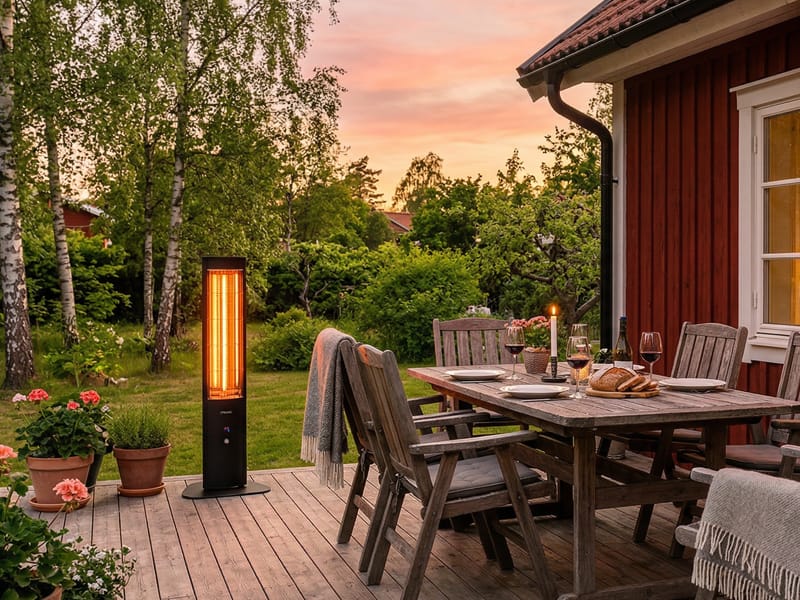
Opranic S70R: warmth wherever you sit
Freestanding design with a cast iron base, five power settings up to 2,300 W, remote control and a five-year warranty.
Opranic Pro V70R: fixed ceiling or wall mounting
Mount the Pro V70R 1.8–2.5 metres above the floor and angle it 30–45 degrees towards your seating area. Weighing 3.5 kg, it keeps your floor clear and suits a conservatory with a permanent roof and a fixed seating layout. Auto-restart mode is available for installations on a central control system. Refer to the operating instructions before using this function.
Pro V70R is designed for outdoor use, covered terraces and open conservatories. In a fully enclosed conservatory, it must be used with a room thermostat with a weekly timer and open-window detection, as specified in the product instructions. For a freestanding option in an enclosed conservatory, choose S70R. Full installation instructions are provided in the user manual.

Pro V70R for walls and ceilings
Directed warmth up to 2,300 W, five power settings, remote control and a timer. Five-year warranty.
4. Position your infrared heater where the warmth reaches you
Place S70R on a firm, level surface, facing your seating area. Leave at least 100 cm clear in front and on each side, 50 cm behind and 50 cm above, measured to the underside of any ceiling, awning or parasol. If your conservatory has a low ceiling, measure the clearance above the heater carefully before you install it.
For Pro V70R, allow at least 100 cm clearance in front, 70 cm to combustible materials at the sides and below, 30 cm to walls to either side of the radiation path, and 10 cm to the wall behind. Keep curtains, blinds and other fabrics out of the path of radiant heat. Always read the full installation instructions before fitting the heater.
Plan separate heating zones for the sofa and the dining table
A sofa beside the glazing and a dining table further away may need heat from different directions. A heater aimed at the sofa may not warm the dining area as well. Check how the warmth reaches each seat before choosing a permanent position. Large pieces of furniture and chair backs can block radiant heat.
For wall mounting, make sure the wall can carry the weight of the heater, and choose fixings suited to its construction. Measure the clearances to the ceiling, timber beams, curtains and any blinds or shades. Where the roof is low or sloping, a freestanding model may be the more practical choice, provided you can maintain all its required safety clearances.
5. Plan your power supply and controls
At full power, both models draw 10 A. Connect only one heater per circuit and use a socket protected by an RCD. The cable is 1.9 m long, so check that it reaches the socket without crossing a walkway. Before moving the S70R, switch it off, unplug it and let it cool down for 10–15 minutes.
Two heaters at full power draw a total of 4,600 W. Before you plan separate seating areas, check which sockets share a circuit. If you need additional sockets or a fixed electrical connection, contact a registered electrical installation company.
Elsäkerhetsverket, the Swedish Electrical Safety Authority, advises that the socket must be RCD-protected and that you keep to the manufacturer’s minimum installation clearances. Read the authority’s guidance on installing infrared heaters.
6. Running costs for a conservatory infrared heater
At full power, the S70R and Pro V70R use 2.3 kWh per hour. At an illustrative rate of 2.00 SEK/kWh, that costs 4.60 SEK per hour. Substitute your own total electricity price to estimate your running costs.
| Power | Cost per hour at 2.00 SEK/kWh |
|---|---|
| 920 W | 1.84 SEK |
| 1,265 W | 2.53 SEK |
| 1,610 W | 3.22 SEK |
| 1,955 W | 3.91 SEK |
| 2,300 W | 4.60 SEK |
To calculate the cost, multiply the power in kW by the price per kWh and by the hours of use. Four hours at full power costs 18.40 SEK in this example. A lower power setting and a shorter running time both bring the bill down.
How to limit electricity use
Aim the heat at the people seated in your conservatory, choose a comfortable power setting and use the timer to limit running time. Switch the heater off when you leave. A second heater running at the same time adds to your usage, even if it spreads the warmth more evenly. Base your calculation on the combined power of all heaters and their actual running time.
7. Autumn checklist for infrared heating in your conservatory
- Measure your seating area. Mark out the sofa, dining table and the seats you want to heat.
- Choose the position. Check that the heat reaches everyone seated there and that you can maintain the required safety clearances.
- Plan the electrical supply. Check the circuits, residual current device (RCD) and cable route to the socket.
- Check your conservatory type. A fully enclosed conservatory may have different control requirements from an open terrace.
- Try the power settings. Start with a setting suited to the weather, then adjust for comfort.
- Switch off after use. Let the heater cool before moving it or fitting a cover.
Conservatory infrared heating: questions and answers
Is one infrared heater enough for a 15-square-metre conservatory?
One S70R may be enough if your seating area covers approximately 11 square metres and the heater is aimed towards it. If your seats are spread out, two heaters can provide more even warmth. Distance, air temperature and positioning all affect the result.
Heating a 20 m² conservatory: one heater or two?
Start by marking out the seats you actually use. If your family sits together in a sofa area of around 8-10 m², one heater aimed at that area is a sensible place to start, even if the conservatory itself measures 20 m². A dining table at the other end forms a separate seating area and may need its own heater.
Two heaters can provide warmth from different directions, but plan both their positions and electrical connections before buying. Two 2,300 W units draw 4.6 kWh for every hour at full power. At an example electricity price of 2.00 SEK/kWh, that costs 9.20 SEK per hour. When you are only using the sofa area, you can switch off the heater by the dining table. Match the number of heaters to your seating areas, and run only the ones you are using.
Which conservatory heater should I choose?
S70R is the freestanding model, easy to move between seating areas. Pro V70R is designed for a fixed installation above a seating area you use regularly. Compare power output, mounting height, safety clearances and the controls your conservatory requires.
Does infrared heating work with the glass doors open?
Yes, radiant heat can warm people and surfaces even when the doors are open. Draughts and low outdoor temperatures still affect comfort. Direct the heater towards your seats and adjust the power setting to suit the conditions.
Can infrared heaters keep a conservatory frost-free all winter?
The power recommendations in this guide are for targeted warmth in seating areas. For frost protection or a consistent room temperature, you need to assess heat loss across the whole room and choose heating and controls designed for that purpose. Do not use the seating-area guideline of 200 W/m² to size your winter heating.
Is a heater with no visible glow always the better choice for a conservatory?
Base your choice on the warmth you feel where you sit and on the conditions in the room. A no-light radiant heater can suit the right setting, but it does not automatically provide enough targeted warmth in a cold conservatory. S70R and Pro V70R combine IR-X Carbon Black with a subdued glow and five power settings.
Can the heater withstand rain and moisture?
S70R and Pro V70R are IP65-rated. Follow the instructions for use and electrical connection in the manual. A protective cover is available as an accessory. Only fit it once the heater is switched off, unplugged and completely cool.
Can I use S70R in a fully enclosed conservatory?
Yes, S70R can be used in enclosed rooms in accordance with its instructions. Observe the safety clearances specified in the manual. For a smaller glazed space, see our guide to heating a glazed balcony.
Which infrared heater leaves the floor free?
Pro V70R can be mounted on a wall or ceiling. Check the mounting height, clearances and external control requirements if your conservatory is fully enclosed.
Choose your conservatory heater to suit your seating
Start with the seating area, use approximately 200 W per square metre as a guide, and position the heater to suit how you use the room. S70R is a freestanding infrared heater with five power settings and a five-year warranty. Pro V70R provides a fixed installation that keeps the floor clear.
See the product pages for models and current prices, or compare the options in our infrared heater test guide.
Choose S70R for your conservatory View Pro V70R for wall or ceiling mounting