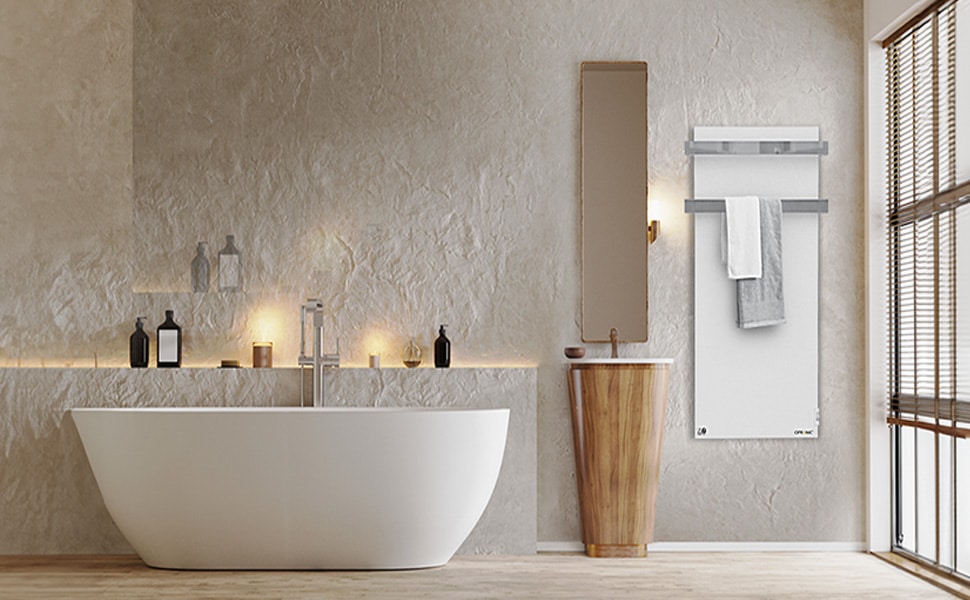
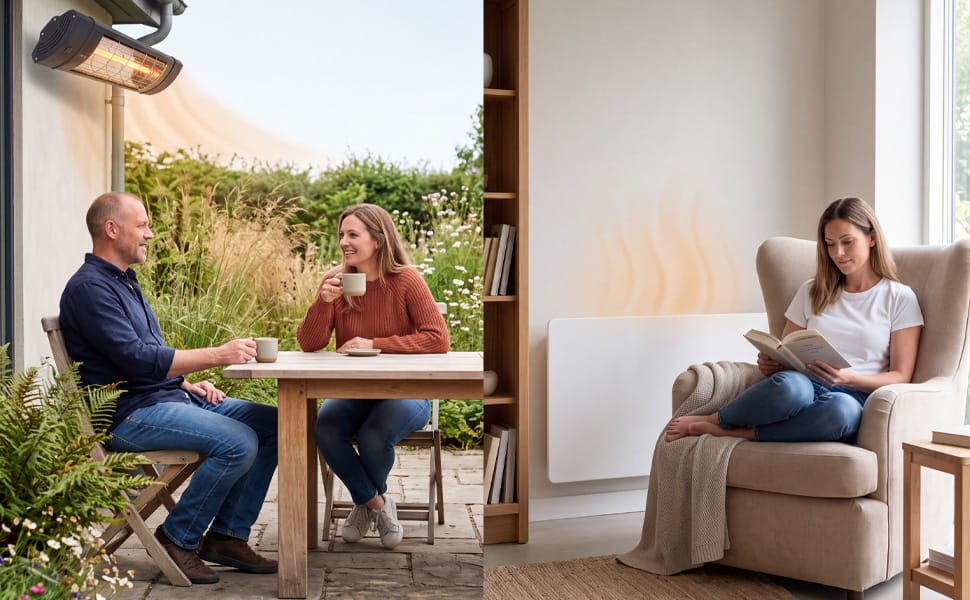
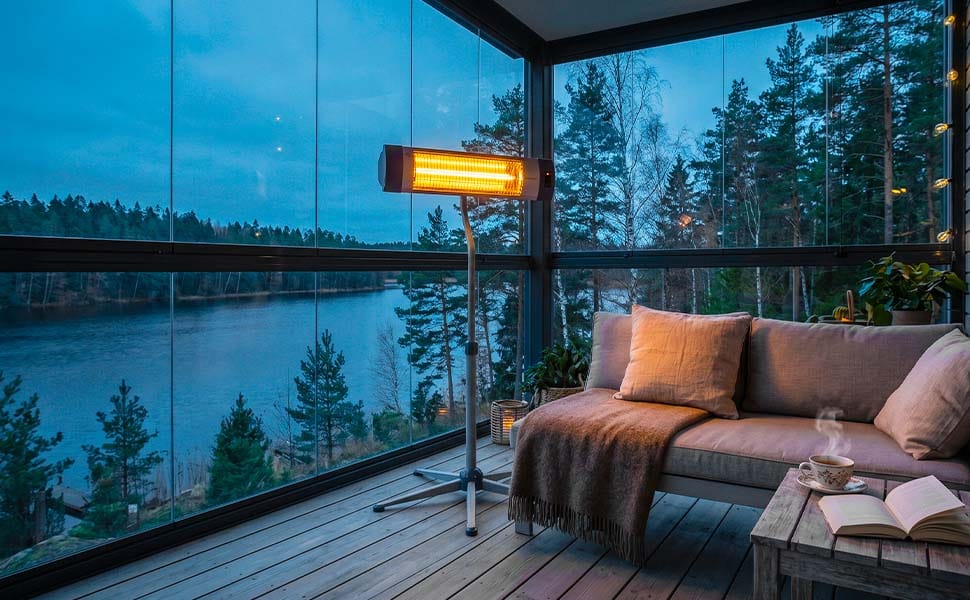
An infrared ceiling heater keeps every wall free and sends its warmth down over the place where you sit, work or sleep. This guide shows when the ceiling is the better position, which Opranic panel mounts there, which size to choose and how to plan the installation.
Walls fill up quickly: windows, shelves, a sofa, a wardrobe. The ceiling is often the largest free surface in the room, and nothing can be placed in front of it.
What is an infrared ceiling heater?
An infrared ceiling heater is a slim panel fixed flat to the ceiling. It gives off long-wave infrared heat, which warms the people and surfaces in its path. The panel works in silence, with no fan and no moving parts.
Radiant heat travels in a straight line and in the direction the panel faces. A panel on the ceiling therefore sends its warmth downwards. This is different from a convection heater, which warms the air and lets it rise.
Ceiling or wall: which is better?
The right choice depends on the free space you have and on where people spend their time.
| On the ceiling | On the wall | |
|---|---|---|
| Wall space | Every wall stays free | Needs a free wall facing the room |
| Where the warmth goes | Down over the floor, the furniture and the people below | Across the room from one side |
| Furniture | Nothing can stand in front of the panel | Sofas and shelves must not block the panel |
| Opranic model | P5 | P5, P6 Hybrid and P7 |
| Cable and socket | Plan the route from the ceiling to a socket | A socket near the panel is usually enough |
Choose the ceiling when the walls are taken, when the room has a fixed place you want to warm, such as a desk, a dining table or a bed, or when children and pets should not be able to reach the panel. Choose the wall when the ceiling is high, sloping or hard to reach with a cable. Read more in the guide to placing infrared panels.
Which Opranic panel mounts on the ceiling?
The Opranic P5 is the panel for the ceiling. It has a textured steel front in matt white and a metal housing, and it is 2.5 cm deep. Behind the heating element sit 2 cm of insulation and an aluminium reflector that direct the warmth into the room. The back of the panel stays at about 35 to 45 °C, while the front reaches 95 to 115 °C.
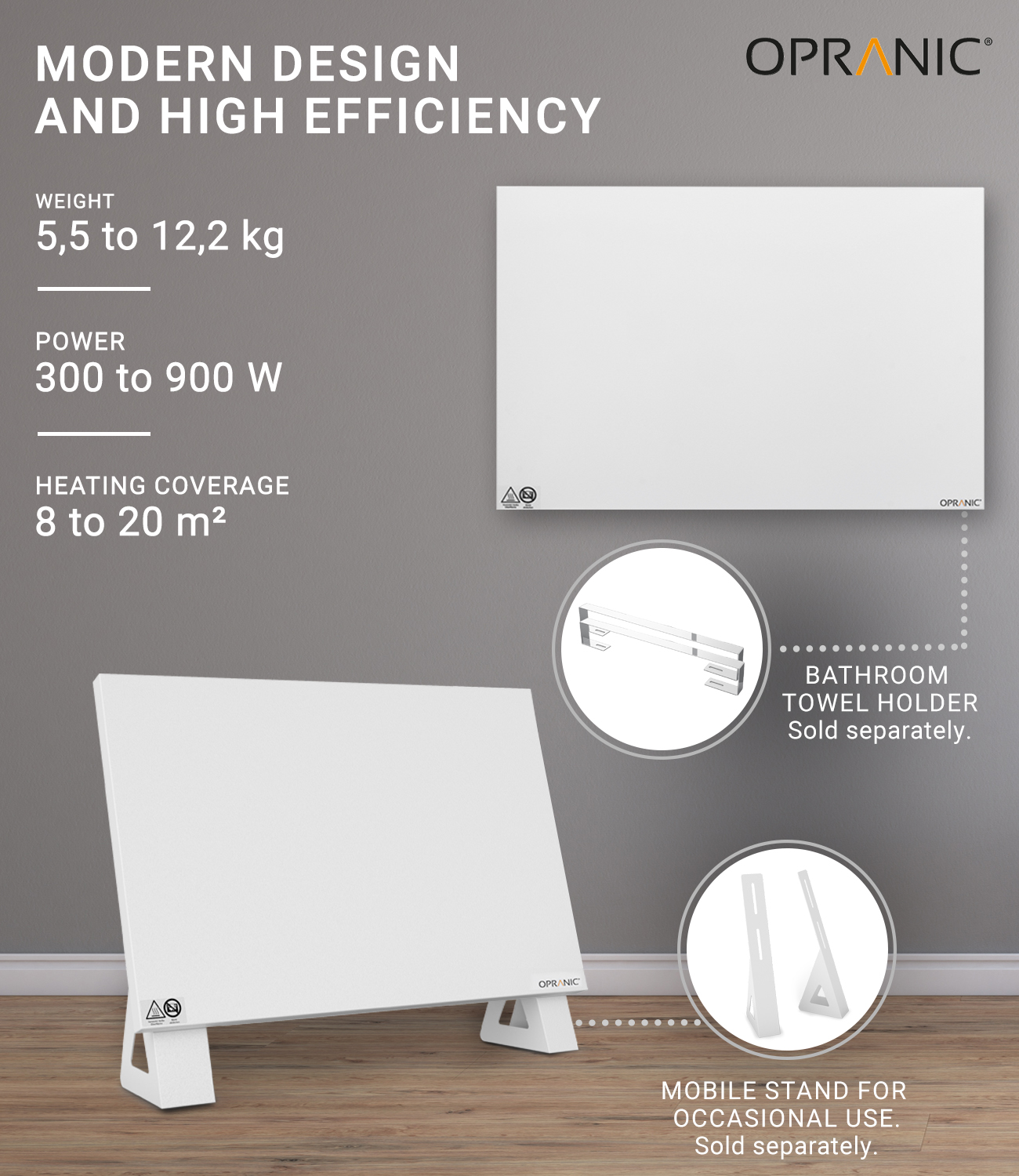
The P6 Hybrid and the P7 Glass are made for the wall only.
What size infrared ceiling heater do you need?
As a starting point, allow around 100 W per square metre in an insulated room with a 2.4 m ceiling. Older buildings, large windows and higher ceilings need more.
| Model | Output | Dimensions | Weight | Guide room size |
|---|---|---|---|---|
| P5 300 | 300 W | 60 × 40 × 2.5 cm | 5.5 kg | 3 to 4 m² |
| P5 450 | 450 W | 60 × 60 × 2.5 cm | 6.9 kg | 4 to 6 m² |
| P5 700 | 700 W | 90 × 60 × 2.5 cm | 8.4 kg | 7 to 9 m² |
| P5 900 | 900 W | 120 × 60 × 2.5 cm | 12.2 kg | 9 to 12 m² |
In a larger room, two or three panels spread over the ceiling give more even warmth than one large panel in the middle.
How to mount an infrared heater on the ceiling
The P5 comes with a locking bracket, screws and wall plugs. The bracket is fixed to the ceiling first, then the panel slides into place and is secured. The installed depth is about 5 cm including the bracket.
- Check what the ceiling is made of and use fixings that suit it. The supplied plugs do not suit every ceiling, and a plasterboard or suspended ceiling needs fixings made for it.
- Check that the ceiling carries the weight. The panels weigh between 5.5 and 12.2 kg.
- Keep combustible materials at least 30 cm from the front and 10 cm from the edges of the panel.
- Keep the panel clear of curtains, lamps and anything that hangs from the ceiling.
- Place the panel no more than 3 to 4 m from the area you want to warm.
Cable and socket
The P5 has a 1.9 m cable with a plug, so the panel itself needs no electrician. On the ceiling you need to plan where the cable goes. A socket high on the wall or on the ceiling keeps the cable short and out of sight. If there is none, a cable duct along the ceiling and down the wall is a tidy solution. A new socket is work for an electrician.
Ceiling height
The higher the ceiling, the further the warmth has to travel before it reaches you. At a normal ceiling height of about 2.4 m the panel sits well within the 3 to 4 m range. In a room with a much higher ceiling, a wall position closer to the people in the room is often the better choice.
Thermostat for an infrared ceiling heater
The P5 needs an external room thermostat, sold separately. The thermostat switches the panel off when the room is warm and on again when it cools, so the panel does not run longer than needed.
Position the room sensor away from the panel, so that it measures the temperature of the room and not the warmth from the panel. Read more in the guide to thermostats for infrared heaters.
Where an infrared ceiling heater works well
- Home office: a panel above the desk warms you and the work surface while you sit still.
- Living room: a panel above the seating keeps the walls free for shelves and pictures.
- Bedroom: a panel above the foot of the bed works in silence through the night.
- Bathroom: the P5 is rated IP44 and can go on the ceiling when the walls are full. Mount it outside the splash zone and follow the manual. See the guide to infrared heaters in the bathroom.
What does an infrared ceiling heater cost to run?
A panel draws its rated output while it heats, on the ceiling as on the wall. Multiply the output in kilowatts by the hours and by your electricity price. The table uses €0.38 per kWh.
| Panel | Per hour | Per month at four hours a day |
|---|---|---|
| 300 W | about €0.11 | about €14 |
| 450 W | about €0.17 | about €21 |
| 700 W | about €0.27 | about €32 |
| 900 W | about €0.34 | about €41 |
With a thermostat the panel does not heat at full output all the time, so the real figure depends on the room, on the temperature you choose and on the hours you heat. The P5 turns about 99% of the electricity into heat. That figure describes the conversion and is no promise of a lower bill. The full calculation is in the guide to infrared heater power consumption.
Questions about infrared ceiling heaters
Does the heat stay under the ceiling?
No. The panel radiates in the direction it faces, which on the ceiling is downwards. The warmth reaches the floor, the furniture and the people below.
Does the P5 have a built-in light?
No. The P5 is a heating panel without a lamp. Plan the room lighting separately and keep lamps clear of the panel.
Can I mount the panel on a sloping ceiling?
The bracket is made for walls and ceilings. On a sloping ceiling the fixings, the safe distances and the direction of the warmth all need checking, so follow the manual and ask us before you order.
Is an infrared ceiling heater safe above a bed or a sofa?
The P5 can go above a bed or a sofa when the distances are kept: at least 30 cm between the front of the panel and anything combustible. The P5 has overheating protection and a locking bracket. The surface is hot while it heats and must not be touched or covered.
Can a ceiling panel be the only heating in the room?
That depends on the room. These products are only suitable for well-insulated spaces or occasional use. In a well-insulated room, correctly sized panels can keep it comfortable. In an older building they work best as extra warmth for the hours you use the room.
Find the right panel for your ceiling
Measure the floor area, check what the ceiling is made of and note where the nearest socket is. With those three details the choice of size is quick.
See the Opranic P5 for wall and ceiling or ask us for advice.
Model details are based on the current product information for the Opranic P5, P6 Hybrid and P7. Checked in October 2026. For installation, always follow the manual that belongs to your panel.