Understanding infrared heater power consumption helps you calculate how much electricity your heater uses and what it costs to run. This guide gives you the formula, worked examples for heaters rated at 300 to 900 watts, and costs per hour, month and heating season. It also explains whether infrared heaters use a lot of electricity.
Your Opranic offer
Save 15% on Opranic P-series infrared heaters for indoor use
Choose heating that suits your home. Use premium15 to save 15% on Opranic P-series infrared heaters for indoor use. Accessories are excluded.
premium15Enter the code in the basket.
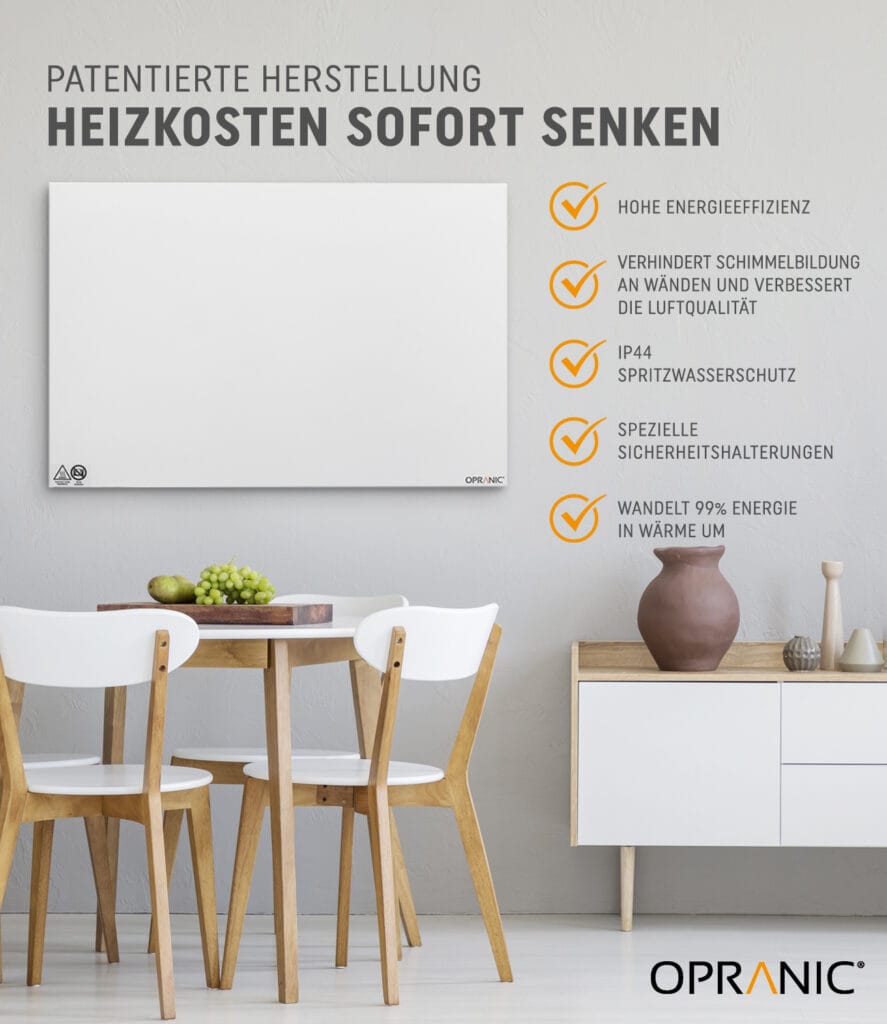
All examples in this article use an illustrative electricity price of €0.38/kWh. For a more accurate calculation, use the unit rate on your electricity tariff.
Infrared heater power consumption explained
A heater’s power rating in watts tells you how much electricity it uses when running at full power. A 450 W infrared heater uses 0.45 kWh in one hour at full power. At an illustrative electricity price of €0.38/kWh (38 cents per kWh), that costs around 17 cents per hour.
In practice, the heater rarely runs continuously. A room thermostat switches it off when the set temperature is reached and back on as the room cools. Actual electricity consumption therefore depends on the room’s heat loss, your chosen temperature and how long you use the heating. In a well-insulated room, the infrared heater runs at full power for only part of that time.
How to calculate the cost of running an infrared heater
You need three figures: the heater’s power in kilowatts, the equivalent number of hours at full power and your electricity price.
Power (kW) × equivalent hours at full power × electricity price (€/kWh) = electricity cost
Example: 0.45 kW × 4 hours × €0.38/kWh = €0.68 per day
Equivalent full-load hours express the total running time as hours at full power. If a 450 W infrared heater is used over eight hours but the thermostat keeps it switched on for only half that time, this amounts to four hours at full power. This is the figure used in the calculations below.
Infrared heater power consumption and running costs: 300-900 W examples
The table shows the cost of running an infrared heater for each of the four Opranic P5 power options. Hourly costs assume continuous operation at full power. Daily, monthly and heating season figures assume the equivalent of four hours at full power each day.
| Power | Room size (guide) | Per hour | Per day | Per month | Per heating season |
|---|---|---|---|---|---|
| 300 W | 3-4 m² | €0.11 | €0.46 (1.2 kWh) | €13.68 (36 kWh) | €82.08 (216 kWh) |
| 450 W | 4-6 m² | €0.17 | €0.68 (1.8 kWh) | €20.52 (54 kWh) | €123.12 (324 kWh) |
| 700 W | 7-9 m² | €0.27 | €1.06 (2.8 kWh) | €31.92 (84 kWh) | €191.52 (504 kWh) |
| 900 W | 9-12 m² | €0.34 | €1.37 (3.6 kWh) | €41.04 (108 kWh) | €246.24 (648 kWh) |
Swipe horizontally to see more columns.
Assumptions: an electricity price of €0.38/kWh, the equivalent of four hours at full power per day, 30 days per month and a 180-day heating season from October to March. Room sizes assume an insulated room with a ceiling height of 2.4 m.
Which P5 suits your room?
Select the power and configuration you need on the product page.
Power consumption of a 450 W infrared heater
The 450 W model suits small rooms of around 4-6 m², such as a bathroom, hallway or home office. At full power, it uses 0.45 kWh per hour. The equivalent of four hours at full power each day gives a daily consumption of 1.8 kWh, costing around €20.52 per month and €123.12 over the full heating season.
Infrared heater power consumption per square metre
As a starting point, allow around 100 W of heating power per square metre for an insulated room with a ceiling height of 2.4 m. Older buildings, large areas of glazing, several external walls and higher ceilings need more power. In larger rooms, several carefully positioned heaters distribute warmth more evenly than a single large unit.
If you use infrared heating as the main heating system throughout your home, electricity consumption depends on the building’s heating energy demand. An infrared heater converts almost all the electricity it uses into heat. Each kilowatt-hour of heat your building needs therefore requires approximately one kilowatt-hour of electricity.
Annual infrared heating electricity consumption by building type
| Building | Heating energy demand (guide) | Annual cost per m² | 50 m² | 100 m² |
|---|---|---|---|---|
| Well-insulated new build | 30-50 kWh/m² | €11.40-19.00 | €570-950 | €1,140-1,900 |
| Partially renovated existing building | Approx. 100 kWh/m² | €38 | €1,900 | €3,800 |
| Unrenovated older building | 150-250 kWh/m² | €57.00-95.00 | €2,850-4,750 | €5,700-9,500 |
Swipe sideways to see more columns.
Annual costs based on an illustrative electricity price of €0.38/kWh. Check your building’s Energy Performance Certificate (EPC) for its heating energy demand.
For a well-insulated new build of 100 m², infrared heating as the main heating system would therefore cost approximately €1,140 to €1,900 a year. Spread across the six-month heating season, that is around €190 to €317 a month. Costs are considerably higher in an unrenovated older building, where using infrared heaters to heat individual rooms as needed is the more economical option.
Do infrared heaters use a lot of electricity?
An infrared heater converts approximately 99% of the electricity it uses into heat. This figure describes energy conversion, not energy savings. Your actual infrared heater power consumption depends on where and how you use it.
A heat pump delivers several kilowatt-hours of heat for every kilowatt-hour of electricity because it also draws heat from its surroundings. Heating an entire, poorly insulated home solely with infrared will therefore cost more than using a heat pump. Infrared heating is particularly suited to spaces where you need targeted warmth for limited periods:
- in your home office, heated only during the day
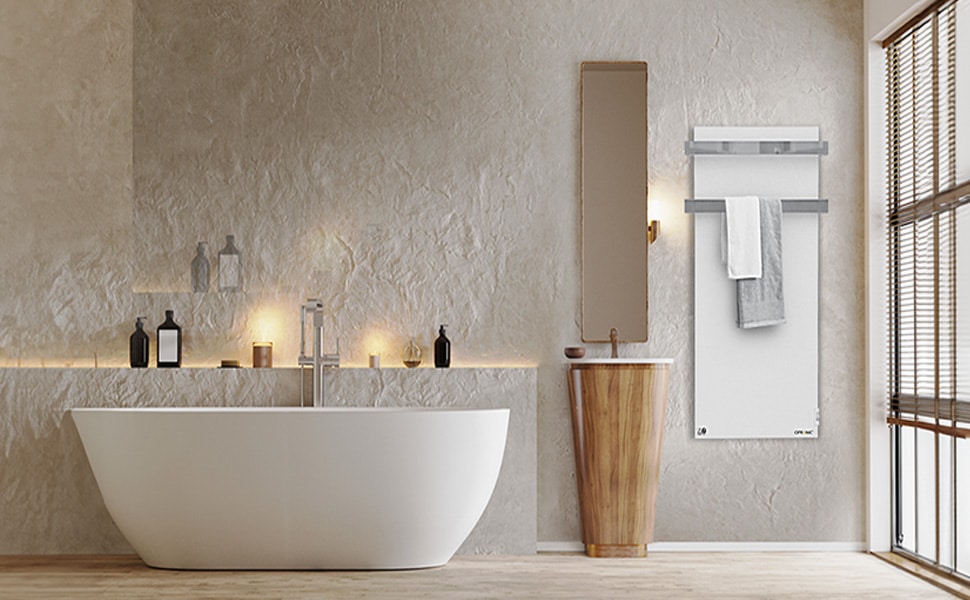
- in your bathroom, for quick warmth in the morning and evening
- in a guest room, hobby room or loft that you use occasionally
- between seasons, before you turn on the central heating
- in a well-insulated new home with low heating demand
You can heat these rooms only when you use them, while keeping the central heating at a lower setting. An infrared heater needs no fuel supply, chimney or water pipes. It mounts on the wall or ceiling and plugs into a socket.
The way heat reaches you also matters. Infrared directly warms people and surfaces within its radiant range, so a room can feel comfortable at a slightly lower air temperature. Each degree you lower the room temperature reduces electricity consumption.
Reducing infrared heater power consumption: five tips
1. Use a thermostat with a heating schedule
Your room thermostat has the greatest influence on your electricity costs. Choose a model with a weekly programme and open-window detection. This allows your infrared heater to run only when you use the room and switch off while you air it. According to Germany’s Federal Environment Agency (Umweltbundesamt), programmable thermostats can reduce energy use by around 10%. Read more in our guide to infrared heating control and automation.
2. Choose the right power rating
An undersized heater runs almost continuously at full power, yet still takes longer to reach your chosen temperature. Use around 100 W per square metre as a guide, and allow for more power in older buildings or rooms with large windows or high ceilings.
3. Position your heater correctly
Direct the heater towards the area you use, such as your desk or sofa. Avoid pointing it directly at windows, and keep furniture and curtains clear of the unit. You can find further guidance in our infrared heater positioning tips.
4. Heat rooms individually
Heat only the rooms you are using, and keep doors to unheated rooms closed. This is the main advantage of individual infrared heaters over central heating.
5. Review your electricity tariff
Your electricity price directly affects every bill, so compare tariffs regularly. Some suppliers offer dedicated tariffs for electric heating. Ask your electricity supplier and network operator whether these apply to infrared heaters and whether you need a separate meter. Solar PV panels allow you to use electricity you generate yourself, particularly in spring and autumn when there are more hours of sunlight.
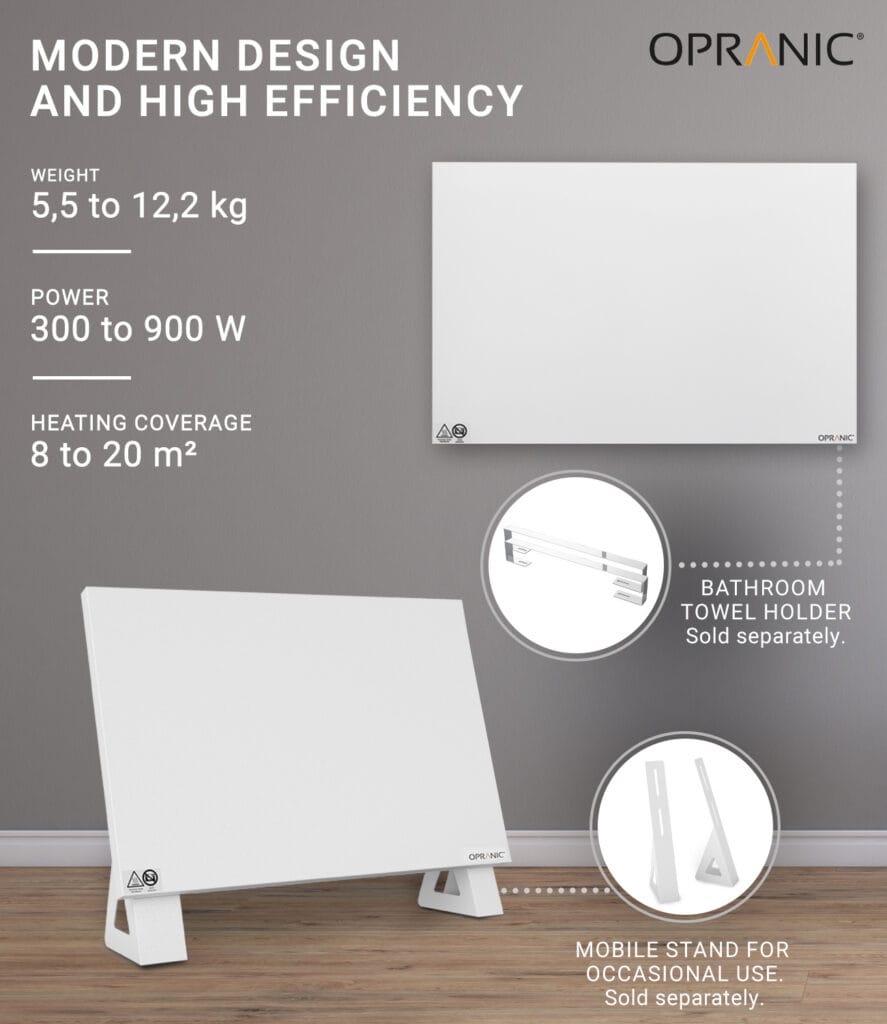
Opranic P5: Metal heating panel for walls and ceilings
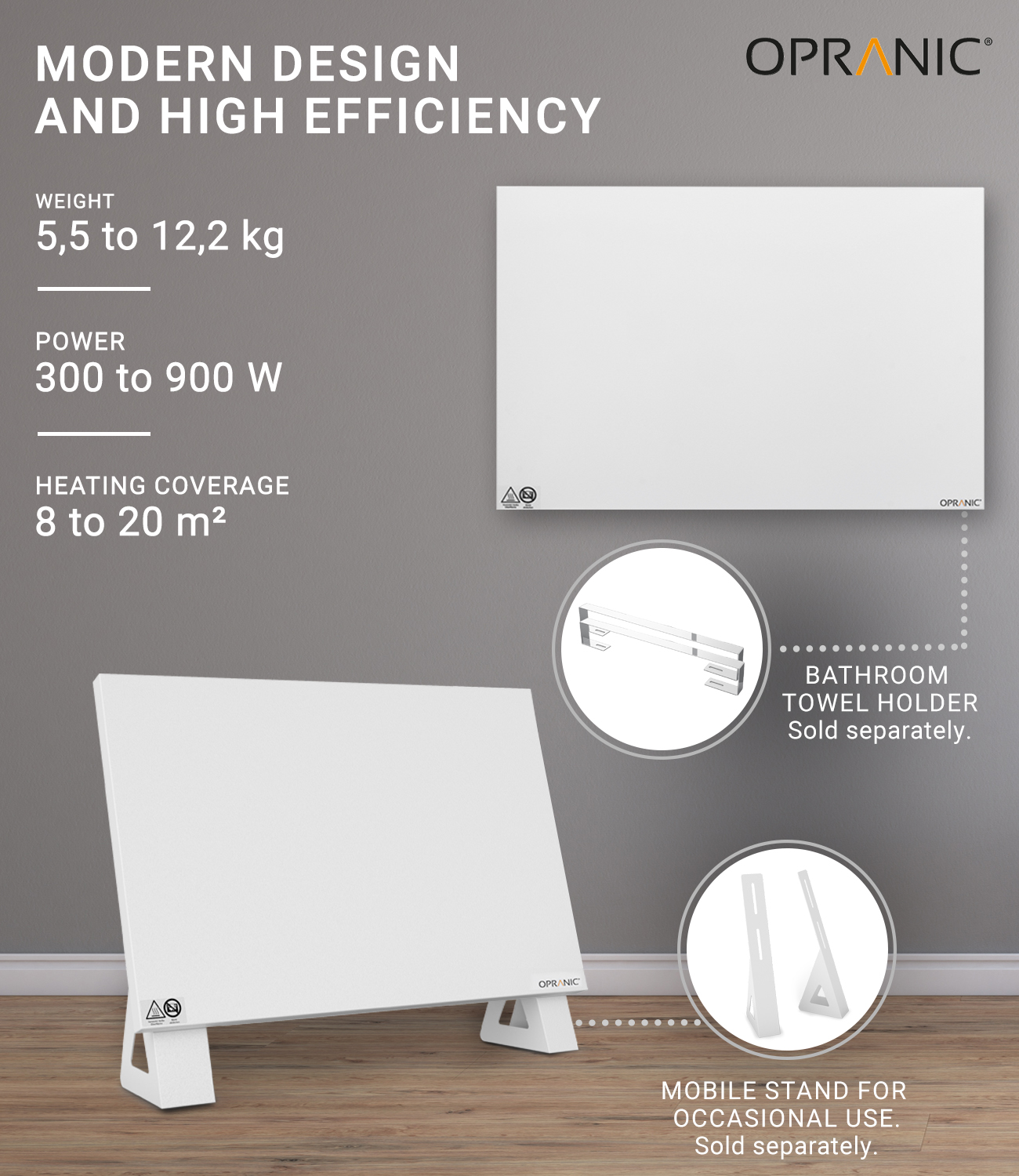
The Opranic P5 is a slim infrared heating unit with a textured steel front and metal housing, designed for your living room, bathroom or study. A 2 cm layer of insulation and an aluminium reflector at the rear direct heat forwards into the room. The heating elements extend close to the edges, distributing warmth evenly across the steel surface.
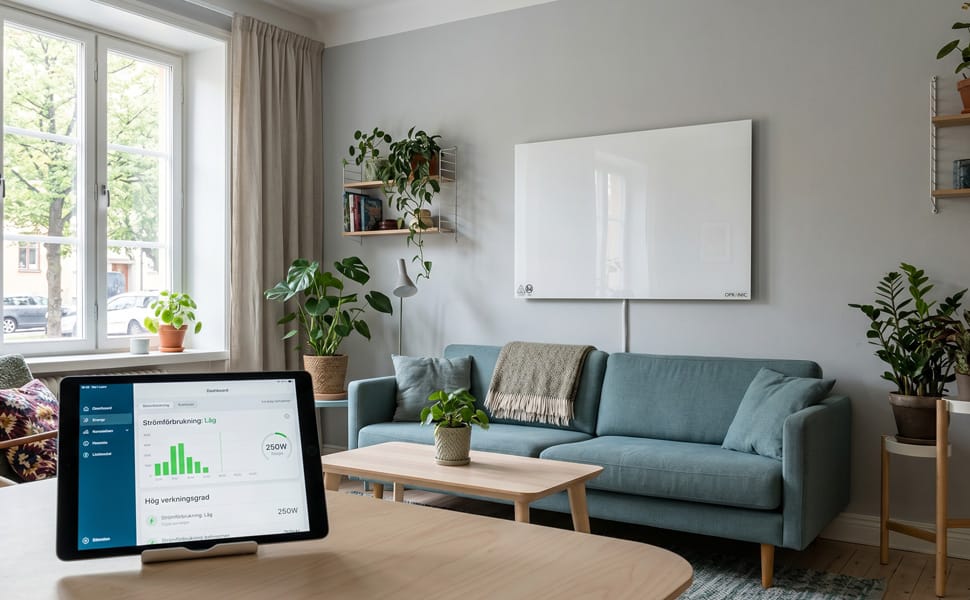
At just 2.5 cm deep, the P5 mounts on your wall or ceiling, keeping floor space clear. With no fan, it operates silently. Control is provided by an external room thermostat, sold separately. A weekly programme and open-window detection let you match heating to the times you use the room.
- Power
- 300, 450, 700 or 900 W
- Room size (guide)
- 3-12 m²
- Depth
- 2.5 cm
- Mounting
- Wall or ceiling, with optional floor stands
- IP rating
- IP44
- Temperature control
- External room thermostat, sold separately
- Certification
- TÜV SÜD, CE
- Warranty
- Five-year warranty
Warmth for your patio and balcony
Save 10% on outdoor heaters and fans
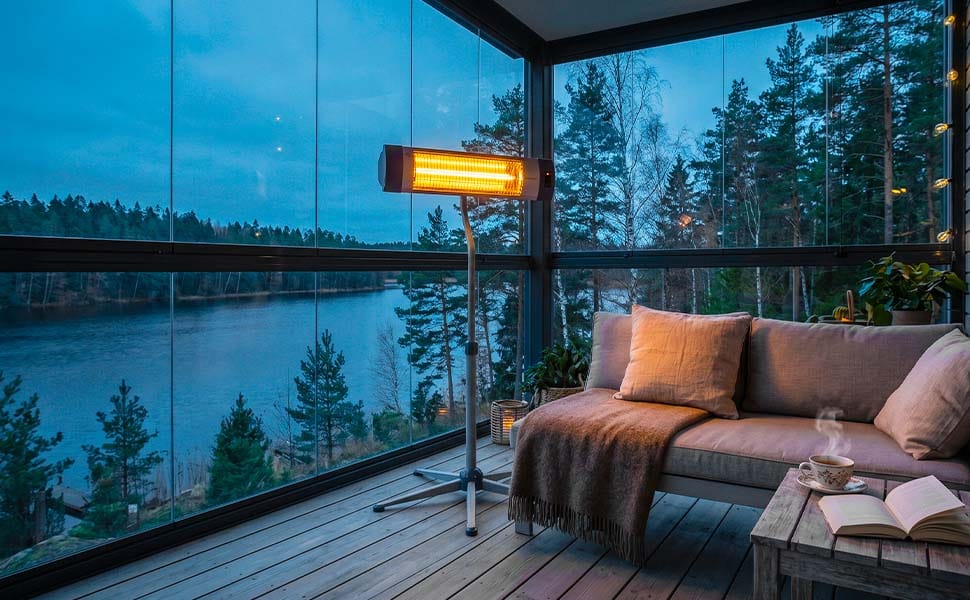
Spend more time on your patio, in your conservatory or on your glazed balcony with Opranic infrared heaters. Choose a freestanding model or a heater for wall or ceiling mounting. Suitability for conservatories and glazed balconies depends on the model and its location.
The same code also gives you 10% off Opranic fans for air circulation on warm days.
premium1010% off outdoor heaters and fans. Enter the code in the basket. Accessories excluded.
Conclusion: infrared heater power consumption at a glance
You can calculate the cost of running an infrared heater with a simple formula: power in kilowatts multiplied by hours at full power multiplied by your electricity price. At an illustrative price of €0.38/kWh (38 cents per kWh), a 450 W infrared heater costs around 17 cents per hour at full power. Assuming four hours of full-power operation each day, the monthly cost is approximately €20.52.
Used selectively, an infrared heater can keep electricity use in check: heat individual rooms, use a thermostat and heating schedule, and choose the right power for the space. As your sole heating system, it is most cost-effective in a well-insulated new build.
Choose a P5 for your room Frequently asked questions about infrared heating
Infrared heating cost analysis: purchase, running costs and savings
What is infrared heat? Technology and applications
Patio heating: comparing the running costs of infrared and gas patio heaters