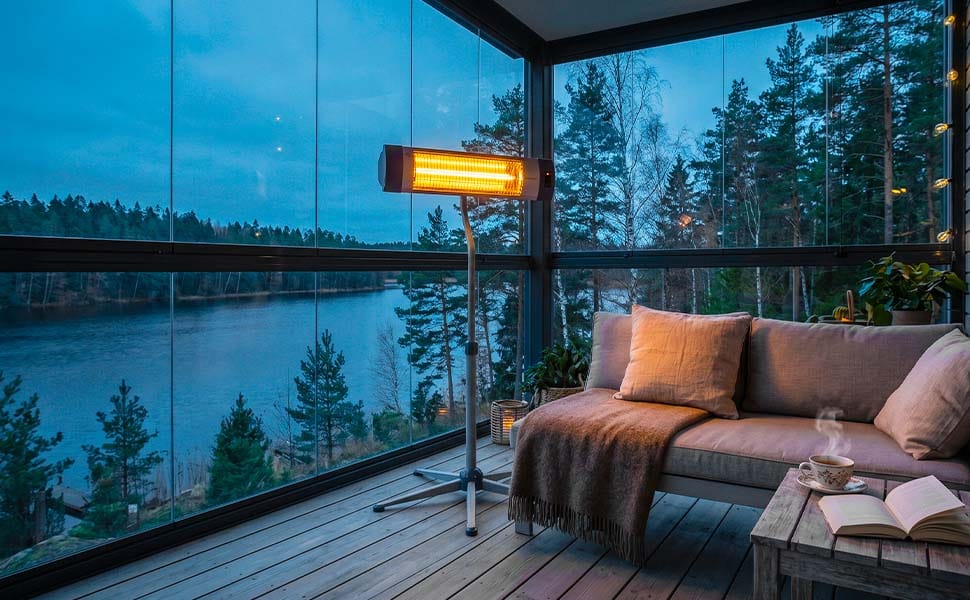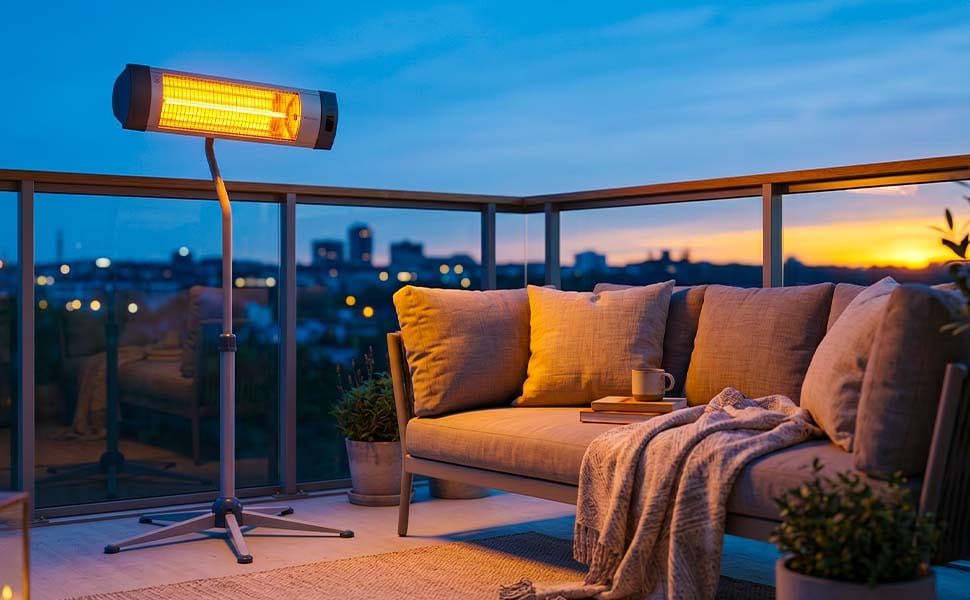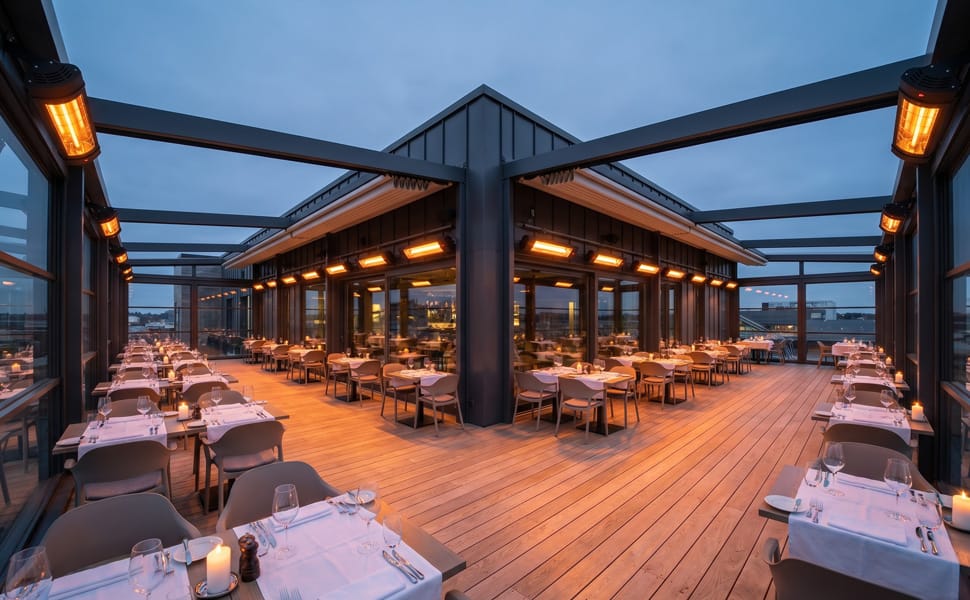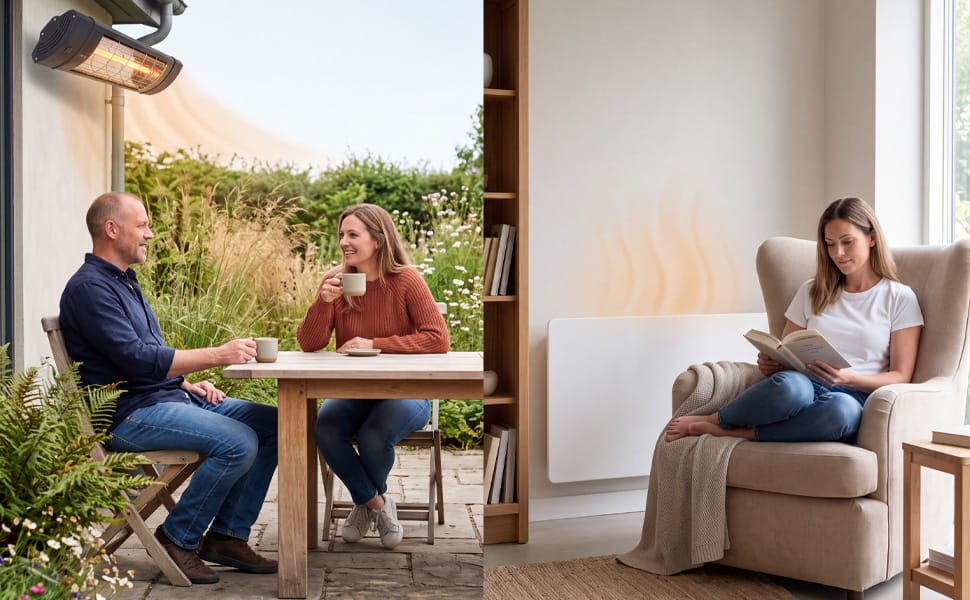
An infrared heater warms you directly rather than heating the air around you. The principle works on your patio and in your living room, but each setting calls for a different type of heater.
Start with the space you want to heat. This guide explains the options for outdoor and indoor heating, then points you towards more detailed advice for your setting.
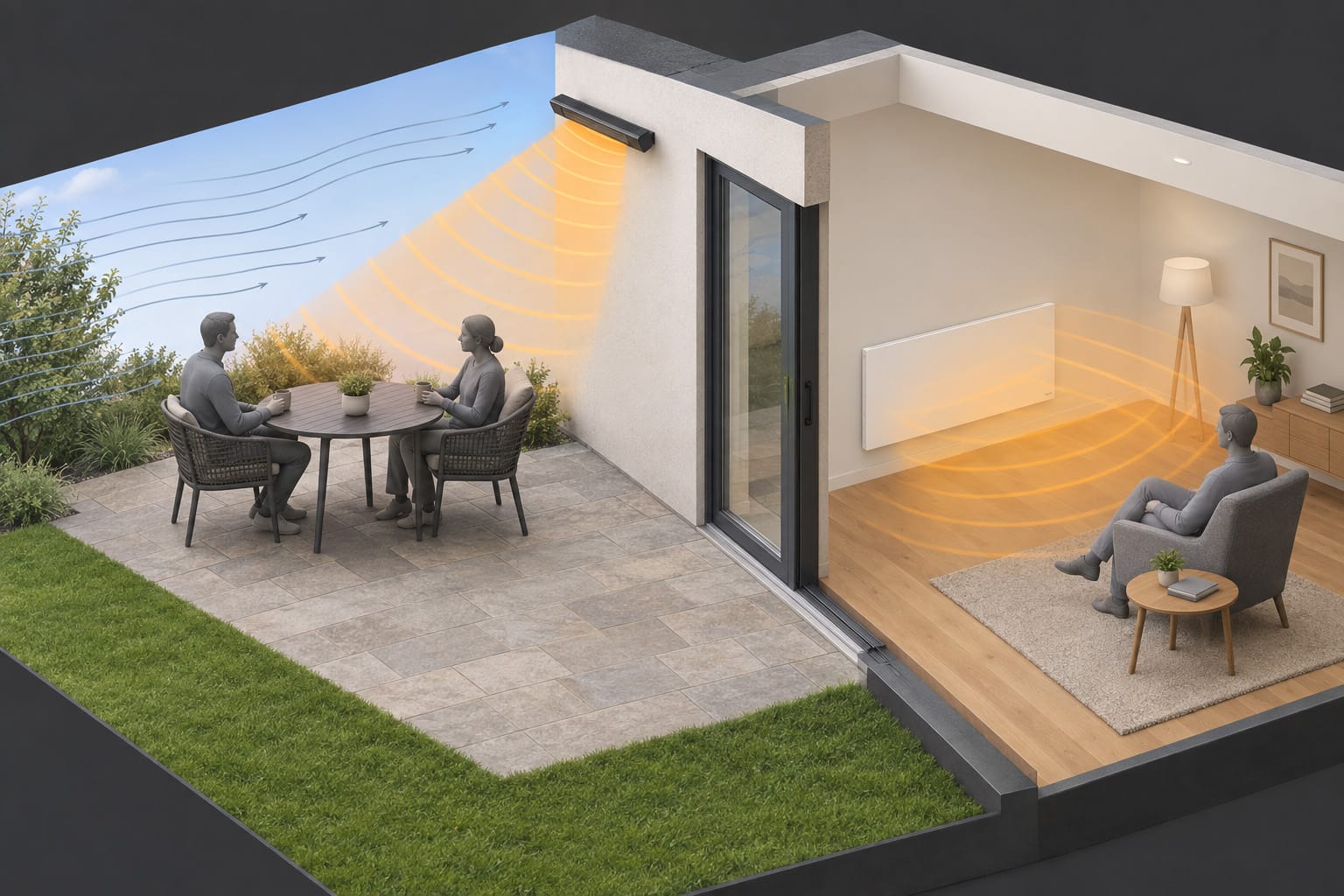
In brief
The more open the space, the more precisely the heat needs to be directed. An outdoor infrared heater can serve your patio, balcony, conservatory or workshop. An infrared panel is suited to indoor spaces.
What is an infrared heater?
Infrared heating works on the same principle as warmth from the sun. Radiation becomes heat when it reaches a surface, such as your skin, clothing, floor or furniture. It heats very little of the air in between.
The difference between these products is the temperature of the heat source. For the underlying principles, see What is infrared heating?
| Outdoor infrared heater | Infrared panel | |
|---|---|---|
| Heat source | High-temperature element and reflector | Large surface at a moderate temperature |
| Warmth | Directed and concentrated | Gentle and even |
| Suited to | Places exposed to wind and cold air | Indoor spaces |
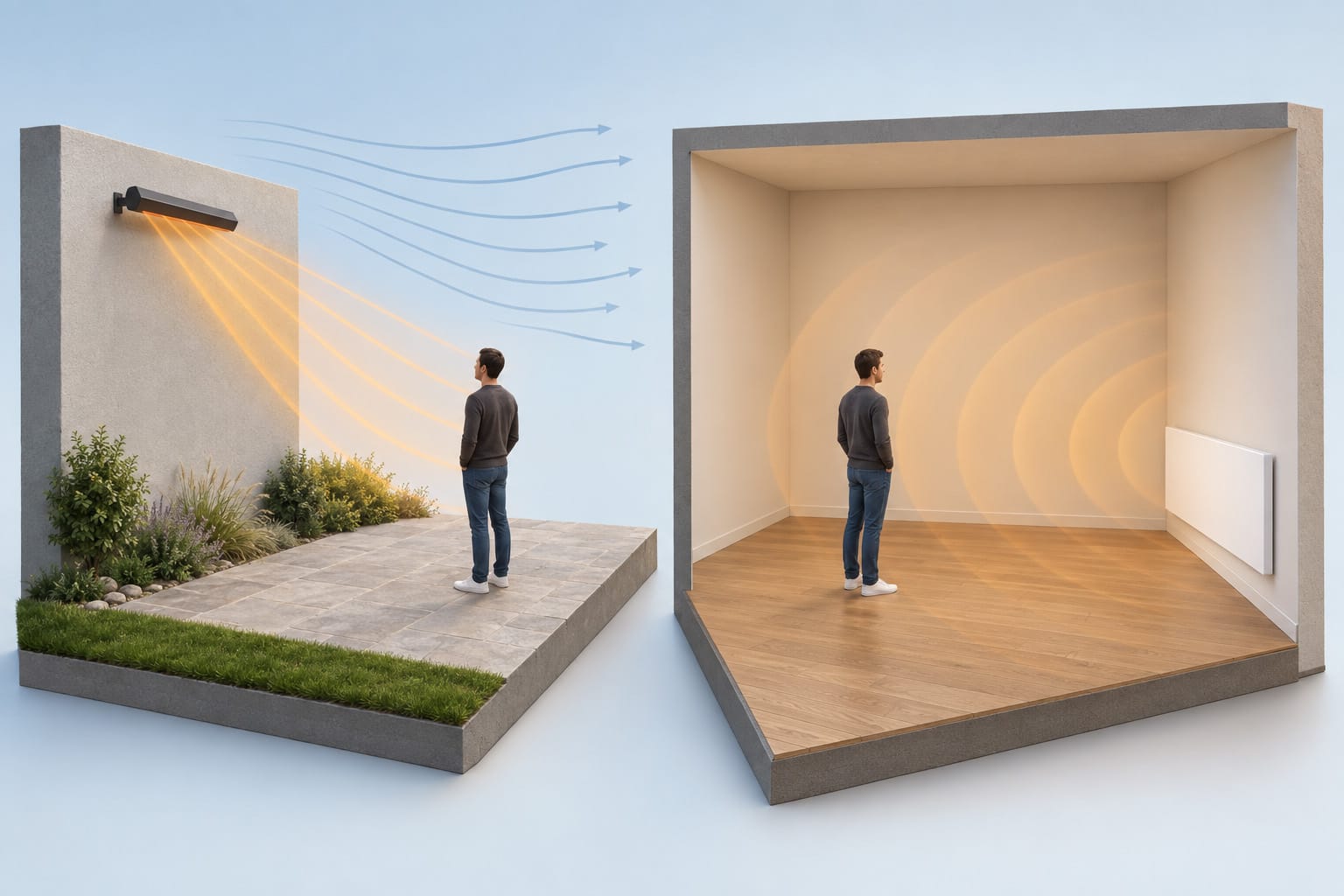
Start with the space: where will your infrared heater be used?
The first consideration is how exposed the space is, rather than the brand or power rating. Where wind and cold air move through, an infrared heater needs to direct concentrated warmth towards you. Indoors, gentler heat distributed across a larger area is sufficient.
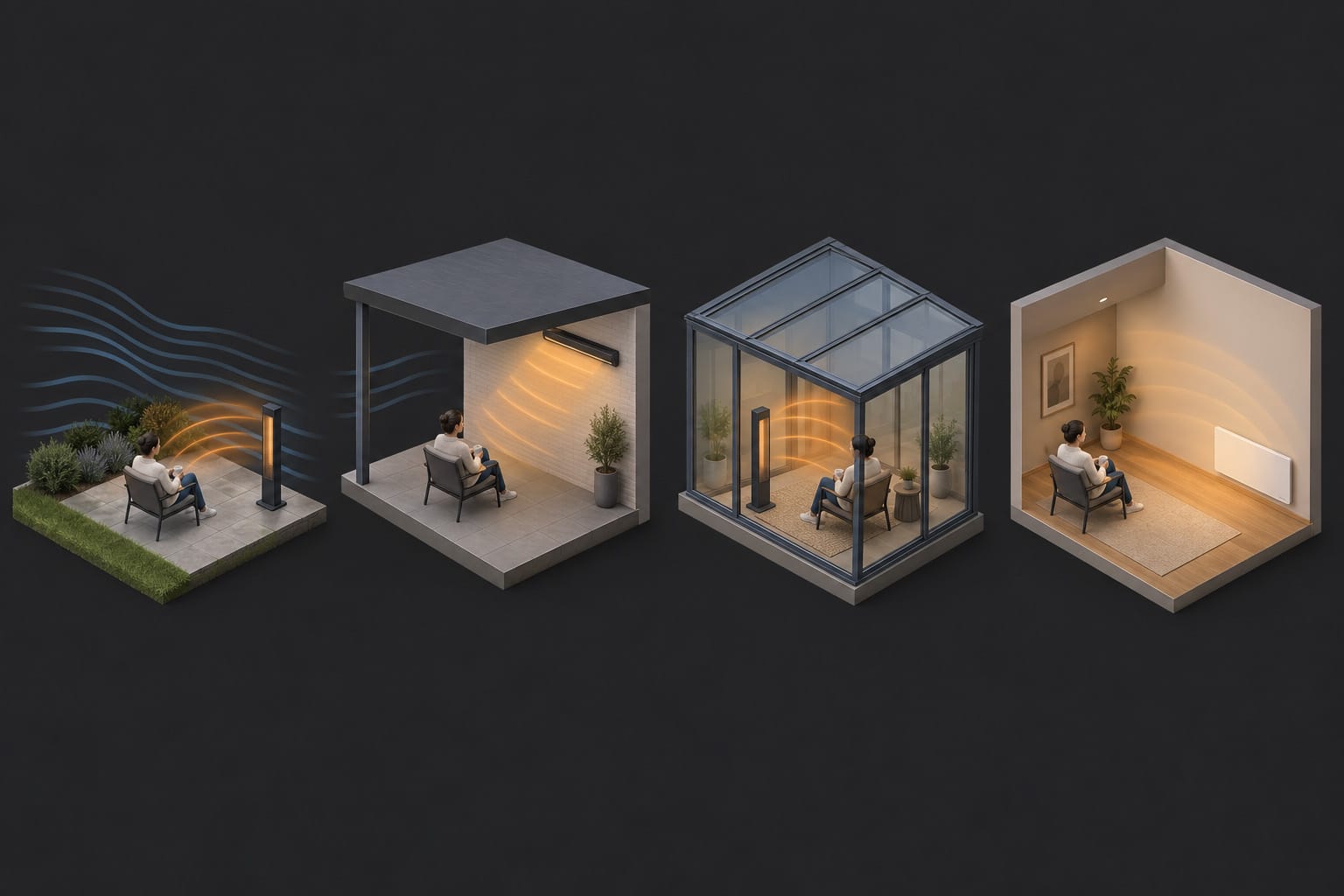
| Space | Suitable heater | Opranic |
|---|---|---|
| Open patio | Freestanding patio heater you can place near your seat | S70R, S50R |
| Covered terrace, pergola or awning | Wall-mounted or ceiling-mounted infrared heater | PRO V70R |
| Balcony | Freestanding or wall-mounted heater, depending on the available space | S50R, PRO V70R |
| Conservatory or glazed balcony | Freestanding infrared heater | S50R, S70R |
| Workshop, garage or summer house | Freestanding infrared heater positioned near where you work | S50R, S70R |
| Restaurant or outdoor seating area | Multiple wall-mounted heaters with central control | PRO V70, PRO V70R |
| Living room, study or bathroom | Infrared panel with a room thermostat | P5, P6 Hybrid, P7 |
Patio heaters for terraces and patios
On a terrace, warm air quickly disperses. An infrared heater directs radiant warmth towards you instead. Switch it on when you sit down and off when you go inside.
3–5 s
to full warmth
2,300 W
across five power settings
about 11 m²
in a sheltered position, S70R
IP65
protected against rain and dust
Place the freestanding Opranic S70R where you sit. The wall- or ceiling-mounted Opranic PRO V70R delivers the same power. Mount it at a height of 1.8 to 2.5 metres, angled towards the seating area. For guidance on power and placement, see the outdoor heater guide.
Infrared heaters for conservatories and glazed balconies
An uninsulated conservatory sits between indoors and outdoors. The glazing blocks the wind, but heat still escapes, so heating the entire space rarely makes sense. For more detail, see the guide Heating a glazed balcony.
Heat the place where you sit, for the hours you spend there.
Good to know
For enclosed rooms, Ecodesign Regulation (EU) 2024/1103 requires, among other things, electronic temperature control. Opranic S50R and S70R meet the regulation’s requirements for portable radiant heaters. PRO V70R is intended for outdoor use, covered terraces and open conservatories. In an enclosed room, it must be controlled by a room thermostat with the functions required by the regulation.
Garage, workshop and summer house heater
Garage and workshop walls are often uninsulated, and the door may be open while you work. Heating the air takes time and uses considerable energy.
An infrared heater directed towards your work area delivers warmth within seconds, so you only pay for the time you spend working.
You can move a freestanding S50R or S70R to where you are working. Follow the clearances in the user manual. For the S70R, leave at least 100 cm in front and on either side, and 50 cm behind and above.
Infrared heaters for balconies
On a balcony, available space shapes the choice. Opranic S50R is shorter and lighter, and you can carry it with one hand. If you have a suitable wall or ceiling, a mounted heater keeps the floor clear.
Restaurants and outdoor seating
An outdoor seating area needs several heaters that can be controlled together. The Opranic PRO V70 has a fixed output of 1,800 W and can be controlled centrally through a timer, occupancy sensor or building management system.
Each heater draws 8 A, which may allow more heaters to use an existing electrical supply. A qualified electrician determines how many can be connected to each circuit.
Why an outdoor infrared heater faces greater demands
Indoors, a heater operates in a sheltered space with still air. Outdoors, it must deliver warmth through wind, rain and cold, year after year. That places three demands on its design.
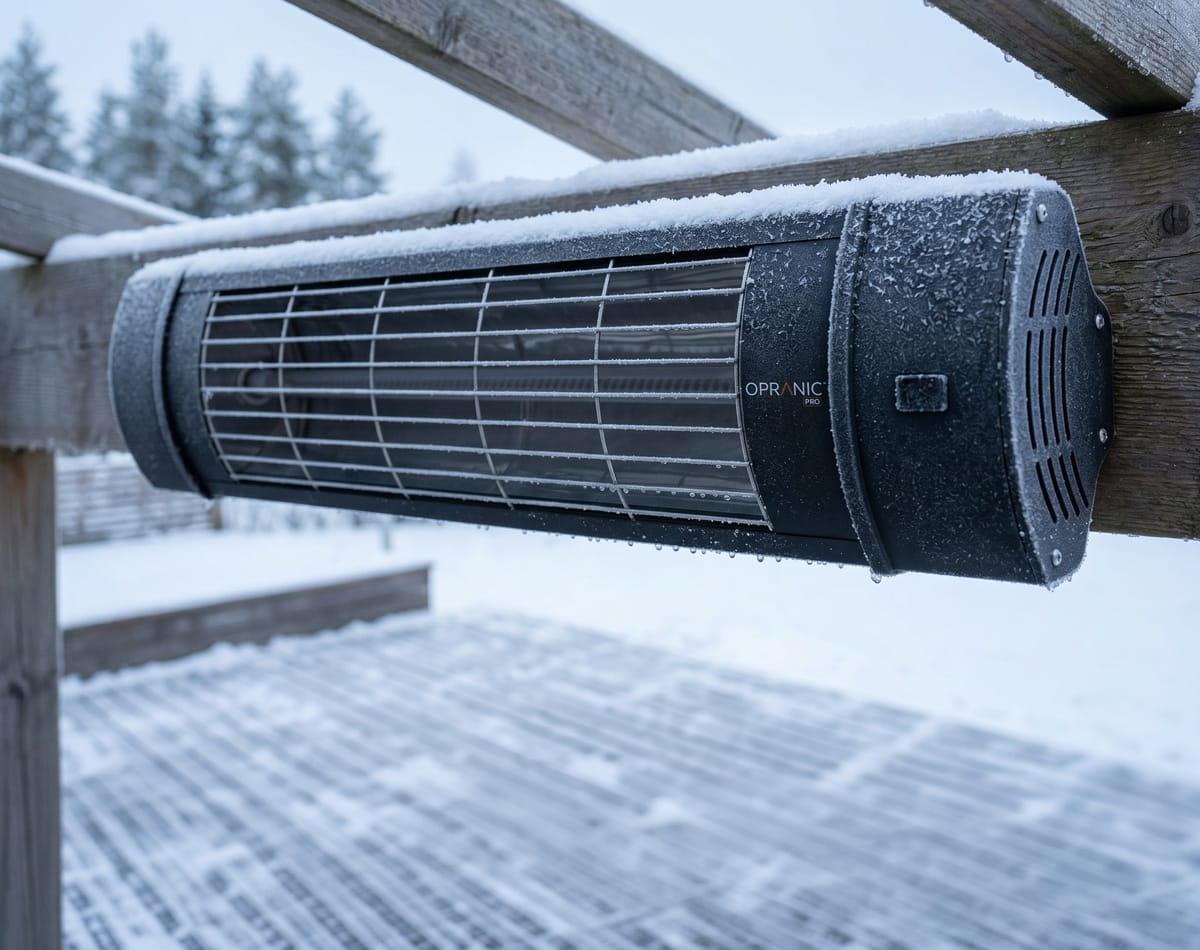
Warmth must reach you in windy conditions
That requires a high-temperature heating element and a reflector that directs radiant heat towards the seating area rather than dispersing it.
The construction must withstand water
IP65 means the enclosure is dust-tight and protected against water jets from any direction. The electronics, wiring and seals must withstand those conditions day after day.
Materials must withstand temperature changes
When an element goes from sub-zero temperatures to full heat in seconds, the grille, reflector and enclosure are placed under considerable stress. The enclosure is therefore made of aluminium and the grille of stainless steel.
Opranic has worked with infrared heating since 2009. Experience gained from its outdoor heaters also informs its panels, with the same standards for materials, safety and certification.
Infrared panels for indoor use
Indoors, a panel is the right type of infrared heater. It mounts on the wall or ceiling, takes up no floor space and is controlled by a room thermostat.
How much power do you need?
Allow roughly 100 W per square metre in a well-insulated room. A 20 m² room would therefore need around 2,000 W, spread across two or more panels. You will need more in an older, less well-insulated home.
Wall or ceiling, and how close to furniture?
The panel needs a clear path to radiate heat into the room. Its position and distance from walls, furniture and people determine how evenly you feel the warmth.
How much electricity does a panel use, and what does it cost?
A panel converts almost all the electricity it uses into heat. Consumption depends on its power and how many hours it runs. A 450 W panel running for four hours a day costs approximately 0.67 euros per day at an electricity price of 0.37 euros per kWh.
Thermostat control
Without a thermostat, the panel runs at full power continuously. With a thermostat and a schedule, it runs only when needed.
Infrared heating: pros and cons
Advantages
- +Warmth within seconds, directed where you sit
- +Works where warm air would blow away, such as on your patio
- +Provides warmth in an uninsulated conservatory, where a conventional radiator mainly heats air that escapes
- +Lets you keep the background heating lower at home while warming the space you use
- +No fan, noise or moving air
- +Straightforward installation, with running costs only while the heater is on
Considerations
- iRadiant warmth reaches what the heater faces, so aim it towards the seating area
- iInfrared heating works by zone. If you need to heat an entire house around the clock, a heat pump costs less to run
- iIndoor panels use a separate thermostat
Conclusion
An infrared heater provides warmth where you are, when you need it: on your patio, in your conservatory, in your workshop, in the bathroom or at your desk. Keep the background heating lower in the rest of your home and use infrared heating for the space you occupy.
What does an infrared heater cost to run?
Power in kW × hours of use × electricity price = cost.
| Example | Power | Cost per hour |
|---|---|---|
| S70R or PRO V70R at full power | 2.3 kW | approximately 0.85 euros |
| S70R or PRO V70R at the lowest setting | 0.92 kW | approximately 0.34 euros |
| 450 W infrared panel | 0.45 kW | approximately 0.17 euros |
These examples use 0.37 euros per kWh, the average household electricity price in Germany. Use your own electricity price for a more precise figure.
Explore the guides
If you would like to explore a topic further, there is a dedicated guide for each area.
Outdoor
Frequently asked questions about infrared heaters indoors and outdoors
Summary
Start with the space you need to heat. For your patio, balcony, conservatory or workshop, choose an infrared heater designed for outdoor use, either freestanding or wall-mounted. Indoors, a radiant panel with a thermostat is suitable.
Sources: Opranic product data sheets for S70R, PRO V70 and PRO V70R; Ecodesign Regulation (EU) 2024/1103. Cost examples use assumed values. Reviewed in October 2026.